Photo: Wikipedia
Political ClimatePolitical Climate in Grafton, WV
District shown is the primary district for this city’s centroid. Cities may span multiple districts.
Local Political AnalysisPolitical Analysis of Grafton, WV
Grafton, West Virginia, has long been a rock-solid conservative stronghold, and the numbers back that up with a Cook PVI of R+20. You can feel it in the air here—this isn't a place that's suddenly flipped; it's a community that's held its ground while the rest of the country went sideways. The political lean here is deeply rooted in traditional values, personal responsibility, and a healthy skepticism of government overreach, and that trajectory hasn't budged much in decades. If anything, the recent shifts toward progressive ideology in places like Morgantown or even parts of Fairmont have only made folks here dig in their heels harder.
How it compares
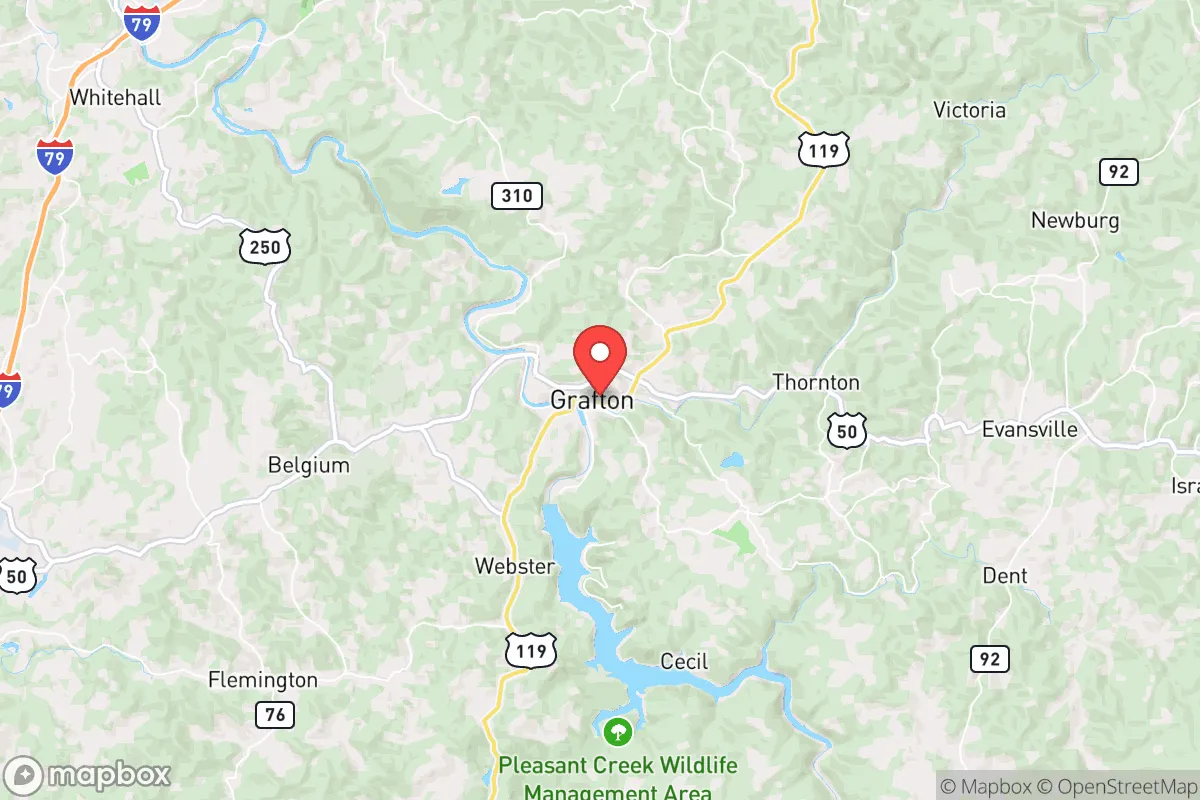
Drive thirty minutes north to Morgantown, and you're in a different world—a college town that's been trending blue for years, with a Cook PVI of D+5. That's a 25-point swing from Grafton, and it's not just numbers on a map. In Morgantown, you'll see more talk of government programs and social engineering; in Grafton, the conversation is about keeping the government out of your business. Fairmont, just south, is a bit more purple but still leans conservative, though it's starting to feel the pull from the university crowd. Grafton, by contrast, remains a place where the Second Amendment isn't debated, where property rights are sacred, and where folks remember when the county commission didn't need to ask permission from the state to run things. The contrast is stark, and it's why a lot of people from those other towns move here to get away from the noise.
What this means for residents
For the people living here, the political climate translates into a daily life that feels more free and less managed. You won't find the same kind of zoning overreach or business-killing regulations that plague bigger cities. Local government here still operates with a light touch, which means you can run a small business out of your garage, hunt on your own land, and not worry about some bureaucrat telling you how to live. The downside? Services are lean, and you won't get the same level of public transit or social programs you'd see in a blue area. But for most residents, that's a trade-off they're happy to make. The real concern is watching state-level policies creep in—like recent pushes for more centralized health mandates or land-use restrictions—that threaten to erode the local control that makes Grafton what it is. If that trend continues, you'll see more folks packing up and heading to even smaller towns like Philippi or Elkins.
One thing that sets Grafton apart culturally is its quiet resistance to the progressive wave that's washing over so many small towns. You won't see pride flags on Main Street, and the local churches still anchor community life. There's a strong sense that personal freedoms—like the right to refuse a vaccine or to homeschool your kids without state interference—are non-negotiable here. The long-term outlook is cautious: as long as the county commission stays conservative and the state doesn't get too heavy-handed, Grafton will remain a refuge for folks who value liberty over convenience. But keep an eye on the school board elections—that's where the real battles are brewing, with outside groups trying to push curriculum changes that don't reflect local values. For now, though, Grafton is holding the line, and that's exactly how most of us want it.

State Political ClimatePolitical Climate in West Virginia
State Political AnalysisPolitical Environment in the State
West Virginia has long been one of the most reliably Republican states in the nation, but that wasn’t always the case. As recently as the 1990s, the Mountain State was a Democratic stronghold, voting for Bill Clinton twice and sending a heavily Democratic delegation to Congress. The shift began in earnest around 2000, accelerated by cultural and economic realignment, and by 2024, Donald Trump carried the state by nearly 40 points. Today, the dominant coalition is a mix of rural conservatives, working-class voters who abandoned the national Democratic Party over gun rights, energy policy, and social issues, and a growing number of out-of-state transplants seeking lower taxes and fewer regulations. The state’s political DNA is now deeply red, but the texture varies significantly by region and community.
Urban vs. rural divide
The political map of West Virginia is starkly divided between its small urban centers and its vast rural expanse. Charleston, the capital and largest city, is the state’s lone blue dot, with Kanawha County often voting within a few points of the national average. The city itself leans Democratic, driven by government workers, university faculty at West Virginia State University and the University of Charleston, and a modest but vocal progressive activist base. Morgantown, home to West Virginia University, is another liberal-leaning pocket, though Monongalia County as a whole has trended redder in recent cycles as student populations are offset by surrounding rural precincts. Huntington and Wheeling are more mixed but have shifted rightward as their industrial bases declined and cultural conservatism deepened. Outside these islands, the state is overwhelmingly Republican. Berkeley County in the Eastern Panhandle, part of the Washington D.C. exurbs, has become a GOP stronghold, with voters drawn by lower taxes and a more conservative lifestyle. Greenbrier County and Pocahontas County in the southeast are reliably red, while the northern panhandle counties like Ohio County and Brooke County have flipped from blue to deep red over the past two decades. The rural-urban divide here isn’t just about population density—it’s about economic dependence on coal, natural gas, and timber versus a service-and-government economy in the cities.
Policy environment
West Virginia’s policy environment is among the most conservative in the country, and it’s been getting more so. The state has no personal income tax on Social Security benefits and has been phasing down its personal income tax rates—the top rate dropped from 6.5% to 5.12% in 2024, with a path to elimination by 2028 if revenue targets are met. Property taxes are among the lowest in the nation, capped by the state constitution at 1.5% of assessed value for most classes. The regulatory climate is business-friendly, with a right-to-work law in place since 2016 and a tort reform system that caps non-economic damages. On education, the state passed a robust school choice law in 2021, creating the Hope Scholarship, which allows parents to use state education funding for private school tuition, homeschooling, or other alternatives. Governor Jim Justice, a Republican, signed a near-total abortion ban in 2022 with exceptions only for rape, incest, and medical emergencies. Election laws are moderately restrictive: voter ID is required, early voting is available for 10 days, and no-excuse absentee voting is permitted. The state has not expanded Medicaid under the Affordable Care Act, though it did so in 2013 under a Democratic governor—a decision that remains controversial among conservatives who see it as federal overreach.
Trajectory & freedom
On the freedom front, West Virginia has been moving decisively in the direction of personal liberty, especially for conservatives. The state passed constitutional carry (permitless concealed carry) in 2016, and in 2023, it eliminated the requirement for a permit to purchase a firearm entirely. Parental rights were strengthened with the 2021 Parental Bill of Rights, which requires schools to notify parents of any medical or mental health services provided to their children and to obtain consent before administering surveys on sensitive topics. Medical freedom saw a win with the 2023 law prohibiting COVID-19 vaccine mandates by private employers and government entities. Property rights were bolstered by the 2020 “Ag-Gag” law, which protects farms from undercover investigations, and by the 2023 law limiting the use of eminent domain for carbon capture pipelines. However, there are concerns: the state’s heavy reliance on federal funding—over 40% of its budget comes from Washington—creates a vulnerability to federal strings. The 2024 law banning TikTok on state devices and the 2023 law restricting foreign ownership of agricultural land show a growing wariness of external influence. Overall, the trajectory is toward more personal freedom in the traditional conservative sense, but the state’s economic dependence on federal dollars remains a long-term risk.
Civil unrest & political movements
West Virginia has seen its share of political activism, but it’s generally been more organized and less chaotic than in other states. The 2018 teachers’ strike, which shut down schools for nine days and drew national attention, was a rare moment of left-leaning labor activism, but it was focused on pay and benefits, not cultural issues. On the right, the “Second Amendment Sanctuary” movement swept through the state in 2019-2020, with over 40 counties passing resolutions declaring themselves sanctuaries from state or federal gun laws. The 2020 election integrity debate was muted compared to other states, but there were scattered protests outside county clerk offices in Berkeley County and Jefferson County over ballot drop boxes. Immigration politics are largely absent—West Virginia has one of the smallest foreign-born populations in the country, and there are no sanctuary cities. The most visible flashpoint in recent years has been the battle over the Mountain Valley Pipeline, which sparked protests from environmental activists in Monroe County and Summers County, but the state government and local law enforcement largely sided with the pipeline company. A new resident would notice a general sense of political stability, with most activism happening through legal channels like county commission meetings and statehouse lobbying rather than street protests.
Projection
Looking ahead 5-10 years, West Virginia is likely to become even more conservative, but with some important caveats. The state’s population is aging and shrinking—it lost 3.2% of its population between 2010 and 2020—and the young people leaving tend to be more moderate or liberal, while those moving in from places like Virginia, Maryland, and Pennsylvania are often seeking a more conservative lifestyle. The Eastern Panhandle, particularly Berkeley County and Jefferson County, will continue to grow as an exurb of D.C., bringing in more fiscally conservative but socially moderate voters who may push the state toward a more libertarian-leaning Republicanism. The coal industry’s decline will accelerate, but natural gas and renewable energy (wind in the highlands, solar on reclaimed mine lands) will create new economic bases. The personal income tax phase-out, if completed, will make the state even more attractive to retirees and remote workers. However, the state’s heavy reliance on federal Medicaid and highway funding means any major federal budget cuts could trigger a fiscal crisis. The political trajectory is clear: West Virginia will remain one of the most conservative states in the union, but its flavor may shift from the old-school, union-influenced conservatism of the coalfields to a more suburban, tech-enabled, and culturally libertarian conservatism in the growing eastern counties.
For someone moving to West Virginia today, the bottom line is this: you’ll find a state that respects your right to live as you see fit, with low taxes, strong gun rights, and a government that generally stays out of your personal life. The trade-offs are real—limited job diversity, a struggling healthcare system in rural areas, and a dependence on federal money that creates long-term uncertainty. But if you value personal freedom over government services, and you’re willing to trade the amenities of a big city for space, privacy, and a community that shares your values, West Virginia is one of the best bets in the country. Just know that the state is changing, and the version of conservatism you’ll find in Morgantown or Shepherdstown may look different from what you’ll find in Beckley or Parkersburg. Do your homework on the specific county and community, because the political climate varies as much as the terrain.
* Values derived from national, state, county, city and local statistics and may differ in a specific area. Last updated: 2026-05-01T21:36:50.000Z
Narrative content on this page is AI-generated and may contain mistakes. Verify any details that matter before acting on them.
ReloMaps may earn a commission from affiliate links at no extra cost to you.

