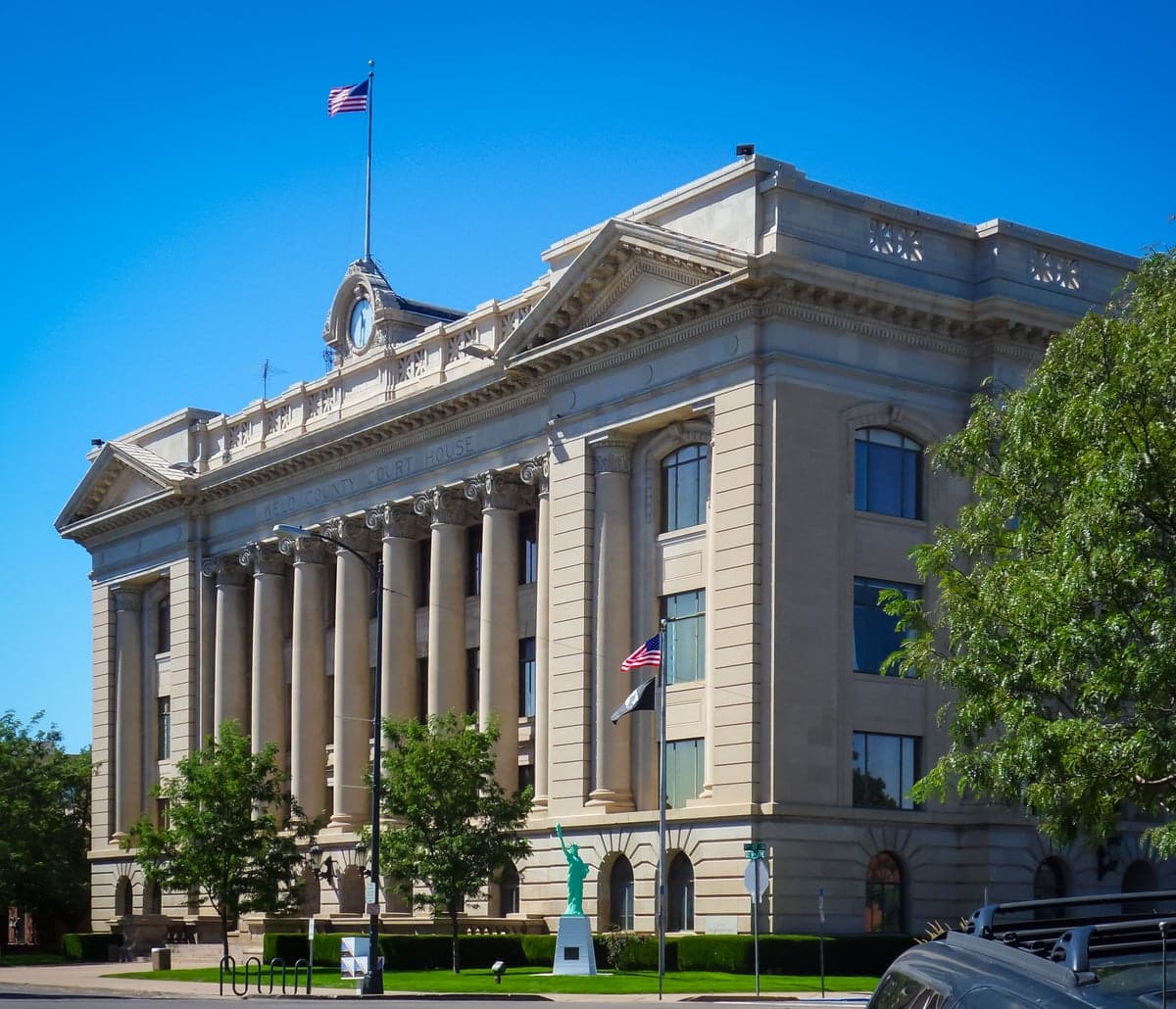
Photo: Wikipedia
Personal Sovereignty in Greeley, CO
Viable for self-reliance. Generally workable, though some barriers may limit total independence.
What does Personal Sovereignty tell us?
Personal Sovereignty measures your capacity for self-reliance and independence with minimal government friction. Higher scores mean fewer barriers between you and the way you want to live... but it assumes you have the space you need and good neighbors.
What does this tell us?
Personal Sovereignty measures your capacity for self-reliance and independence with minimal government friction. Higher scores mean fewer barriers between you and the way you want to live... but it assumes you have the space you need and good neighbors.
State Policy
Energy independence: Net exporter (110% of energy produced in-state)
Personal Liberty
Homesteading

Personal Liberty Analysis
Greeley, Colorado, offers a mixed bag for those prioritizing personal sovereignty, with a state-level political climate that increasingly challenges individual autonomy but a local culture and geography that still provide meaningful room for self-reliance. While Colorado’s state government has moved aggressively on issues like gun control and energy regulation, Weld County—where Greeley sits—remains a conservative stronghold that pushes back against many of these mandates. For a survivalist or prepper mindset, the key is understanding where the state’s overreach ends and where local buffers, practical geography, and community resilience begin. The net assessment: Greeley is not a sovereignty haven like rural Idaho or Montana, but it offers a viable middle ground for those willing to navigate state-level restrictions while leveraging local freedoms.
Tax burden and regulatory posture in Weld County
Colorado’s overall tax burden is moderate, but the regulatory environment is where sovereignty-minded individuals need to pay close attention. The state income tax is a flat 4.4% as of 2025, and the state sales tax is 2.9%, though Greeley’s combined local rate pushes that to roughly 7.5% depending on the specific jurisdiction. Property taxes are relatively low by national standards, with Weld County’s effective rate around 0.55% of assessed value, thanks to Colorado’s Gallagher Amendment legacy (though it was repealed in 2020, the low-rate structure persists). The real sovereignty concern is regulatory: Colorado has some of the most aggressive energy and environmental regulations in the West, including strict methane rules and renewable energy mandates that can complicate off-grid or independent energy projects. However, Weld County’s government is notably hostile to state overreach—it has declared itself a “Second Amendment Sanctuary” and routinely sues the state over land-use and energy policies. For a prepper, this means local permitting for things like rainwater collection (legal in Colorado since 2016) or small-scale solar is generally straightforward, but state-level red tape on larger projects (e.g., drilling a well for irrigation) can be a headache. The county’s regulatory posture is best described as pro-business and pro-property rights, but you’re still operating under a state government that has shown willingness to preempt local control on issues like oil and gas setbacks.
Self-defense and gun law specifics in Greeley and Colorado
This is the sharpest edge of the sovereignty debate in Greeley. Colorado has moved significantly toward gun control in recent years, and those laws apply statewide—including in Weld County. The state now requires universal background checks for all firearm sales, including private transactions, and has a “red flag” law (Extreme Risk Protection Orders) that allows courts to temporarily seize firearms from individuals deemed a risk. Magazine capacity is capped at 15 rounds for handguns and 10 rounds for long guns. These restrictions are a direct limitation on personal sovereignty, and they’re not optional—local sheriffs in Weld County have publicly stated they will not enforce the red flag law, but the legal risk remains for gun owners. On the positive side, Colorado is a “shall issue” state for concealed carry permits, and Weld County’s sheriff’s office processes permits efficiently—typically within 30-60 days. Open carry is legal without a permit for anyone 18 or older, though local ordinances in Greeley city limits may restrict it in certain public buildings. For a survivalist, the practical workaround is to build a network of private land (outside city limits) where range practice and storage are less scrutinized. The bottom line: you can still own and carry firearms in Greeley, but the state’s legal framework is increasingly adversarial, and any future federal or state-level magazine bans or registration schemes would hit here hard. Weld County’s sanctuary status provides political cover, not legal immunity.
Self-reliance and homesteading viability: lot sizes, zoning, and off-grid feasibility
Greeley’s zoning and land-use patterns offer real opportunities for self-reliance, especially compared to the Front Range’s urban corridor. Within city limits, standard residential lots range from 6,000 to 10,000 square feet, which is enough for a substantial garden, small livestock (chickens are allowed with a permit), and even a modest greenhouse. But the real potential lies in unincorporated Weld County, where you can find parcels of 1 to 5 acres within a 15-minute drive of downtown Greeley. Zoning in these areas is generally agricultural or rural residential, which permits goats, sheep, and even a horse or two without special exemptions. Off-grid feasibility is mixed: Colorado law requires that any dwelling have a “legal” water source and sewage system, which typically means a well and septic. Drilling a well in Weld County can cost $15,000 to $30,000 depending on depth, and the state’s water rights system is complex—you cannot simply dig a well without a permit from the Colorado Division of Water Resources. Solar panels are legal and net metering is available through Xcel Energy, but going fully off-grid (disconnecting from the grid) is technically allowed but practically discouraged by utility policies and building codes. For a prepper, the most viable path is a rural acreage with a well, septic, and grid-tied solar—you maintain independence while avoiding legal battles. The county’s building codes are less restrictive than those in Boulder or Denver, but you still need permits for structural changes. Overall, Greeley’s surrounding area is one of the more homesteading-friendly zones in Colorado, especially if you’re willing to drive 20-30 minutes for true rural isolation.
Personal liberties: parental rights, medical autonomy, speech, and property
On parental rights, Colorado has moved in a direction that concerns many conservative families. The state passed a law in 2023 that prohibits school districts from notifying parents if a student changes their gender identity or pronouns, effectively overriding parental authority in educational settings. Greeley’s school district (Greeley-Evans School District 6) has implemented this policy, though local school board meetings have seen heated opposition. For parents, this means you need to be actively engaged and consider alternative schooling options—Weld County has a robust homeschooling community and several private Christian schools, including Dayspring Christian Academy and Frontier Academy. Medical autonomy is another flashpoint: Colorado has legalized assisted suicide (Medical Aid in Dying) and has some of the most permissive vaccine mandates in the country for healthcare workers and schoolchildren. For a sovereignty-minded individual, this means you may face pressure to comply with state health directives, though enforcement has been uneven. Free speech protections are strong in Colorado, and Greeley’s public forums—including city council meetings and county commissioner hearings—are generally open and civil, though the state’s anti-discrimination laws can be used to challenge certain forms of public expression. Property rights are the bright spot: Weld County is a “right-to-farm” county, meaning agricultural operations are protected from nuisance lawsuits, and property taxes are low. The county also has a strong track record of defending landowners against state eminent domain overreach. For a prepper, the property rights environment is arguably the best in Colorado outside of the Western Slope.
Overall, Greeley offers a pragmatic sovereignty profile—not a libertarian paradise, but a place where a determined individual can carve out significant autonomy. The state’s gun laws and parental rights policies are genuine concerns, and the regulatory climate on energy and water requires careful planning. However, Weld County’s political culture, low taxes, and rural zoning options create a buffer that many Front Range cities lack. Compared to Denver or Boulder, Greeley is a clear win for personal sovereignty. Compared to rural Wyoming or Montana, it’s a compromise—you trade some legal freedom for better economic opportunity and a more temperate climate. For a survivalist or prepper, the smart play is to buy land in unincorporated Weld County, build a grid-tied solar system with battery backup, and stay politically engaged at the local level to defend the freedoms that remain. The state is trending in the wrong direction, but Greeley is still a place where you can live on your own terms—if you’re willing to fight for it.

* Values derived from national, state, county, city and local statistics and may differ in a specific area. Last updated: 2026-04-23T02:52:33.000Z
Narrative content on this page is AI-generated and may contain mistakes. Verify any details that matter before acting on them.
ReloMaps may earn a commission from affiliate links at no extra cost to you.

