
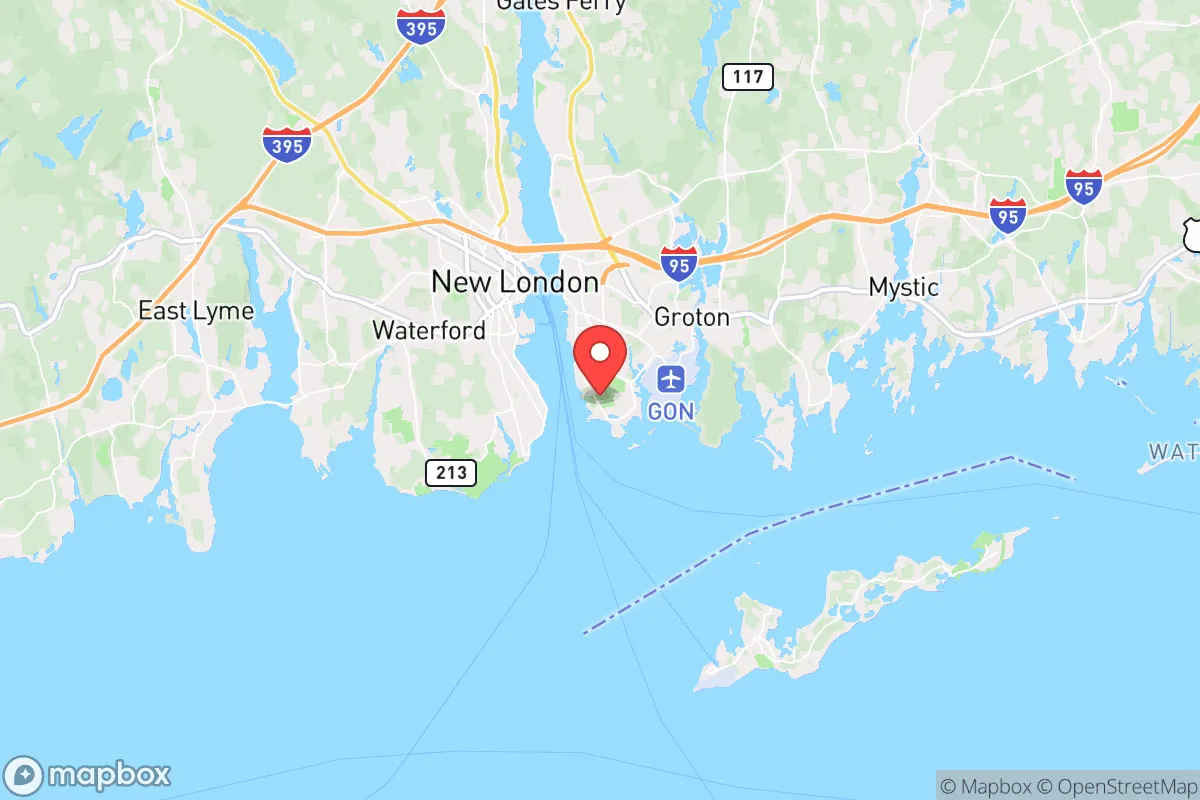
Photo: Wikipedia
Political ClimatePolitical Climate in Groton, CT
District shown is the primary district for this city’s centroid. Cities may span multiple districts.
Local Political AnalysisPolitical Analysis of Groton, CT
Groton, Connecticut, sits in a district with a Cook PVI of D+4, meaning it leans about four points more Democratic than the national average. That number tells you something, but not everything. For a long time, this was a blue-collar, military town, centered on the Naval Submarine Base and Electric Boat. The politics here used to be more about the job, the union, and the local economy than about the culture war stuff you see on TV. But over the last ten or fifteen years, that’s been shifting. The old-school, pragmatic Democrats who ran things are being replaced by a younger, more progressive crowd, and the local elections are starting to feel a lot more like the national ones. It’s not a radical place yet, but the trajectory is concerning if you value keeping government out of your personal life and your wallet.
How it compares
Drive ten minutes west to Ledyard, and you’re in a town that votes much more conservatively, with a strong independent streak and a lot of pushback on state mandates. Head east across the Thames River to New London, and you’re in a solidly progressive city with a D+20 lean, where the local government is much more aggressive on things like zoning changes and social policies. Groton sits right in the middle, but it’s drifting toward the New London side. The surrounding towns in southeastern Connecticut—like Stonington, North Stonington, and even parts of Waterford—tend to be more skeptical of the one-size-fits-all policies coming out of Hartford. Groton used to be in that camp, but the recent town council and school board elections have brought in candidates who are more interested in state-level progressive priorities than in local common sense. The contrast is stark: you can live in a town where the tax burden is rising and the school curriculum is changing, or you can move ten miles and find a place that still believes in local control and fiscal restraint.
What this means for residents
For the average person living here, the political shift means a few concrete things. First, property taxes have been creeping up faster than inflation, partly because the town is taking on more social programs and administrative bloat that a smaller, more conservative board would have cut. Second, there’s been a noticeable uptick in local ordinances that feel like overreach—things like stricter noise regulations, limits on short-term rentals, and a push for more density in single-family neighborhoods. The school board has also become a battleground, with debates over curriculum transparency and parental rights that would have been unthinkable a decade ago. If you’re a gun owner, a small business owner, or just someone who doesn’t want the town telling you what to do with your property, you’re starting to feel the squeeze. The long-term trend is clear: unless the local electorate wakes up and votes for candidates who prioritize freedom and fiscal sanity, Groton will continue to drift toward the kind of progressive governance that New London has embraced, with all the higher taxes and reduced personal autonomy that come with it.
One cultural distinction worth noting: Groton still has a strong military and submarine community, and that group tends to be more libertarian-leaning and skeptical of government overreach. They’re the ones keeping the town from going full progressive. But that demographic is aging out, and the new arrivals—many from more liberal parts of the state—are changing the voting patterns. The local paper and the town social media groups are full of arguments between the old guard and the new activists. It’s a town at a crossroads. If you’re thinking of moving here, pay close attention to the next few town council elections. That’s where the real future of Groton will be decided.

State Political ClimatePolitical Climate in Connecticut
State Political AnalysisPolitical Environment in the State
Connecticut has long been a solidly blue state in presidential elections, voting Democratic by double digits in every cycle since 1992, but the picture is more complicated than a simple partisan label. The state’s political center of gravity is driven by the affluent, educated, and increasingly progressive suburbs of New York City and the urban cores of Hartford, New Haven, and Bridgeport, while the eastern and northwestern corners remain reliably red. Over the last 10-20 years, the state has shifted leftward on social issues and gun control, but a growing backlash against high taxes, regulatory overreach, and education policy has created real friction, especially among families and small business owners. If you’re considering a move here, you need to understand that the political climate is not monolithic — it’s a patchwork of competing visions, and the direction of travel is a source of genuine concern for anyone who values personal freedom and fiscal sanity.
Urban vs. rural divide
The political map of Connecticut is a textbook case of the urban-rural split. The Democratic strongholds are the cities of Hartford, New Haven, Bridgeport, and Stamford, along with their inner-ring suburbs like West Hartford and Hamden. These areas are dense, diverse, and heavily reliant on public sector employment, social services, and transit-oriented development. They vote 70-80% Democratic and drive the state’s overall blue lean. In contrast, the eastern half of the state — places like Litchfield County, the Quiet Corner (Windham and Tolland counties), and the shoreline towns east of New Haven — are reliably Republican or at least competitive. Litchfield County in particular has become a refuge for conservatives fleeing the high taxes and progressive policies of Fairfield County’s commuter belt. The 2020 presidential election saw New Haven County vote 60% for Biden, while Windham County went 52% for Trump — a 12-point gap that underscores the divide. The 2022 gubernatorial race was closer than expected, with Democrat Ned Lamont winning by only 13 points, thanks to strong GOP turnout in the eastern and northwestern towns. If you’re looking for a politically like-minded community, you’ll find it in places like Brookfield, New Milford, or Woodstock, but you’ll be surrounded by blue territory the moment you head toward the coast or the capital.
Policy environment
Connecticut’s policy environment is a mixed bag that leans heavily toward progressive interventionism, with a few notable exceptions. The state has one of the highest tax burdens in the nation — a progressive income tax that tops out at 6.99%, plus high property taxes that average over 2% of home value annually. There is no sales tax on most clothing and footwear under $50, but the general sales tax is 6.35%. The regulatory posture is dense: the state has some of the strictest environmental and land-use regulations in New England, which drives up housing costs and slows development. Education policy is a flashpoint — Connecticut spends more per pupil than almost any other state, yet achievement gaps are among the widest in the country. The state has a universal mail-in voting law passed in 2023, and early voting was expanded via a constitutional amendment in 2022. On the plus side for conservatives, Connecticut has no state-level rent control, no statewide ban on plastic bags (though many towns have their own), and no state income tax on Social Security benefits, which is a small win for retirees. But the overall direction is clear: the state government is comfortable using its power to tax, regulate, and mandate, and that’s a red flag for anyone who values limited government.
Trajectory & freedom
Over the last five years, Connecticut has become less free by almost any measure, and the trend is accelerating. The most visible area is gun rights: after the Sandy Hook tragedy in 2012, the state passed some of the strictest gun laws in the nation, including an assault weapons ban, universal background checks, and a 10-round magazine limit. In 2023, the legislature passed HB 6667, which expanded the state’s “ghost gun” ban and created a new requirement for firearm owners to report lost or stolen guns within 72 hours. On the medical freedom front, the state imposed one of the longest-lasting COVID-19 vaccine mandates for healthcare workers, and the governor’s emergency powers were extended through 2023 via a controversial bill that limited legislative oversight. Parental rights took a hit with the passage of HB 6668 in 2023, which requires schools to allow students to use names and pronouns without parental notification if the student requests it — a direct challenge to family authority. Property rights are under pressure from the state’s aggressive affordable housing mandates, which force towns to zone for multi-family units. The state’s “Fair Share” housing law (PA 23-205) requires municipalities to plan for 10% of their housing stock to be “affordable,” and towns that resist face lawsuits. For a conservative, this is a clear pattern: the state is using its power to override local control, parental rights, and the Second Amendment.
Civil unrest & political movements
Connecticut has not seen the kind of large-scale civil unrest seen in other states, but there are real political flashpoints. The Black Lives Matter protests in 2020 were significant in Hartford, New Haven, and Bridgeport, with some property damage and arrests, but they were smaller than in major cities. The anti-lockdown protests in 2020-2021 were notable in rural areas, especially in Litchfield County, where crowds gathered at the state capitol to oppose business closures and school shutdowns. The state’s sanctuary city policies are a major concern for conservatives: Hartford, New Haven, and Bridgeport have all declared themselves “welcoming cities” that limit cooperation with federal immigration enforcement. In 2023, the legislature passed HB 6690, which prohibits state and local law enforcement from asking about immigration status or cooperating with ICE detainers — a de facto statewide sanctuary policy. Election integrity has been a hot topic: the 2020 election saw a massive surge in absentee voting, and the 2023 universal mail-in law has raised concerns about ballot security. The “Stop the Steal” movement had a presence in the state, with rallies at the capitol, but it never reached the intensity of swing states. The most visible political movement on the right is the Connecticut Citizens Defense League, which organizes pro-Second Amendment rallies at the capitol and has become a powerful lobbying force. If you move here, you’ll see these tensions play out in town hall meetings and local elections, especially around school curriculum and housing policy.
Projection
Looking ahead 5-10 years, the trajectory for Connecticut is concerning for conservatives. The state’s population has been declining since 2013, with net domestic out-migration of over 100,000 people, many of them families and young professionals moving to lower-tax states like Florida, Texas, and the Carolinas. The people leaving are disproportionately conservative-leaning, which means the remaining electorate is becoming more Democratic. The in-migration is largely from New York and Massachusetts, bringing more progressive voters. The state’s fiscal situation is precarious — the pension system is underfunded by over $30 billion, and the state’s bond rating is among the worst in the nation. This will likely force either massive tax increases or severe service cuts, both of which will accelerate the exodus. On the policy front, expect more gun control, more housing mandates, and more erosion of parental rights. The 2024 election results will be telling: if the GOP can’t make gains in the state legislature despite the unpopularity of the current policies, it will signal that the demographic shift is irreversible. For a new resident, the realistic expectation is that Connecticut will become more progressive, more expensive, and less free over the next decade. The only countervailing force is the possibility of a fiscal crisis that forces a reckoning, but that’s a long shot.
For a conservative individual or family considering a move to Connecticut, the bottom line is this: you can find like-minded communities in the eastern and northwestern towns, but you will be swimming against a strong state-level current. The tax burden is high and rising, the regulatory environment is hostile to business and personal freedom, and the political culture is increasingly comfortable with government overreach. If you value low taxes, school choice, gun rights, and local control, Connecticut is a tough sell. The state’s natural beauty and proximity to New York are real draws, but the political climate is a serious liability that will only get worse. My advice: visit the towns I mentioned — Brookfield, New Milford, Woodstock — and talk to the locals. You’ll get an honest picture of what it’s like to live here as a conservative. But don’t expect the state to change direction anytime soon.
* Values derived from national, state, county, city and local statistics and may differ in a specific area. Last updated: 2026-04-29T23:21:28.000Z
Narrative content on this page is AI-generated and may contain mistakes. Verify any details that matter before acting on them.
ReloMaps may earn a commission from affiliate links at no extra cost to you.

