
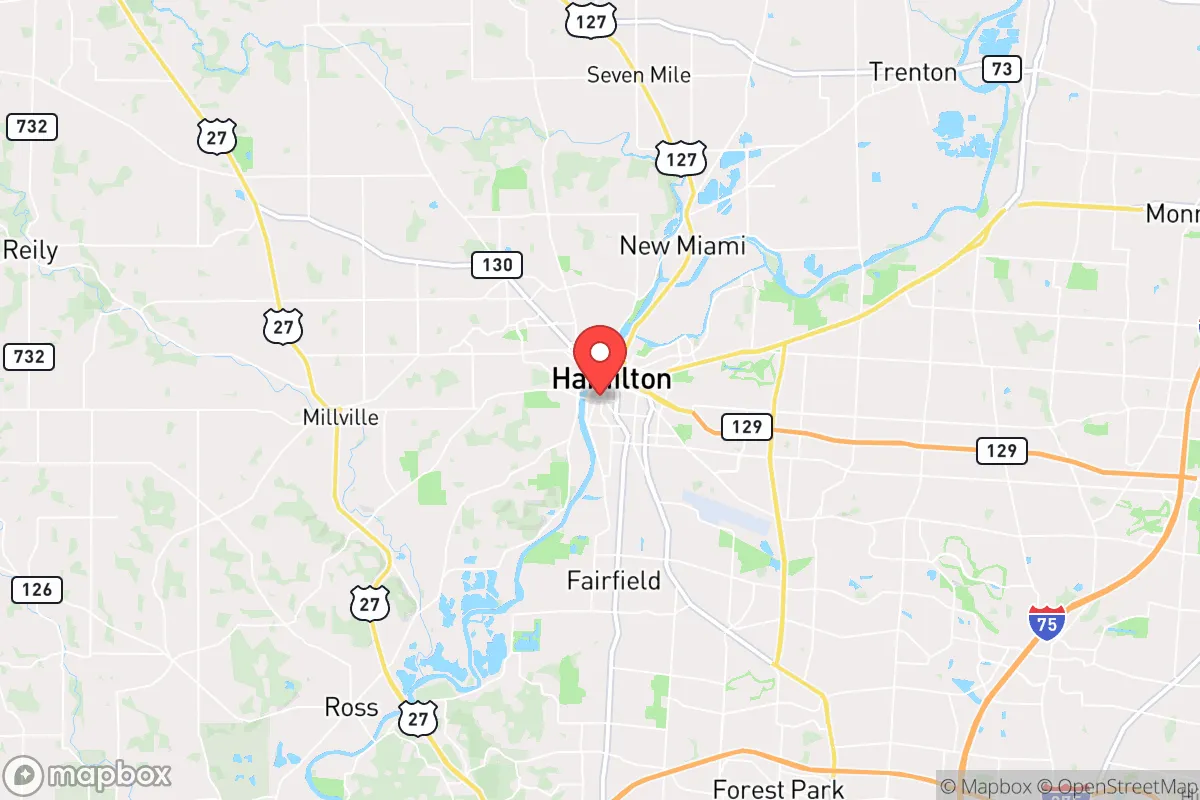
Photo: Wikipedia
Personal Sovereignty in Hamilton, OH
Viable for self-reliance. Generally workable, though some barriers may limit total independence.
What does Personal Sovereignty tell us?
Personal Sovereignty measures your capacity for self-reliance and independence with minimal government friction. Higher scores mean fewer barriers between you and the way you want to live... but it assumes you have the space you need and good neighbors.
What does this tell us?
Personal Sovereignty measures your capacity for self-reliance and independence with minimal government friction. Higher scores mean fewer barriers between you and the way you want to live... but it assumes you have the space you need and good neighbors.
State Policy
Energy independence: Importer (40% of energy produced in-state)
Personal Liberty
Homesteading

Personal Liberty Analysis
Hamilton, Ohio offers a notably high degree of personal sovereignty relative to many Midwestern cities, particularly for those who prioritize minimal government interference in daily life. The city sits in a state that has actively pushed back against federal overreach in areas like gun rights, medical autonomy, and parental control, creating an environment where a survivalist or prepper mindset can operate with fewer legal hurdles. While Hamilton itself is a blue-collar city with some urban challenges, its position within Butler County and the broader Ohio legal framework provides a strategic base for those seeking to maximize personal freedom and self-reliance.
Tax burden and regulatory posture: How Ohio’s fiscal policies affect your autonomy
Ohio’s tax structure is generally favorable for those looking to keep more of their own money, though it’s not a tax-free haven. The state levies a flat income tax of 3.5% as of 2026, down from higher rates in recent years, and Hamilton adds a 1.5% municipal income tax for residents. This combined 5% rate is manageable, especially when compared to high-tax states like California or New York. Property taxes in Butler County average around 1.5% of assessed value, which is moderate for the region. The regulatory posture in Ohio is decidedly pro-business and pro-individual, with the state preempting many local ordinances that would restrict property use or firearm ownership. For a prepper, this means fewer zoning battles over storing supplies or building structures on your land, though Hamilton’s city code does impose standard building permits and setback requirements. The state’s right-to-work status (though not a formal law, Ohio has a strong at-will employment culture) and lack of a state-level estate tax further reduce government entanglement in your financial affairs. Overall, the tax burden here is low enough to allow meaningful savings for self-sufficiency projects, but not so low that you’ll escape all municipal oversight.
Self-defense and gun law specifics: What Hamilton’s legal landscape allows for armed preparedness
Ohio is a constitutional carry state, meaning no permit is required to carry a concealed firearm for anyone legally allowed to possess one. This is a critical advantage for those prioritizing self-defense and preparedness. Hamilton itself does not impose additional local gun restrictions beyond state law, so you can carry openly or concealed without fear of municipal overreach. The state also has strong Stand Your Ground and Castle Doctrine laws, eliminating any duty to retreat in your home, vehicle, or anywhere you are legally present. For preppers, this legal framework means you can defend your property and family without the legal ambiguity found in states like New York or Illinois. Magazine capacity is unrestricted, and there are no bans on common rifle platforms like AR-15s. However, be aware that Ohio does require a background check for all firearm purchases from licensed dealers, and private sales are legal without a check. The state also has a 24-hour waiting period for handgun purchases, which is a minor inconvenience but not a barrier. For those building a serious armory, Ohio’s laws are among the most permissive in the Midwest, and Hamilton’s local enforcement tends to respect these rights, though the city’s higher crime rate means you should be prepared to use them.
Self-reliance and homesteading viability: Lot sizes, zoning, and off-grid feasibility in Hamilton
Hamilton’s urban core is not ideal for full-scale homesteading, but the surrounding areas within Butler County offer viable options. Inside city limits, standard residential lots average 0.1 to 0.25 acres, which limits gardening to raised beds or small plots. Zoning codes allow backyard chickens in most residential zones, but livestock like goats or pigs require a special permit and larger lots. For off-grid living, Hamilton’s building codes require connection to municipal water and sewer in most developed areas, making true independence difficult without moving to unincorporated parts of the county. However, just a few miles outside the city, in places like Ross Township or Oxford Township, you can find 1-5 acre parcels with fewer restrictions. These areas allow rainwater collection, solar panel installation, and even private wells with proper permits. Ohio’s net metering policy lets you sell excess solar power back to the grid, which is a practical step toward energy independence. The county’s soil is fertile for gardening, and the growing season runs from April to October, supporting substantial food production. For a prepper, the key is to buy land outside Hamilton’s city limits to avoid the more restrictive urban codes, while still having access to the city’s resources. The feasibility of off-grid living is moderate—you can achieve significant self-reliance, but full autonomy requires careful property selection and investment in infrastructure.
Personal liberties: Parental rights, medical autonomy, speech, and property protections
Ohio has become a battleground for personal liberties, with recent laws strengthening parental rights in education and medical decisions. The state passed a Parents’ Bill of Rights in 2023, requiring schools to notify parents of any curriculum involving sexuality or gender identity and to obtain consent before providing medical services. This is a strong protection for conservative parents who want to control their children’s upbringing. Medical autonomy is mixed: Ohio has no vaccine mandate for adults, but some employers and healthcare facilities may require them. The state does not have a right-to-try law for experimental treatments, but it does allow for medical marijuana use with a prescription, though recreational use remains illegal. For those concerned about government overreach in health decisions, Ohio’s stance is moderate—you have more freedom than in blue states but less than in states like Texas or Florida. Free speech is protected under the Ohio Constitution, and the state has no hate speech laws that would criminalize political or religious expression. Property rights are strong, with Ohio having a robust eminent domain law that requires just compensation, but the state has been aggressive in using it for economic development projects, so be cautious about land near proposed developments. Overall, Hamilton offers a solid foundation for personal sovereignty, with the state’s legal framework generally favoring individual choice over government control.
Compared to other regions, Hamilton, Ohio provides a balanced environment for those seeking personal sovereignty without the extreme isolation of rural states or the heavy regulation of coastal cities. The tax burden is manageable, gun laws are permissive, and parental rights are protected. The main trade-off is that true self-reliance requires moving outside the city limits to avoid urban zoning restrictions, and the state’s moderate stance on medical autonomy may not satisfy those seeking complete freedom. For a survivalist or prepper looking for a strategic location with access to urban resources and a legal framework that respects individual rights, Hamilton is a solid choice—especially when paired with a rural property in Butler County. It’s not a libertarian paradise, but it’s a place where you can build a life with minimal government interference, provided you understand the local rules and plan accordingly.

* Values derived from national, state, county, city and local statistics and may differ in a specific area. Last updated: 2026-04-30T02:08:18.000Z
Narrative content on this page is AI-generated and may contain mistakes. Verify any details that matter before acting on them.
ReloMaps may earn a commission from affiliate links at no extra cost to you.

