
Photo: Wikipedia
Strategic Assessment of Hamilton, OH
Meaningful friction. Expect exposure to either population pressure, blast zones, or natural disaster risk. Consider buying a retreat property.
What does the Strategic Assessment tell us?
Our Strategic Assessment grades tactical survivability of an area. Major population centers, military targets, fallout zones, natural disasters, and border exposure all drive risk — lower exposure means a more defensible position in a crisis.
This is heavily inspired by Joel Skousen's Strategic Relocation book. Highly recommended you checkout the book ($)What does this tell us?
Our Strategic Assessment grades tactical survivability of an area. Major population centers, military targets, fallout zones, natural disasters, and border exposure all drive risk — lower exposure means a more defensible position in a crisis.
This is heavily inspired by Joel Skousen's Strategic Relocation book. Highly recommended you checkout the book ($)Strategic Pillars

Key Distances
Regional Safe Places
Below is our recommended "safe zones" in Ohio and the surrounding area based on our strategic heuristics. For most people, it's unrealistic to live in a “safe zone” full-time due to work, family or other personal reasons. They tend to be more rural. However, many of these areas are perfect for second homes and retreat properties that double as a vacation home or even a short-term rental.

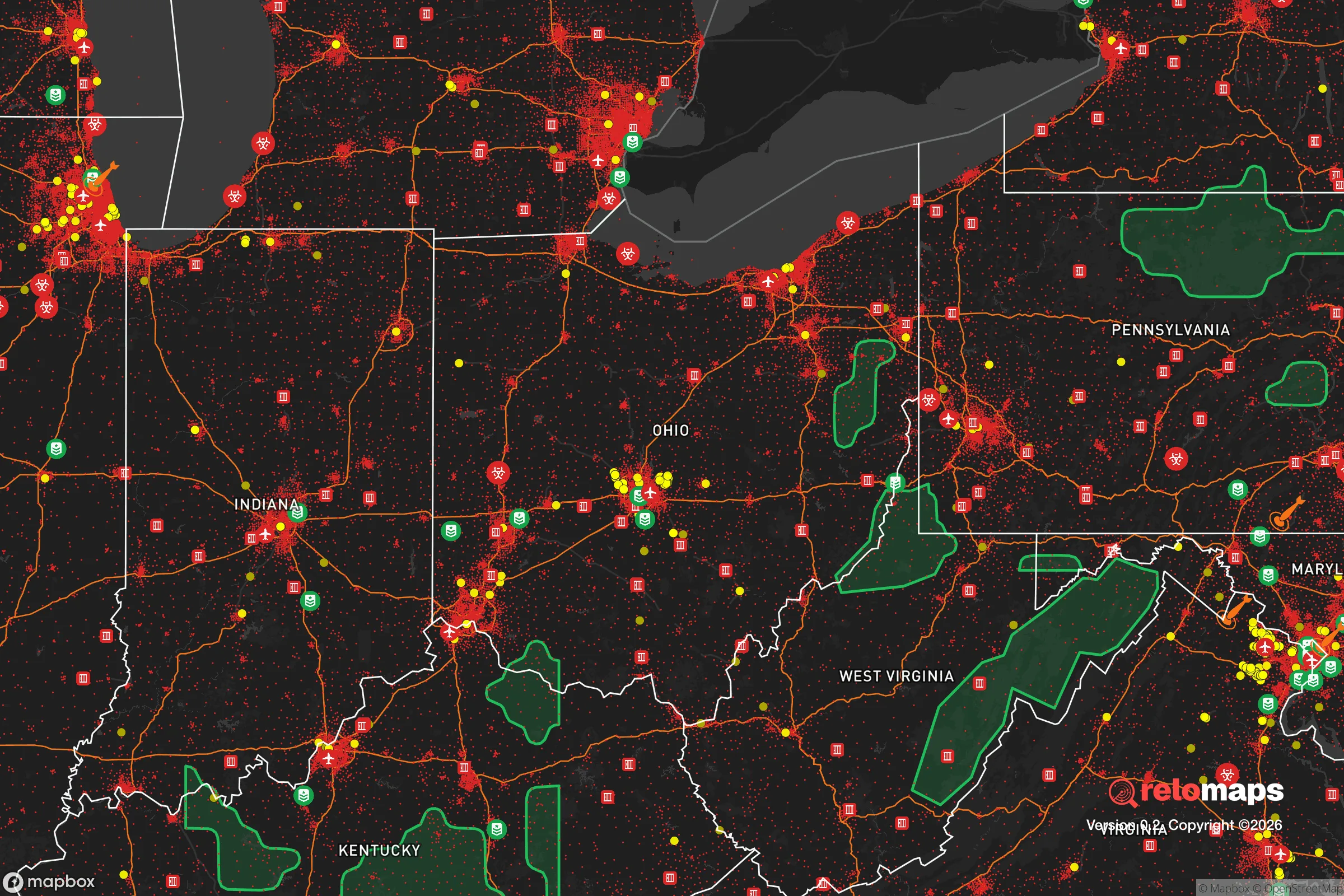


Important Note: For informational purposes only. This does not mean nothing bad ever happens in the green zones. Please use common sense. This is based on public data and modeled with AI. We tried to take a conservative approach but mistakes happen. We update this regularly as new information becomes available.
Solar Generator Recommendations
Backup power matters more here than in safer locations. We've picked three solar generators across budgets and capacity tiers — start with the budget unit if you only need a few essentials, or step up if you want to run a fridge and HVAC for days at a time.

Jackery Portable Power Station Explorer 300
Budget OptionPower on the Go: Weighing only 11 lbs, it's convenient to set up and store with book-sized foldable solar panels

BLUETTI Portable Power Station AC180
Designed for both indoor and outdoor scenarios, AC180 is highly capable as it has a robost capacity and continuous output power.

EF ECOFLOW DELTA Pro Ultra Power Station
Upgraded PickEcoFlow DELTA Pro Ultra is a whole-home energy system designed to grow with your family. Integrated with the Smart Home Panel 2, it scales to meet your evolving energy needs — keeping your home powered, intelligent, and secure through every stage of life.
We earn a commission, at no additional cost to you.
Strategic Assessment Analysis
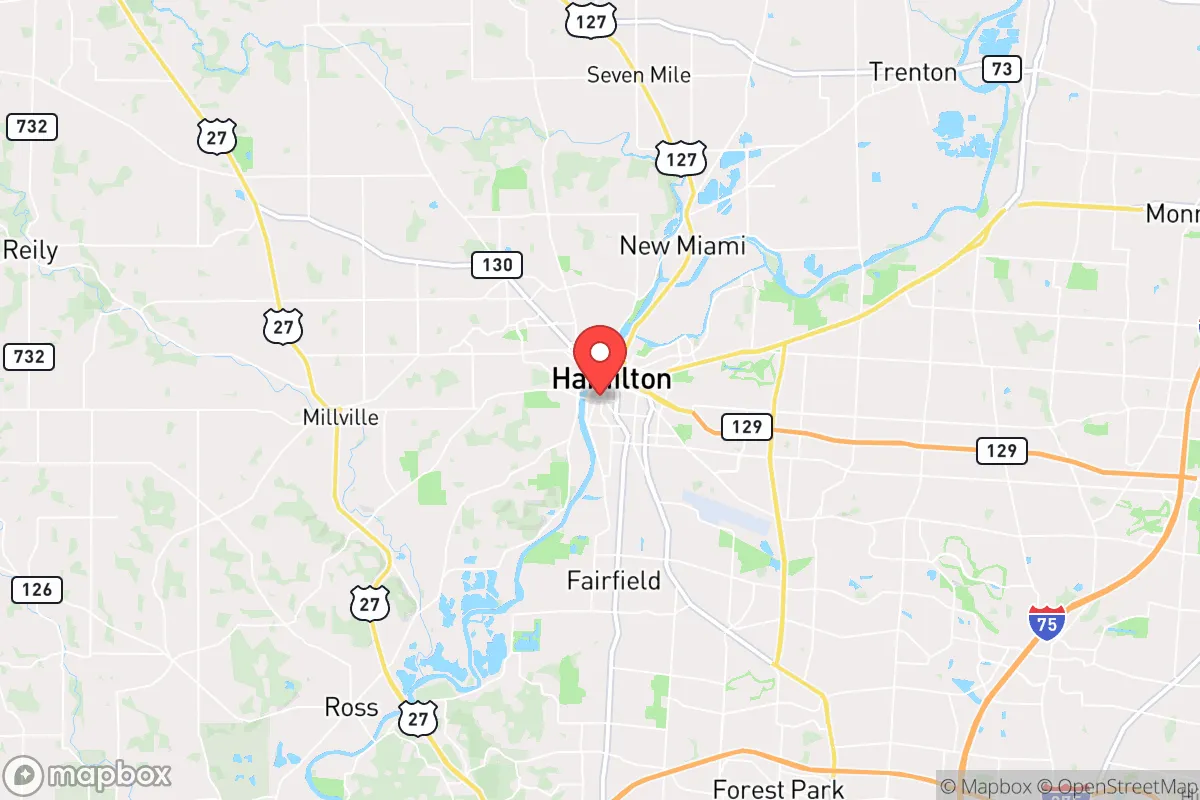
Hamilton, Ohio, occupies a strategic position in the southwestern corner of the state, roughly 25 miles north of Cincinnati, that offers a blend of industrial resilience and geographic buffer. For a relocator with a prepper mindset, the city’s location along the Great Miami River and its status as the county seat of Butler County provide a foundation of infrastructure and community cohesion that is rare in the Rust Belt. While not a remote survivalist haven, Hamilton presents a viable base for those seeking to balance access to urban resources with a degree of separation from the most volatile fallout zones, provided you understand its specific risks and practical advantages.
Geographic position and natural advantages for a strategic relocation
Hamilton sits at the intersection of several key transportation corridors, including Interstate 75 and State Route 4, which connect it to Dayton (30 miles north) and Cincinnati (25 miles south). This positioning offers a logistical edge for resupply or evacuation, but it also means the city is within a 45-minute drive of two major metropolitan areas—a double-edged sword in a crisis. The Great Miami River runs through the city’s core, providing a reliable freshwater source, though it is heavily industrialized in stretches. The surrounding Butler County terrain is mostly flat to gently rolling farmland, with scattered woodlots that offer limited cover but decent agricultural potential. The area’s natural advantages are modest: moderate climate with four distinct seasons, average annual rainfall of about 40 inches, and a growing season long enough for subsistence gardening. However, the region lacks significant natural barriers—no mountains, dense forests, or large bodies of water to create a natural buffer. The nearest substantial wilderness is the 4,000-acre Hueston Woods State Park, about 15 miles northwest, which offers some retreat space but is not a defensible stronghold. For a relocator, the key takeaway is that Hamilton’s geographic strength lies in its connectivity and water access, not in isolation or rugged terrain.
Risks, exposures, and proximity to fallout-relevant landmarks
The most significant risk for a Hamilton-based prepper is its proximity to multiple high-value targets. Cincinnati, with its major interstate bridges, the Port of Cincinnati, and the GE Aviation plant, is a likely target for civil unrest or infrastructure disruption. Dayton, home to Wright-Patterson Air Force Base (a major military and logistics hub), is a primary fallout-relevant landmark—any large-scale conflict or EMP event would likely see that base as a priority. Hamilton itself is not a primary target, but it sits within the blast and fallout radius of both cities. The city also hosts its own industrial assets: the AK Steel plant (now Cleveland-Cliffs) on the riverfront, which could be a secondary target or a source of hazardous material release during a disaster. Additionally, the nearby Fernald Preserve, a former uranium processing site about 10 miles northwest, is a legacy contamination zone that could become a secondary hazard if infrastructure fails. The region’s power grid is served by Duke Energy, with transmission lines running along the I-75 corridor—a likely chokepoint for cascading failures. For a relocator, the risk profile is moderate-high: you are not in the bullseye, but you are in the blast shadow of two major cities and a military base. The best mitigation is to have a bug-out plan that moves east or south into more rural Ohio or Kentucky, away from the I-75 axis.
Practical resilience for a relocator: food, water, energy, and defensibility
For daily life and crisis preparedness, Hamilton offers a mixed bag. Water access is the strongest asset: the Great Miami River is a perennial source, though it requires treatment due to industrial runoff and agricultural silt. The city’s municipal water comes from groundwater wells in the Great Miami Aquifer, one of the most productive in the Midwest, so a well-drilled property outside city limits could provide independent supply. Food resilience is moderate: Butler County has active farmland, with corn, soybeans, and livestock operations within a 10-mile radius. The Hamilton Farmers Market operates seasonally, and local CSAs are available, but the area is not a breadbasket—you’d need to establish your own garden or secure a rural plot for serious self-sufficiency. The city’s grocery infrastructure is decent (Kroger, Meijer, Aldi), but these would be quickly depleted in a panic. Energy resilience is a weak point: the grid is aging, and the region has experienced notable outages from storms (e.g., the 2021 ice storm left thousands without power for days). Solar potential is average—about 4.5 peak sun hours per day—but local permitting is straightforward in unincorporated Butler County. Natural gas is widely available, but a backup generator or propane system is essential. Defensibility is poor within the city itself: Hamilton’s urban layout with dense residential blocks and limited choke points makes it hard to secure. The best defensible properties are on the outskirts—think farmhouses with acreage along the river or in the rural townships like Ross or St. Clair. The local law enforcement presence (Butler County Sheriff’s Office, Hamilton Police) is professional but stretched thin; the county’s population of 390,000 means response times in rural areas can exceed 20 minutes. For a relocator, the practical path is to buy a property with a well, garden space, and a generator within 15 minutes of Hamilton’s core, using the city as a resource hub rather than a primary residence.
The overall strategic picture for Hamilton, Ohio, is one of calculated compromise. It is not a prepper’s paradise—the proximity to Cincinnati and Dayton, the industrial riverfront, and the lack of natural defenses are real liabilities. But for a conservative-leaning relocator who values community infrastructure, water access, and a lower cost of living (median home price around $180,000, well below national average), it offers a viable base for a layered preparedness plan. The key is to treat Hamilton as a hub, not a fortress: use its resources for supply and networking, but maintain a bug-out location in the more rural areas of Preble or Darke counties to the west. The city’s political leanings are mixed—Butler County voted +18 for Trump in 2020, giving it a conservative tilt that aligns with a self-reliant mindset, but the city itself has a working-class Democratic history. If you can navigate the trade-offs, Hamilton provides a solid foundation for weathering the next decade’s uncertainties, provided you don’t mistake its convenience for security.

* Values derived from national, state, county, city and local statistics and may differ in a specific area. Last updated: 2026-04-30T02:08:18.000Z
Narrative content on this page is AI-generated and may contain mistakes. Verify any details that matter before acting on them.
ReloMaps may earn a commission from affiliate links at no extra cost to you.

