Photo: Wikipedia
Demographics of Hamilton, OH
Affluence Level in Hamilton, OH
A below-average socioeconomic profile. Incomes, home values, and educational attainment trail the U.S., with higher poverty and unemployment.
People of Hamilton, OH
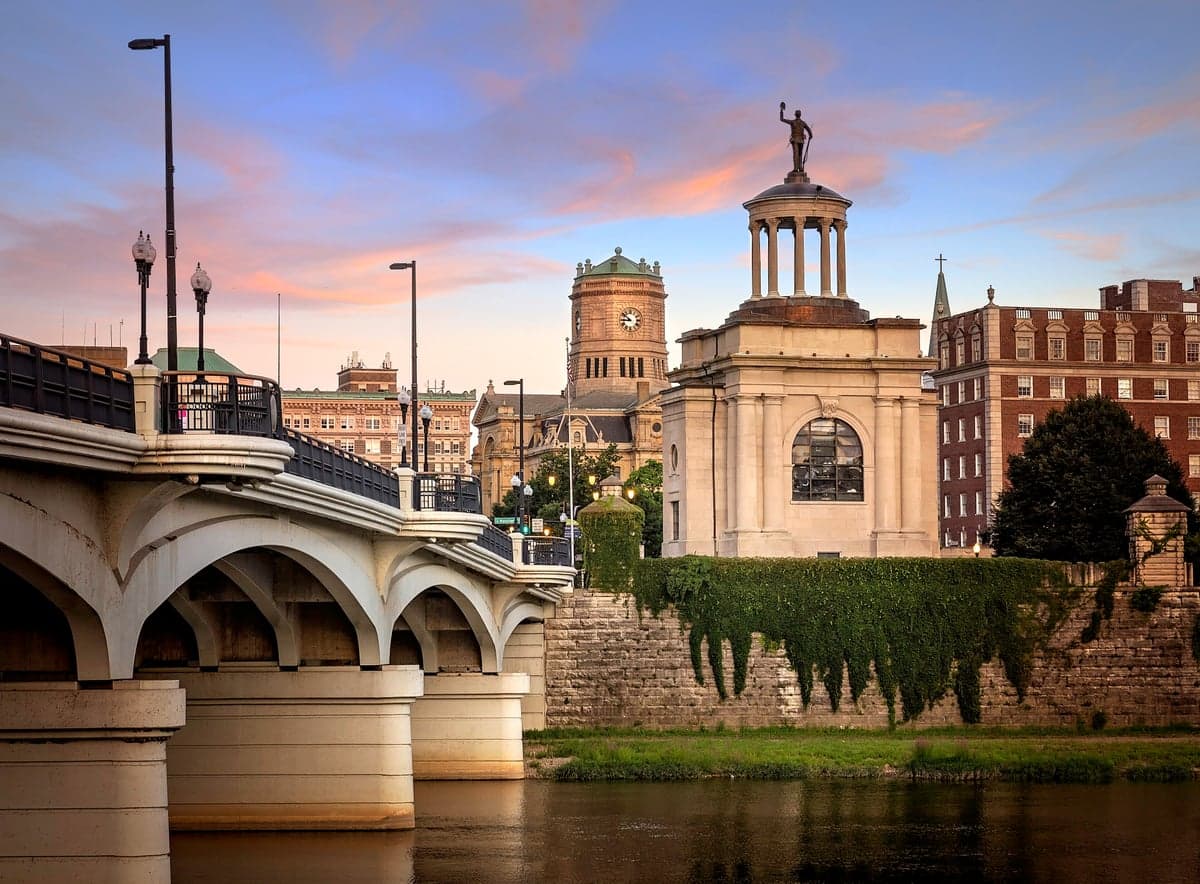
The people of Hamilton, Ohio, today number 63,124, forming a community that is predominantly white (73.8%) with a significant and growing Hispanic population (11.4%) and a smaller Black community (8.3%). The city is notably less diverse than the national average and has a low college attainment rate of 15.7%, reflecting its historical identity as a working-class industrial hub. Distinctive markers include a strong sense of local pride, a revitalizing downtown, and a population that is older and more rooted than many suburban counterparts, with a foreign-born share of just 5.1%.
How the city was settled and grew
Hamilton’s population history is tied directly to its position on the Great Miami River and the Miami-Erie Canal. Founded in 1791 as Fort Hamilton, the city’s first major wave of settlers were German and Irish immigrants drawn by canal construction and later by heavy industry. The German population was particularly influential, establishing the German Village neighborhood (centered around Dayton Street) with its brick homes and social halls. By the late 19th century, the city became a powerhouse of paper, steel, and machine-tool manufacturing, attracting a second wave of Eastern European immigrants—primarily Polish and Hungarian—who settled in the West Side neighborhoods near the factories. The Black population grew during the Great Migration (1910–1970), with many families moving into the North End and Lindenwald areas for work at Fisher Body and other plants. By 1950, Hamilton’s population peaked near 72,000, a mix of native-born whites, European ethnics, and a small but established Black community.
Modern era (post-1965)
After the 1965 Hart-Cellar Act, Hamilton saw a modest but notable shift. The city’s foreign-born population remains low (5.1%), but the composition changed. The most significant modern wave has been Hispanic immigration, primarily from Mexico and Central America, beginning in the 1990s. These families concentrated in the South Hamilton and Rossville neighborhoods, where they found affordable housing and work in manufacturing, warehousing, and food processing. The Hispanic share grew from roughly 3% in 2000 to 11.4% today, making it the fastest-growing demographic. The Black population (8.3%) has remained relatively stable, with many families staying in the North End and Lindenwald, though some have moved to nearby suburbs like Fairfield. East/Southeast Asian communities (0.5%) and Indian-subcontinent residents (0.1%) are very small, with no distinct ethnic enclave; they are scattered across the city, often drawn by professional jobs at the regional hospital or Miami University Hamilton. The white population (73.8%) has aged and declined in numbers, with many younger families moving to outlying townships like Liberty and West Chester.
The future
Hamilton’s population is heading toward greater Hispanic representation, a trend likely to continue as the city’s affordable housing stock and industrial base attract new immigrant families. The white population will likely continue its slow decline through out-migration and aging, while the Black share may hold steady or grow slightly. The city is not tribalizing into distinct enclaves—neighborhoods like Rossville and South Hamilton are becoming more Hispanic, but overall the city remains relatively integrated by income and race. The low college attainment rate (15.7%) suggests that Hamilton will not see a rapid influx of high-skilled professionals, barring a major economic shift. The foreign-born share (5.1%) is below the national average (13.7%) and is unlikely to surge, as the city lacks the large refugee resettlement or tech-job magnets seen in other Ohio cities like Columbus or Dayton.
For someone moving in now, Hamilton is becoming a more Hispanic-influenced, working-class city with a stable but aging white base. It is not a place of rapid demographic upheaval, but rather a slow, organic shift driven by affordability and industrial employment. The city’s character remains rooted in its manufacturing past, with a growing cultural diversity that is most visible in its restaurants and small businesses. New residents will find a community that is welcoming but not rapidly changing, where the cost of living is low and the sense of place is strong.

* Values derived from national, state, county, city and local statistics and may differ in a specific area. Last updated: 2026-04-30T02:08:18.000Z
Narrative content on this page is AI-generated and may contain mistakes. Verify any details that matter before acting on them.
ReloMaps may earn a commission from affiliate links at no extra cost to you.

