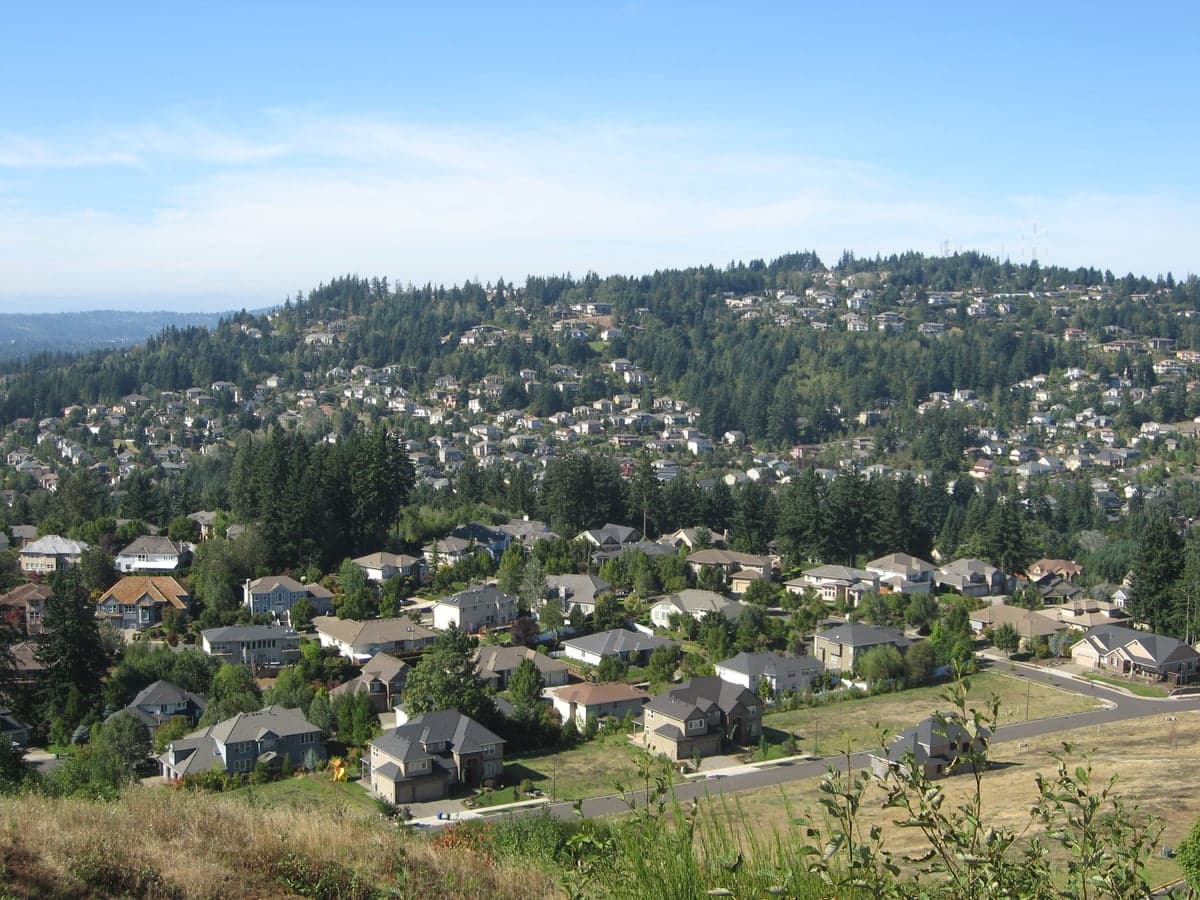
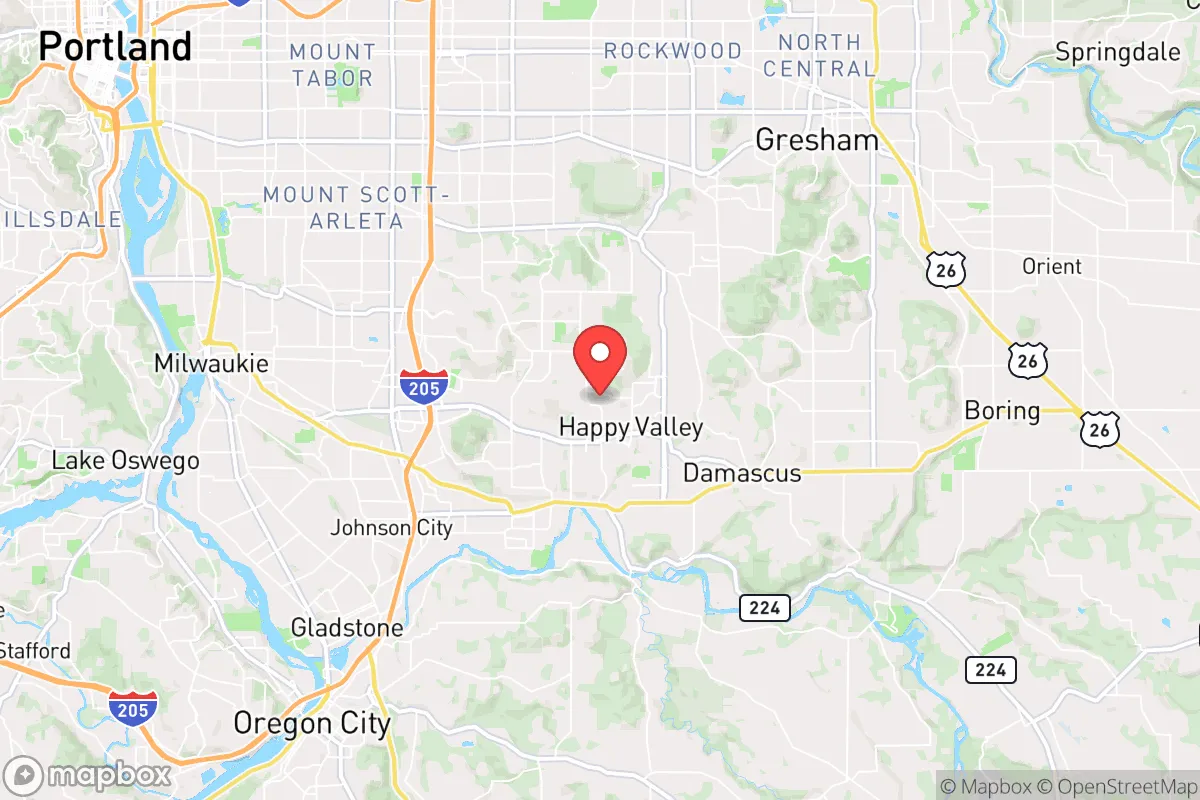
Photo: Wikipedia
Demographics of Happy Valley, OR
Affluence Level in Happy Valley, OR
An upper-middle-class area. Household wealth, education levels, and homeownership run ahead of national benchmarks.
People of Happy Valley, OR
Today, Happy Valley, Oregon is a fast-growing, affluent suburb of Portland with a population of 25,572 that is notably more diverse than the surrounding region. The city is characterized by a high concentration of East and Southeast Asian residents (16.4%), a significant Indian-subcontinent community (1.3%), and a majority-white population (62.5%) that is less dominant than in most other Clackamas County suburbs. With 46.4% of adults holding a bachelor's degree or higher, the population skews professional and family-oriented, drawn by top-rated schools and newer housing stock.
How the city was settled and grew
Happy Valley was not a pioneer-era farming hamlet. The area was sparsely settled by white homesteaders in the mid-19th century, but it remained rural through the 1960s. The original handful of families—names like the Scott and Linn families—farmed wheat and hazelnuts on the rolling hills east of Portland. No historic ethnic enclaves formed because there was no town center to speak of; the area was simply a collection of farms along what is now 152nd Avenue. The first real residential development came in the 1970s, when Portland's suburban expansion pushed eastward. The Scott Creek neighborhood, built on former farmland, became the first subdivision to attract middle-class white families seeking larger lots and newer schools. By 1980, the population was still under 1,000 and nearly entirely white.
Modern era (post-1965)
Happy Valley's modern demographic transformation began in earnest after 1990, driven by two forces: the expansion of high-tech employment along the Sunset Corridor and the construction of master-planned communities. The 1995 opening of the Happy Valley Town Center and the subsequent development of Mount Scott and Park at Happy Valley neighborhoods attracted a wave of domestic in-migrants—primarily white professionals from California and other West Coast states—who were priced out of Portland's westside suburbs. The 2000s saw a distinct shift as East and Southeast Asian families began moving in, drawn by the reputation of the North Clackamas School District. The Summit Ridge and Happy Valley Heights neighborhoods became particular magnets for Chinese-American and Korean-American families, many of whom were second-generation professionals working in tech, medicine, and engineering. The Indian-subcontinent community, though smaller at 1.3%, concentrated in the newer Redland Ridge area, where larger homes and proximity to Intel's Hillsboro campus made the commute viable. The Hispanic population (8.2%) is more dispersed but has a visible presence in the older, more affordable housing stock near the city's western edge, adjacent to the unincorporated community of Sunnyside. The Black population (1.8%) remains very small, reflecting the broader demographics of Clackamas County.
The future
Happy Valley's population is projected to continue growing toward 35,000 by 2040, driven by infill development and the build-out of the Happy Valley North master plan. The city is not homogenizing; rather, it is tribalizing into distinct enclaves by ethnicity and income. The East and Southeast Asian share is likely to rise further, as these families have the highest homeownership rates and the strongest ties to the school system. The Indian-subcontinent community is growing from a small base but faces a ceiling due to limited housing inventory under $700,000. The white share will continue to decline as older residents age in place and younger white families are priced out. The Hispanic population is stable but not growing rapidly, as the city's high home prices (median above $650,000) limit in-migration from lower-income groups. The foreign-born share (5.2%) is low compared to Portland proper, but the second-generation population is much higher, meaning the city's diversity is increasingly native-born.
For a conservative-leaning mover, Happy Valley is becoming a place where traditional suburban values—safety, schools, property rights—are preserved, but the cultural character is shifting toward a multi-ethnic, high-achieving professional class. The city is not becoming a melting pot; it is becoming a collection of distinct, stable enclaves where each group maintains its own institutions and social networks. The bottom line: Happy Valley offers a safe, well-run, and increasingly diverse suburb where the dominant culture is not white nostalgia but aspirational family life, and where newcomers will find their own community waiting.

* Values derived from national, state, county, city and local statistics and may differ in a specific area. Last updated: 2026-05-03T10:47:54.000Z
Narrative content on this page is AI-generated and may contain mistakes. Verify any details that matter before acting on them.
ReloMaps may earn a commission from affiliate links at no extra cost to you.

