Photo: Wikipedia
Personal Sovereignty in Happy Valley, OR
Viable for self-reliance. Generally workable, though some barriers may limit total independence.
What does Personal Sovereignty tell us?
Personal Sovereignty measures your capacity for self-reliance and independence with minimal government friction. Higher scores mean fewer barriers between you and the way you want to live... but it assumes you have the space you need and good neighbors.
What does this tell us?
Personal Sovereignty measures your capacity for self-reliance and independence with minimal government friction. Higher scores mean fewer barriers between you and the way you want to live... but it assumes you have the space you need and good neighbors.
State Policy
Energy independence: Importer (35% of energy produced in-state)
Personal Liberty
Homesteading

Personal Liberty Analysis
Happy Valley, Oregon, presents a complex picture for those prioritizing personal sovereignty. While the city itself is a relatively affluent, planned community with a reputation for safety and order, it operates entirely under the jurisdiction of Oregon state law, which imposes significant constraints on individual autonomy in several key areas. For the survivalist or prepper, the trade-off is clear: you gain a low-crime, high-property-value environment with strong community stability, but you must navigate a state-level regulatory framework that is actively hostile to many forms of self-reliance and personal liberty. The net sovereignty score here is a mixed bag—strong on local property rights and community standards, but weak on gun rights, medical autonomy, and freedom from state-level taxation and regulation.
Tax burden and regulatory posture for a self-reliant individual
Oregon’s tax posture is a primary concern. There is no state sales tax, which is a plus for large purchases, but the trade-off is a progressive state income tax that can reach 9.9% on higher incomes, directly impacting the capital accumulation essential for prepping and self-reliance. Property taxes in Happy Valley are relatively high for the region, typically ranging from 1.0% to 1.2% of assessed value, funding the well-regarded school district and city services. The regulatory environment is heavily centralized in Salem. The state’s land use planning system, particularly through Metro and the Urban Growth Boundary, strictly controls development. This means you cannot simply buy a lot and build a self-sufficient homestead; zoning is tightly enforced, and off-grid living is effectively illegal within city limits. Permitting for any significant construction or modification is a bureaucratic process. For the prepper, this means your ability to modify your property for resilience—installing a large water catchment system, building a root cellar, or erecting a substantial workshop—is subject to city and county approval, which is not guaranteed.
Self-defense and gun law specifics in a state with strict preemption
This is the most significant sovereignty compromise in Happy Valley. Oregon is not a gun-friendly state. In 2024, Measure 114 was partially implemented, requiring a permit to purchase a firearm, a mandatory firearms safety course, and a completed background check before transfer. While the permit-to-purchase component is currently blocked by court order, the law remains in flux, creating uncertainty. Magazine capacity is limited to 10 rounds for new purchases. The state has a "red flag" law (Extreme Risk Protection Order) that allows for the temporary seizure of firearms without a criminal conviction, based on a court order. Open carry is legal without a permit, but concealed carry requires a license (CHL), which is issued by the county sheriff (Clackamas County) and is generally "shall-issue" for residents who pass a background check and complete a safety course. However, carrying a firearm in a vehicle requires a CHL, which is a major restriction for daily preparedness. Happy Valley itself is a low-crime area, so the immediate need for self-defense is lower than in urban Portland, but the legal framework is a clear infringement on the right to keep and bear arms as understood by a conservative or survivalist perspective. The state preempts local gun laws, so Happy Valley cannot create its own more permissive ordinances, but it also cannot be more restrictive than state law.
Self-reliance and homesteading viability: lot sizes, zoning, and off-grid feasibility
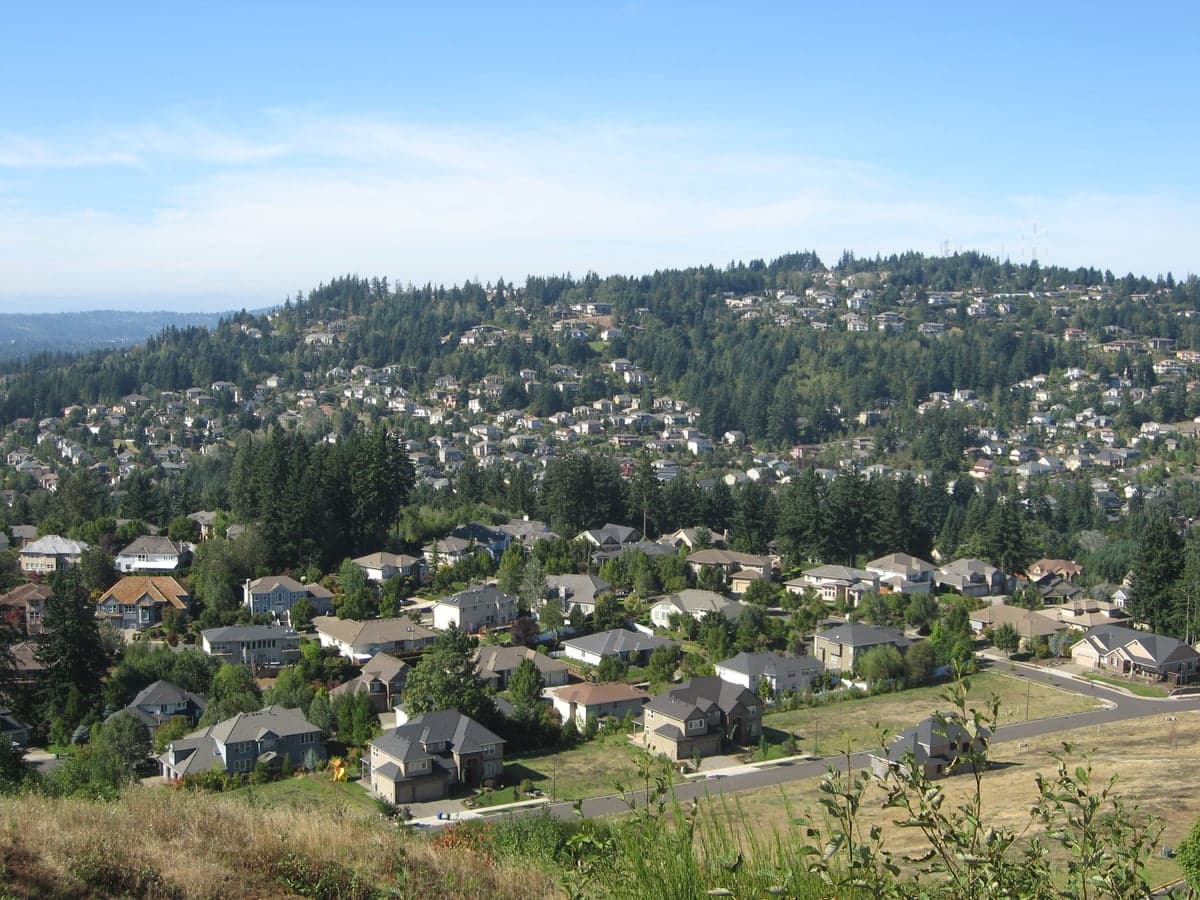
Happy Valley is a master-planned suburb, not a rural homesteading zone. Typical residential lot sizes are small, often 0.1 to 0.25 acres in the denser neighborhoods, with larger custom-home lots reaching 0.5 to 1 acre in areas like the Summit or Carver neighborhoods. Zoning is predominantly residential suburban (RS), which prohibits agricultural activities beyond ornamental gardening. Keeping chickens is generally allowed with restrictions, but larger livestock is not. Off-grid living is not feasible within city limits. The city requires connection to municipal water and sewer systems. Solar panels are permitted but must be installed by licensed contractors and meet building codes; net metering is available but subject to utility regulations. Rainwater collection for outdoor use is generally allowed, but using it as a primary water source is not permitted. For the prepper, the practical reality is that you are buying into a system that provides utilities and services, and your self-reliance is limited to emergency preparedness (food storage, backup power, medical supplies) within a suburban footprint. True homesteading—growing a significant portion of your food, raising animals, and being independent from the grid—is not possible here. You would need to look to rural Clackamas County, such as Estacada or Molalla, for that.
Personal liberties: parental rights, medical autonomy, speech, and property
Oregon is a state with strong protections for some personal liberties and severe restrictions on others. Parental rights are under active debate. The state has a "Parents' Bill of Rights" (HB 4105, passed in 2024) that affirms parents' rights to direct their children's education and healthcare, but it is being challenged in court and its implementation is uncertain. The state mandates comprehensive sex education in public schools, and parents do not have an opt-out for specific content, only for the entire curriculum. Medical autonomy is heavily restricted. Oregon has legalized physician-assisted suicide (Death with Dignity Act) and recreational marijuana, but it has also mandated childhood vaccinations for school attendance (with medical and non-medical exemptions available, though the latter are becoming harder to obtain). The state has a strong public health apparatus that was assertive during the COVID-19 pandemic, including mask and vaccine mandates. For the prepper, this signals a state government willing to override individual medical choices during emergencies. Free speech is protected under the Oregon Constitution, which is broader than the First Amendment in some areas, but local ordinances in Happy Valley can regulate noise, signage, and public gatherings. Property rights are the strongest aspect here. Happy Valley has a robust homeowners' association (HOA) presence in many neighborhoods, which imposes covenants, conditions, and restrictions (CC&Rs) on what you can do with your property. This is a double-edged sword: it maintains property values and community standards, but it also restricts your freedom to modify your home, park vehicles, or engage in activities that HOAs deem unsightly. The city itself has strong code enforcement.
In the final analysis, Happy Valley offers a high degree of personal sovereignty in the realm of property value and community safety, but it does so within a state-level framework that is actively hostile to the core tenets of a survivalist or prepper lifestyle. You will have a safe, stable, and well-maintained home base, but you will be operating under a government that restricts your gun rights, taxes your income heavily, mandates vaccinations, and controls your land use. Compared to a state like Idaho or Montana, the sovereignty score is low. Compared to Portland or Multnomah County, it is significantly higher. For the strategic relocator, Happy Valley is a compromise: a place to build a secure family life and accumulate resources, but not a place to exercise full autonomy over your life, your health, or your property. The smart move is to treat it as a base of operations, with your true prepping activities—shooting, off-grid training, bulk storage—located on rural property outside the city's and state's long reach.

* Values derived from national, state, county, city and local statistics and may differ in a specific area. Last updated: 2026-05-03T10:47:54.000Z
Narrative content on this page is AI-generated and may contain mistakes. Verify any details that matter before acting on them.
ReloMaps may earn a commission from affiliate links at no extra cost to you.

