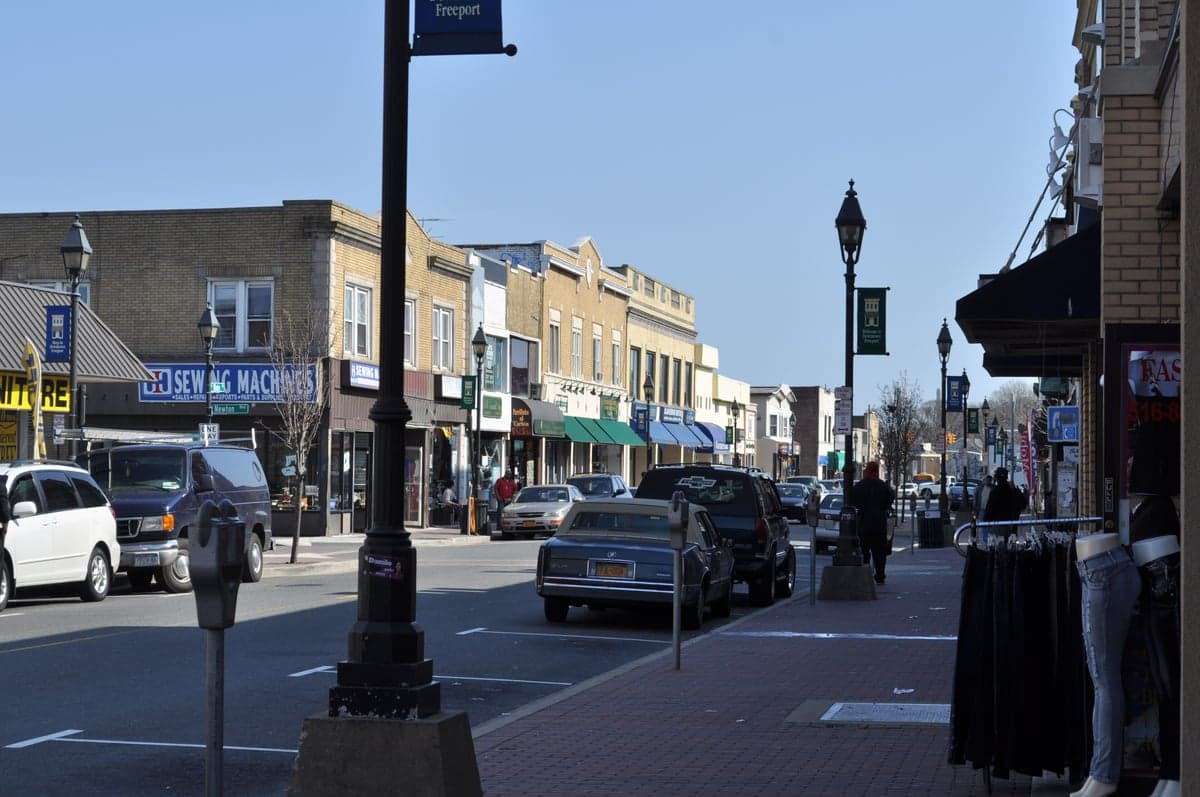
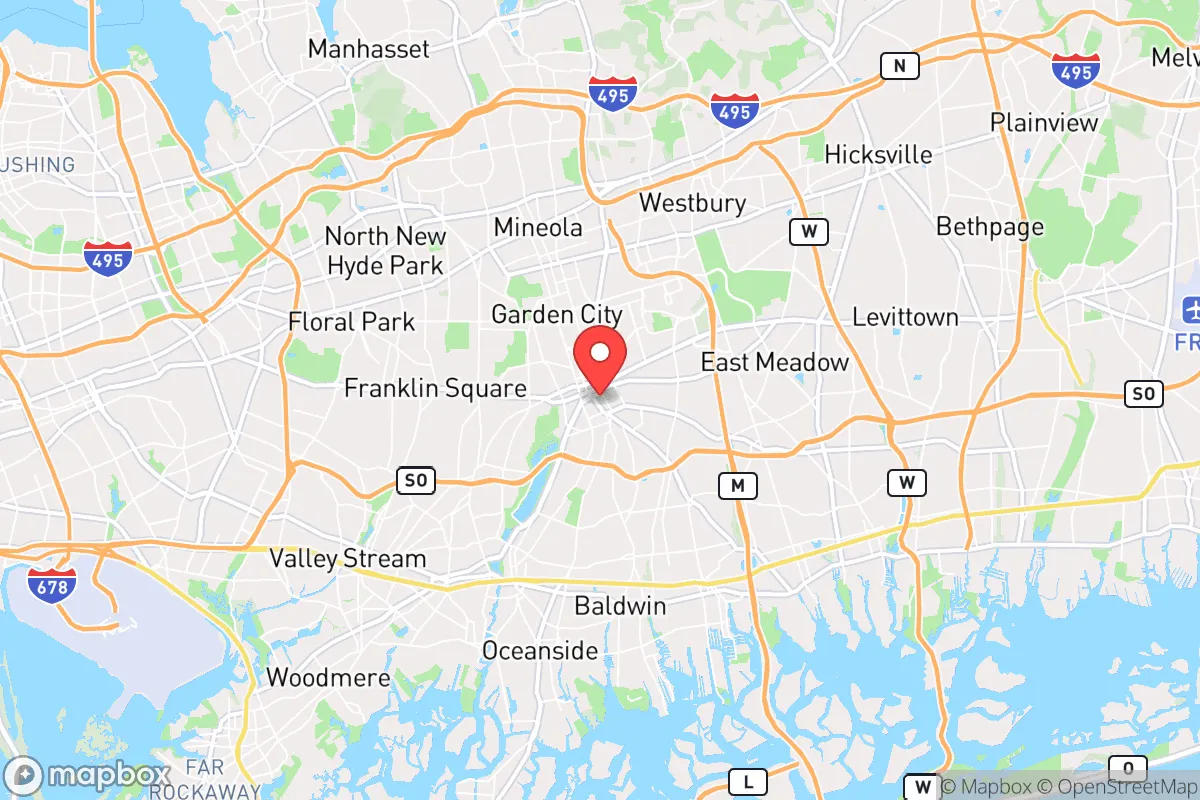
Photo: Wikipedia
Demographics of Hempstead, NY
Affluence Level in Hempstead, NY
A middle-class area roughly in line with national averages across income, home values, education, and employment.
People of Hempstead, NY
The people of Hempstead, New York today form a dense, majority-minority community of 58,569 residents, defined by a nearly equal split between Hispanic (45.4%) and Black (43.2%) populations, with a small White share of 4.8%. The city is one of the most ethnically diverse on Long Island, yet it remains economically strained—only 20.5% of adults hold a college degree, and the foreign-born share stands at 21.0%. Hempstead’s identity is that of a working-class, immigrant-receiving hub, distinct from the wealthier, predominantly White villages that surround it within the Town of Hempstead.
How the city was settled and grew
Hempstead’s original settlement began in 1643, when English colonists from Connecticut and Massachusetts purchased land from the local Lenape people. The early population was entirely English and Protestant, farming the fertile plains of what became known as the Hempstead Plains. The village grew slowly through the 18th and 19th centuries as a rural market center, but the real transformation came after the Civil War. The arrival of the Long Island Rail Road in the 1830s and later the extension of streetcar lines turned Hempstead into a commuter suburb for New York City. By the early 1900s, Irish and German immigrants had settled in the Washington Street and Main Street corridors, working as laborers, domestics, and shopkeepers. A small but established African American community formed in the North Hempstead area, near what is now Hofstra University, drawn by domestic and service jobs in the wealthy estates of Garden City and Old Westbury. Through the 1940s and 1950s, Hempstead remained predominantly White, with a modest Black population concentrated in the Uniondale Avenue corridor.
Modern era (post-1965)
The 1965 Hart-Cellar Immigration Act and the subsequent suburbanization of Long Island reshaped Hempstead’s population dramatically. White flight accelerated in the 1970s and 1980s as Black and Hispanic families moved into neighborhoods like Park Village and the Front Street area. By 1990, the city had become majority Black and Hispanic, with the White share falling below 20%. The Hispanic population—primarily Puerto Rican, Dominican, and Central American—grew rapidly through chain migration, settling in the Jackson Street and Bedford Avenue corridors. The Black population, largely African American but with a growing Afro-Caribbean component (Jamaican, Haitian, Guyanese), concentrated in the Fulton Avenue and North Franklin Street neighborhoods. East/Southeast Asian residents (0.8%) and Indian-subcontinent residents (1.6%) remain small but visible, with Indian families clustering near the Hempstead Turnpike commercial strip. The foreign-born share of 21.0% reflects ongoing immigration, primarily from Latin America and the Caribbean, with a smaller stream from West Africa and South Asia.
The future
Hempstead’s population is likely to continue its trajectory toward a Hispanic majority, driven by higher birth rates and continued immigration from Central America and the Dominican Republic. The Black share, while still large, may slowly decline as younger Black families move to more affordable suburbs in Suffolk County or to the South. The White share, already below 5%, will likely stabilize at a small, mostly elderly remnant. The city is not homogenizing; rather, it is tribalizing into distinct ethnic enclaves—Hispanic-dominant blocks around Jackson Street, Black-dominant blocks around Fulton Avenue, and a small but growing Indian cluster near the Turnpike. The college education rate of 20.5% is a significant barrier to upward mobility, and the city’s high poverty rate (over 20%) suggests that demographic change alone will not drive economic transformation. The next 10-20 years will likely see Hempstead become more Hispanic, more foreign-born, and more economically isolated from the surrounding Nassau County suburbs.
For someone moving in now, Hempstead offers a dense, diverse, and affordable alternative to the pricier villages of Long Island, but it comes with real challenges: underfunded schools, higher crime rates than neighboring communities, and limited local job opportunities. The city is becoming a majority-Hispanic, working-class enclave with a significant Black minority—a place where immigrant energy is high but structural mobility is low. It is not a gentrifying or homogenizing suburb; it is a stable, ethnically defined city that rewards those who are comfortable with density, diversity, and the realities of a lower-resource environment.

* Values derived from national, state, county, city and local statistics and may differ in a specific area. Last updated: 2026-04-24T07:45:32.000Z
Narrative content on this page is AI-generated and may contain mistakes. Verify any details that matter before acting on them.
ReloMaps may earn a commission from affiliate links at no extra cost to you.

