 Popular
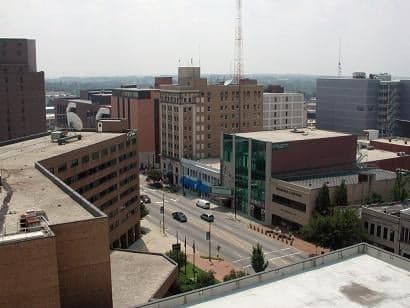
Photo: Wikipedia
Demographics of High Point, NC
Affluence Level in High Point, NC
A middle-class area roughly in line with national averages across income, home values, education, and employment.
People of High Point, NC
High Point, North Carolina, is a city of 115,263 residents defined by its industrial roots and a demographic landscape that is nearly evenly split between White (43.3%) and Black (32.2%) populations, with a growing Hispanic community (12.3%) and notable East/Southeast Asian (4.2%) and Indian (4.0%) enclaves. The city’s character is shaped by its history as the "Furniture Capital of the World," a manufacturing hub that drew successive waves of domestic migrants and international immigrants to specific neighborhoods. Today, High Point is a majority-minority city with a college-educated rate of 33.9%, reflecting a population that is both working-class and increasingly professional, anchored by the furniture industry and the nearby presence of High Point University.
How the city was settled and grew
High Point was founded in 1859 at the highest point on the North Carolina Railroad between Goldsboro and Charlotte, a location that immediately made it a transportation and trade hub. The city’s early population was overwhelmingly White and native-born, drawn from the surrounding Piedmont countryside by the promise of work in the emerging furniture, textile, and hosiery industries. The first major wave of Black residents arrived during the Great Migration (roughly 1910–1940), leaving the rural South for industrial jobs in the city’s booming furniture factories. These families settled primarily in Washington Street and Daniel Brooks, historically Black neighborhoods that became the cultural and commercial heart of the African American community. A smaller but significant wave of Italian and Eastern European immigrants came in the early 1900s, working in the mills and settling in the West End district near the old hosiery plants. By 1950, High Point was a classic Southern industrial city: roughly 70% White and 30% Black, with a small foreign-born population concentrated in a few ethnic pockets.
Modern era (post-1965)
The Immigration and Nationality Act of 1965 reshaped High Point’s population, though the changes were gradual. The city’s furniture industry began attracting new labor sources in the 1980s and 1990s, particularly from Latin America. Hispanic residents, now 12.3% of the population, settled heavily in the Southside and East High Point neighborhoods, areas near the remaining furniture plants and distribution centers. The Asian and Indian populations grew later, driven by professional opportunities at High Point University, the nearby medical centers in Greensboro and Winston-Salem, and the city’s role as a hub for the home-furnishings trade. East/Southeast Asian communities (4.2%)—primarily Vietnamese and Korean—established a small but visible presence in the North High Point area near the university. Indian residents (4.0%), many working in technology, healthcare, and academia, concentrated in newer subdivisions in West High Point and near the Palladium shopping district. The domestic White population, meanwhile, suburbanized outward into areas like Jamestown and Archdale, leaving the city core increasingly diverse. Since 2000, the Black share has held steady near 32%, while the White share has declined from over 55% to 43.3%, driven by both out-migration and the growth of Hispanic and Asian/Indian populations.
The future
High Point’s population is trending toward greater diversity, but not toward homogenization. The Hispanic share is growing steadily, likely to reach 15–18% by 2035, driven by both natural increase and continued immigration for manufacturing and logistics jobs. The East/Southeast Asian and Indian communities are growing more slowly but are consolidating in their respective enclaves—West High Point for Indian families, North High Point for East/Southeast Asians—rather than dispersing. The Black population is stable but aging, with younger Black residents often leaving for larger cities like Charlotte or Atlanta. The White population continues to suburbanize, but the city is seeing a modest influx of younger White professionals drawn to downtown revitalization efforts near the Uptowne district and the new baseball stadium. The foreign-born share (7.6%) is below the national average but rising, and the city remains less diverse than nearby Greensboro or Winston-Salem. High Point is not tribalizing into hostile camps, but it is becoming a city of distinct, self-reinforcing neighborhoods defined by ethnicity and class.
For someone moving to High Point now, the city offers a stable, family-oriented environment with a clear sense of place rooted in its furniture-industry heritage. The population is becoming more diverse and more educated, but the pace of change is moderate, and the city retains a distinctly Southern, working-class character. New arrivals will find established ethnic communities in specific neighborhoods, a growing professional class near the university, and a city that is slowly reinventing itself without abandoning its industrial roots.

* Values derived from national, state, county, city and local statistics and may differ in a specific area. Last updated: 2026-05-03T20:28:11.000Z
Narrative content on this page is AI-generated and may contain mistakes. Verify any details that matter before acting on them.
ReloMaps may earn a commission from affiliate links at no extra cost to you.

