 Popular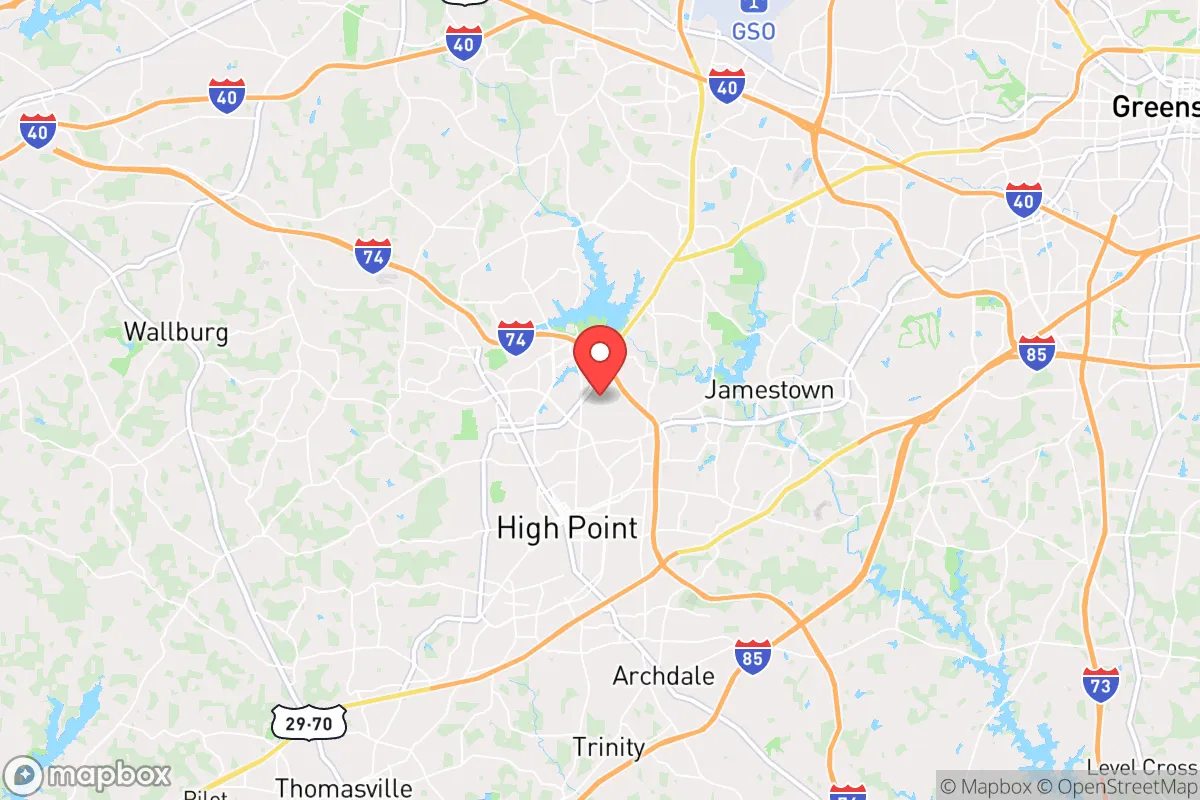
Photo: Wikipedia
Personal Sovereignty in High Point, NC
Viable for self-reliance. Generally workable, though some barriers may limit total independence.
What does Personal Sovereignty tell us?
Personal Sovereignty measures your capacity for self-reliance and independence with minimal government friction. Higher scores mean fewer barriers between you and the way you want to live... but it assumes you have the space you need and good neighbors.
What does this tell us?
Personal Sovereignty measures your capacity for self-reliance and independence with minimal government friction. Higher scores mean fewer barriers between you and the way you want to live... but it assumes you have the space you need and good neighbors.
State Policy
Energy independence: Importer (15% of energy produced in-state)
Personal Liberty
Homesteading

Personal Liberty Analysis
For the individual or family prioritizing personal sovereignty, High Point, North Carolina offers a notably favorable environment compared to many other mid-sized Southern cities, largely due to the state’s preemption laws and a historically restrained local governance culture. While no city is a libertarian utopia, High Point sits in a state that has actively pushed back against federal overreach in recent years, and its local ordinances tend to lean toward minimal interference in daily life. The key question for a survivalist or prepper is whether the city’s regulatory climate, tax structure, and cultural norms allow you to live on your own terms without constant government intrusion—and on that front, High Point generally delivers, though with some important caveats around zoning and local enforcement.
Tax burden and regulatory posture for self-reliant individuals
North Carolina’s flat income tax rate of 4.5% (as of 2025, with scheduled reductions to 3.99% by 2027) is a clear win for anyone trying to keep more of what they earn. High Point’s combined state and local sales tax rate is 7%, which is moderate but not punishing. Property taxes in Guilford County run about $0.74 per $100 of assessed value, meaning a $250,000 home carries an annual bill of roughly $1,850—well below the national average. The city itself has a reputation for being business-friendly, with a streamlined permitting process for home-based enterprises, which matters if you’re running a side hustle or a small-scale food production operation. However, the regulatory posture is not entirely hands-off: the city enforces standard building codes and has a stormwater management program that can complicate major land modifications. For the prepper, the biggest regulatory win is North Carolina’s lack of a state-level income tax on military retirement pay and its relatively low corporate tax rate (2.5%), which encourages small-scale manufacturing and repair work. The state’s right-to-work laws also mean you’re not forced into union membership, preserving your economic freedom.
Self-defense and gun law specifics in High Point and North Carolina
North Carolina is a shall-issue state for concealed carry permits, meaning if you meet the basic requirements—no felony, no domestic violence conviction, completion of a firearms safety course—the county sheriff must issue your permit. High Point is in Guilford County, where the sheriff’s office has a reputation for processing permits efficiently, typically within 45 days. The state also allows permitless open carry of handguns for anyone legally allowed to possess a firearm, though local ordinances in High Point restrict open carry in city parks and government buildings. Stand-your-ground laws are fully in effect: you have no duty to retreat before using deadly force if you are lawfully present and reasonably believe force is necessary to prevent death or great bodily harm. Magazine capacity is not restricted, and there is no state-level assault weapons ban. For the survivalist, the critical detail is that North Carolina has strong preemption laws—cities like High Point cannot pass their own gun control ordinances that are stricter than state law. This means you won’t see the kind of local magazine bans or “safe storage” mandates that plague cities in blue states. The one practical downside: High Point’s proximity to Greensboro and Winston-Salem means you’re in a metro area where gun theft from vehicles is a known issue, so secure storage at home and in your vehicle is non-negotiable.
Self-reliance and homesteading viability: lot sizes, zoning, and off-grid feasibility
High Point’s zoning code is a mixed bag for the serious homesteader. Within the city limits, standard residential lots are typically 0.25 to 0.5 acres, which is enough for a substantial vegetable garden and a few chickens (hens only, no roosters) but not for livestock like goats or pigs. The city does allow beekeeping with a registration permit, and rainwater collection is unrestricted—a major plus for off-grid water planning. However, going fully off-grid is effectively impossible inside city limits because the city requires connection to municipal water and sewer for any habitable structure. For true self-reliance, you need to look at the unincorporated areas of Guilford County or neighboring Randolph County, where lots of 2-5 acres are common and well water and septic systems are the norm. The county’s zoning in rural areas allows for small-scale agriculture, including up to two horses or cattle per acre, and there are no county-level bans on solar panels or composting toilets. The trade-off is that these rural parcels are 15-25 minutes from High Point’s core, meaning you’ll be driving for supplies. For the prepper who wants a suburban buffer, the city’s outskirts—like the area around Archdale or Trinity—offer a compromise: larger lots (1-2 acres) with fewer HOAs and more lenient enforcement of “nuisance” ordinances like noise or vehicle storage.
Personal liberties: parental rights, medical autonomy, speech, and property
North Carolina has been a battleground for parental rights, and the current legal landscape is favorable. The state’s Parents’ Bill of Rights, enacted in 2023, gives parents explicit authority over their children’s education, medical decisions, and access to school materials. In High Point, the Guilford County School Board has been relatively moderate, but the state law overrides any local attempts to restrict parental notification or opt-out rights. On medical autonomy, North Carolina does not have a state-level vaccine mandate for adults, and while COVID-era restrictions are largely gone, the state retains emergency powers that could theoretically be reactivated—a concern for the liberty-minded. The good news is that North Carolina is a “right to try” state, allowing terminally ill patients access to experimental treatments without FDA interference, and it has no state-level prescription drug monitoring program that restricts doctor-patient relationships. Free speech protections are strong: the state has no anti-SLAPP law specifically, but courts generally side with property owners in disputes over signage or political expression. Property rights are bolstered by North Carolina’s “private property protection” laws, which require just compensation for any regulatory taking, and the state’s lack of a statewide building code for agricultural structures means you can erect a barn or workshop without a permit in unincorporated areas. The one area where High Point falls short is in its noise ordinance, which is enforced after 10 PM and can be used to target generators or late-night work—something to consider if you plan to run equipment at odd hours.
Overall, High Point offers a solid baseline of personal sovereignty that compares favorably to cities in the Northeast or West Coast, but it’s not a free-for-all. The state-level protections on guns, taxes, and parental rights are genuine assets, and the city’s moderate regulatory posture means you won’t face the kind of bureaucratic harassment common in places like Portland or Denver. The main limitation is the urban zoning that restricts full self-reliance within city limits—if you want to live truly off-grid or keep livestock, you’ll need to buy land in the surrounding county. For the strategic relocator who wants a low-tax, high-freedom environment with access to a mid-sized city’s infrastructure, High Point is a strong contender, especially when paired with a rural parcel just outside the city limits. It’s not a sovereign citizen’s paradise, but it’s a place where a determined individual can live largely on their own terms without the state constantly looking over their shoulder.

* Values derived from national, state, county, city and local statistics and may differ in a specific area. Last updated: 2026-05-03T20:28:11.000Z
Narrative content on this page is AI-generated and may contain mistakes. Verify any details that matter before acting on them.
ReloMaps may earn a commission from affiliate links at no extra cost to you.

