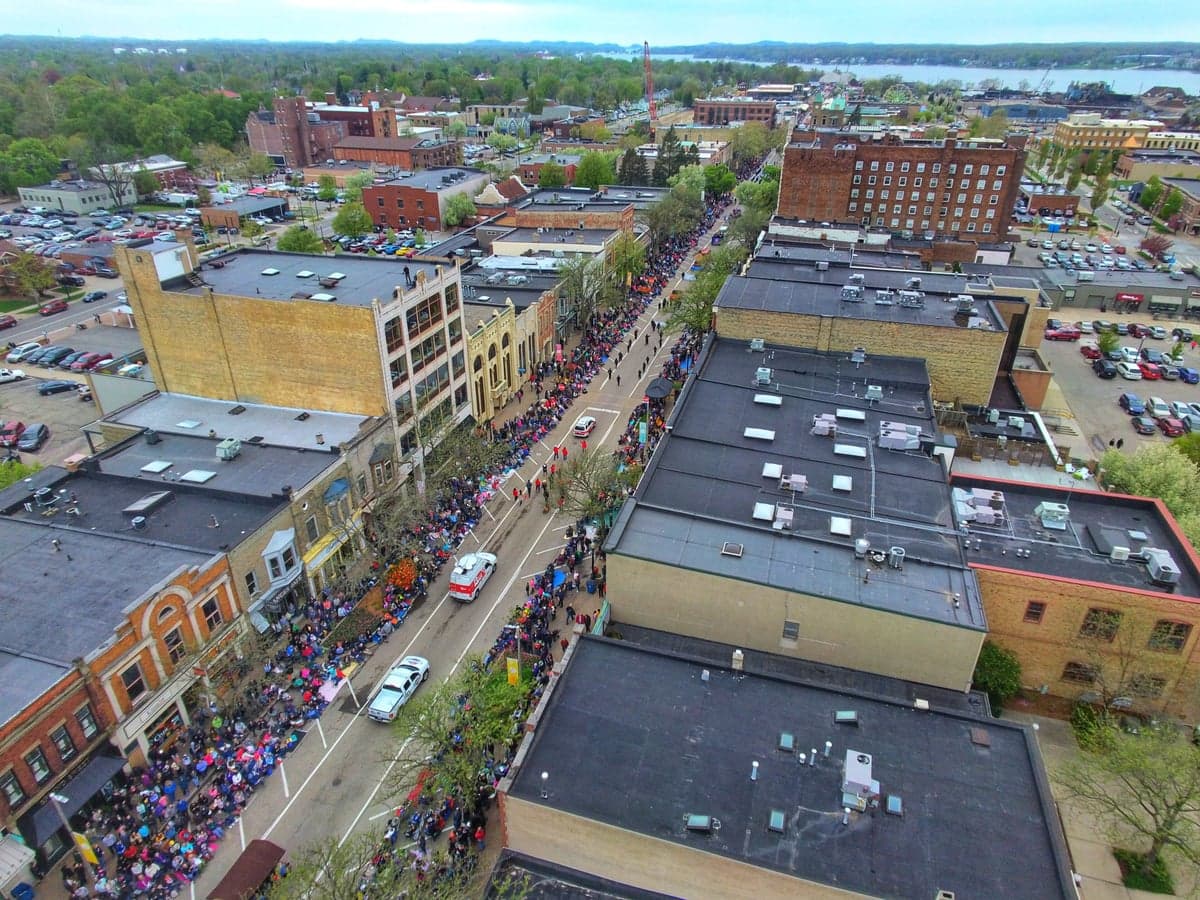
Photo: Wikipedia
Personal Sovereignty in Holland, MI
Strong independent fundamentals that actively favor personal liberty and low regulation.
What does Personal Sovereignty tell us?
Personal Sovereignty measures your capacity for self-reliance and independence with minimal government friction. Higher scores mean fewer barriers between you and the way you want to live... but it assumes you have the space you need and good neighbors.
What does this tell us?
Personal Sovereignty measures your capacity for self-reliance and independence with minimal government friction. Higher scores mean fewer barriers between you and the way you want to live... but it assumes you have the space you need and good neighbors.
State Policy
Energy independence: Importer (20% of energy produced in-state)
Personal Liberty
Homesteading

Personal Liberty Analysis
Holland, Michigan, sits in a region where personal sovereignty is a mixed bag—stronger than coastal blue states in several key areas, but constrained by state-level policies that will frustrate anyone with a survivalist or prepper mindset. The city itself leans left politically, but the surrounding Ottawa County is reliably conservative, and the state of Michigan has a patchwork of laws that both protect and limit individual autonomy. For a single person or family looking to maximize freedom from government overreach, Holland offers some advantages—especially in self-defense and property rights—but demands careful navigation of tax burdens, zoning restrictions, and regulatory creep.
Tax burden and regulatory posture: how Michigan compares to surrounding states
Michigan’s overall tax burden is moderate compared to high-tax states like New York or California, but it’s not a low-tax haven. The state income tax is a flat 4.25%, and sales tax is 6%—neither is crushing, but both are higher than neighboring Indiana (3.15% income tax) or Ohio (3.5% on most income). Property taxes in Holland are a real concern: the average effective rate is around 1.5% of assessed value, which is above the national average. For a $300,000 home, that’s roughly $4,500 annually—money that could otherwise go toward supplies, land, or self-reliance investments. The regulatory posture in Holland is mixed. The city has its own zoning and building codes that can be more restrictive than the county’s, especially in historic districts. Ottawa County as a whole is more business-friendly, but state-level environmental regulations—particularly around water use and shoreline development on Lake Michigan—can be a headache for anyone wanting to build a self-sufficient homestead. The Michigan Department of Environment, Great Lakes, and Energy (EGLE) has significant authority over wells, septic systems, and wetland alterations, so expect permitting delays if you plan to develop raw land.
Self-defense and gun law specifics: what you can and cannot do in Holland
Michigan is a shall-issue state for concealed pistol licenses (CPL), meaning if you pass a background check and complete a training course, the county sheriff must issue your permit. Ottawa County is generally pro-2A, and the sheriff’s office processes CPL applications efficiently. Open carry is legal without a permit for anyone 18 or older who can legally possess a firearm, but Holland’s city ordinances can be tricky: the city bans open carry in public parks and certain municipal buildings, and private property owners can post signs prohibiting firearms. Stand-your-ground laws apply in Michigan—you have no duty to retreat in any place you have a legal right to be—but the law is not as ironclad as in states like Texas or Florida. Castle doctrine is strong: you can use deadly force against an intruder in your home or vehicle if you reasonably believe they intend to cause harm. Magazine capacity is not restricted at the state level, and there is no state-level assault weapons ban. However, Holland is in a county that has seen some local push for gun safety ordinances, so stay vigilant about city council meetings. For preppers, the key takeaway is that you can legally own and carry most firearms, but you must know the specific boundaries of city property and posted signs.
Self-reliance and homesteading viability: lot sizes, zoning, and off-grid feasibility
Within Holland city limits, homesteading is difficult. Minimum lot sizes in residential zones are typically around 6,000 to 10,000 square feet—enough for a garden and maybe a few chickens, but not for serious food production or livestock. The city’s zoning code restricts keeping chickens to a limited number (usually 4-6 hens, no roosters), and goats, pigs, or larger animals are outright prohibited in most residential districts. If you want true self-reliance, you need to look outside the city—in Holland Township or further into rural Ottawa County. There, you can find parcels of 1 to 10 acres with agricultural zoning that allows livestock, orchards, and even small-scale farming operations. Off-grid feasibility is limited by state building codes: Michigan requires connection to the electrical grid for new construction in most areas, and solar panels must be grid-tied unless you get a special exemption. Rainwater collection is legal for non-potable uses, but any system for drinking water must meet EGLE standards. Composting toilets are allowed with proper permitting, but the process is bureaucratic. For a serious prepper, the best bet is to buy land in a rural township like Park or Fillmore, where county oversight is lighter and you can build a more independent setup. Water access is good—the area sits on a large aquifer—but well drilling costs $5,000-$10,000 depending on depth.
Personal liberties: parental rights, medical autonomy, speech, and property
Parental rights in Michigan are generally strong, but there are recent flashpoints. The state has a law requiring parental consent for minors to get an abortion, and parents have the right to opt their children out of sex education. However, Holland Public Schools and other local districts have adopted policies that some conservative parents view as overreaching—like LGBTQ+ inclusive curriculum and social-emotional learning programs that don’t require parental opt-in. School board meetings in Ottawa County have been contentious, and several conservative candidates have been elected in recent cycles, so the pendulum may be swinging back. Medical autonomy is a mixed picture: Michigan did not enact any COVID-19 vaccine mandates for the general public, but healthcare workers and some state employees faced mandates. The state does not have a broad religious exemption for vaccines, and the Michigan Department of Health and Human Services has broad emergency powers that could be used to impose restrictions in a future crisis. For those concerned about medical freedom, Holland has a few private clinics that offer direct primary care and some alternative medicine options, but the mainstream healthcare system is dominated by Spectrum Health, which follows standard CDC guidelines. Free speech is protected under the First Amendment, and Holland has not seen the kind of local censorship battles that plague some cities—public protests and political signage are generally allowed within reasonable time, place, and manner restrictions. Property rights are solid: Michigan is a “property rights” state, meaning you can generally use your land as you see fit as long as you don’t create a nuisance. However, the city of Holland has a strong historic preservation commission that can restrict exterior changes to homes in designated districts—a direct limit on your right to modify your own property. For a prepper, this means avoiding historic districts if you want to build a bunker, install security features, or modify your home without bureaucratic approval.
Overall, Holland offers a moderate level of personal sovereignty compared to other parts of the Midwest. It’s far better than Illinois or Minnesota for gun rights and property freedom, but it lags behind Indiana or Wisconsin in tax burden and regulatory simplicity. The city itself is more restrictive than the surrounding county, so your best strategy is to live just outside city limits—in a rural township—while still having access to Holland’s amenities. For a single person or family with a prepper mindset, the area is viable if you pick your location carefully, stay engaged in local politics to push back against overreach, and accept that Michigan’s state-level bureaucracy will always be a factor. If you want maximum autonomy with minimal government interference, you’d be better off in a state like Texas or South Dakota. But if you’re tied to the Great Lakes region for family or work, Holland can work—as long as you know where the lines are drawn and stay on the right side of them.

* Values derived from national, state, county, city and local statistics and may differ in a specific area. Last updated: 2026-04-29T18:11:04.000Z
Narrative content on this page is AI-generated and may contain mistakes. Verify any details that matter before acting on them.
ReloMaps may earn a commission from affiliate links at no extra cost to you.

