Photo: Wikipedia
Demographics of Holland, MI
Affluence Level in Holland, MI
A middle-class area roughly in line with national averages across income, home values, education, and employment.
People of Holland, MI
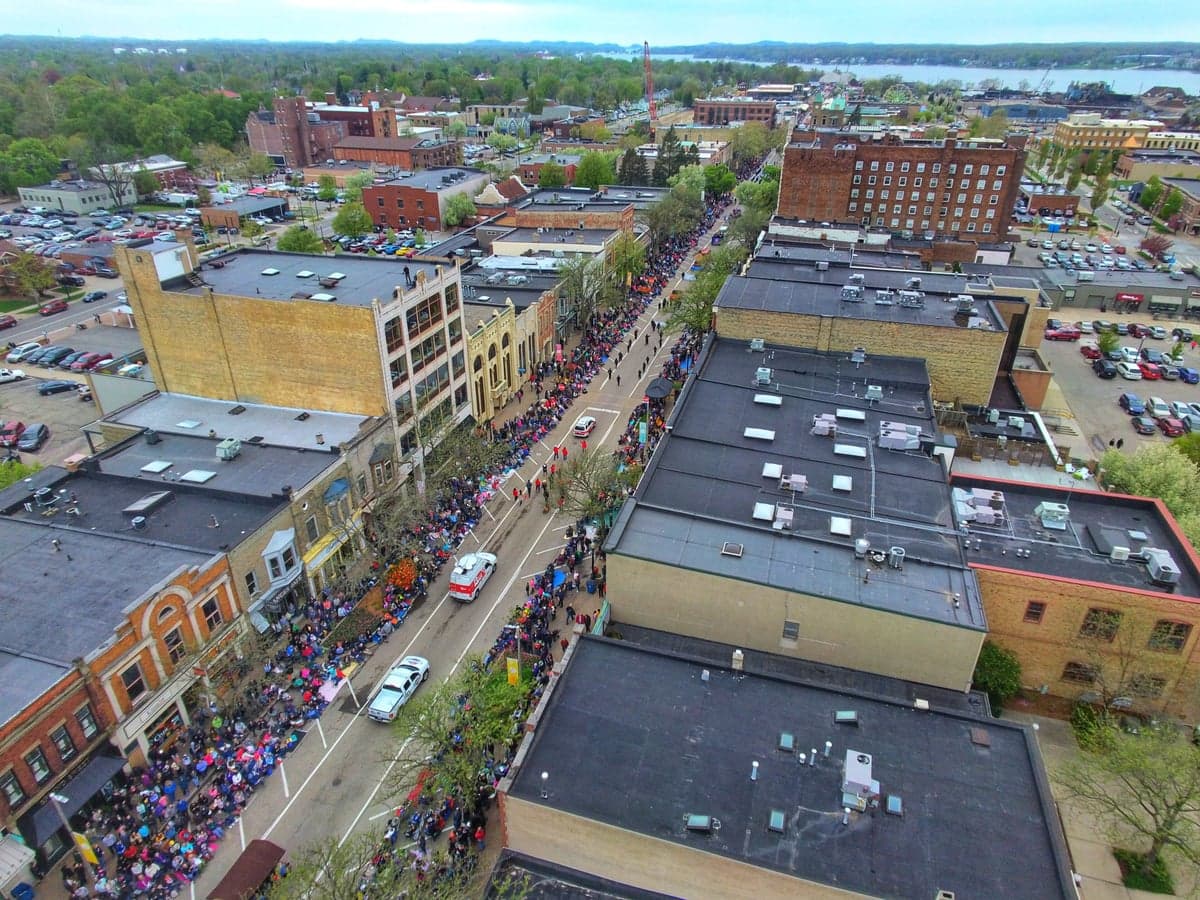
The people of Holland, Michigan today form a community of 34,266 residents that is predominantly white (65.2%) with a substantial and growing Hispanic population (23.2%), a small Black community (4.7%), and a modest East/Southeast Asian presence (2.7%). The city retains a strong Dutch-American cultural identity rooted in its founding, but its character is increasingly shaped by Hispanic families, particularly in the south side and the Washington Square neighborhood, while the historic Dutch core remains concentrated in the Central Park and East Side neighborhoods. With a foreign-born share of just 4.4% and a college-educated rate of 34.6%, Holland is a relatively stable, family-oriented city where assimilation into a conservative, church-going culture is the norm for newcomers.
How the city was settled and grew
Holland was founded in 1847 by Dutch Calvinist separatists led by Reverend Albertus Van Raalte, who sought religious freedom and farmland away from the established Dutch Reformed Church in the Netherlands. The original settlers—mostly farmers and artisans from the provinces of Gelderland and Overijssel—built their homes and churches in what is now the Central Park neighborhood, centered around the historic Pillar Church and the original 40-acre plat. The city grew rapidly through the late 19th and early 20th centuries as successive waves of Dutch immigrants arrived, drawn by the furniture industry (notably the Holland Furnace Company and Baker Furniture) and the region's fruit-growing economy. These later arrivals settled in the East Side neighborhood, where Dutch-language newspapers and Calvinist schools persisted well into the 1930s. By 1950, Holland was over 95% Dutch-American, with a tight-knit, church-centered social structure that discouraged outside migration.
Modern era (post-1965)
The 1965 Hart-Cellar Act and the subsequent decline of the furniture industry began to reshape Holland's population. Hispanic workers, primarily of Mexican descent, started arriving in the 1970s to fill labor shortages in agriculture (blueberry and apple orchards) and light manufacturing. They concentrated in the south side and the Washington Square neighborhood, where affordable housing and proximity to farm work created a distinct Hispanic enclave. By 2000, the Hispanic share had reached 12%, and it has since nearly doubled to 23.2%. The Black population (4.7%) is smaller and more dispersed, with a notable cluster in the northwest quadrant near the Holland Heights area, drawn by manufacturing jobs at companies like Herman Miller and Haworth. The East/Southeast Asian community (2.7%) is largely composed of Vietnamese and Korean families who arrived in the 1980s and 1990s, many settling in the southwest side near 32nd Street, where a small strip of Asian-owned businesses operates. The Indian-subcontinent population (0.2%) is negligible and mostly tied to medical professionals at Holland Hospital. The white population, while still the majority, has aged and suburbanized, with younger Dutch-American families moving to nearby Zeeland and Park Township, leaving the Central Park and East Side neighborhoods increasingly older and more established.
The future
Holland's population is trending toward greater Hispanic growth and white suburbanization. The Hispanic share is projected to reach 30-35% by 2040, driven by higher birth rates and continued migration from southwest Michigan's agricultural corridor. This growth is concentrated in the Washington Square and south side neighborhoods, which are becoming more distinctly Hispanic in businesses, churches, and language use. The white population is declining slowly, as younger Dutch-Americans move to outlying townships and the city's historic Dutch core ages in place. The Black and East/Southeast Asian populations are stable but not growing significantly, as Holland lacks the industrial base or university anchor that drives larger minority in-migration. The city is not tribalizing into hostile enclaves—most neighborhoods remain mixed—but it is becoming more spatially distinct, with the south side emerging as a Hispanic-majority area while the north and east sides remain predominantly white. The foreign-born share (4.4%) is low compared to national averages, indicating that most Hispanic growth comes from U.S.-born families rather than new immigrants.
For someone moving in now, Holland is becoming a city where the historic Dutch-American culture remains dominant in public life and local government, but the demographic future is increasingly Hispanic. The city is stable, family-oriented, and politically conservative, with a strong church presence and low crime. New residents—whether white, Hispanic, or other—will find a community that values assimilation into this existing culture, with few ethnic enclaves beyond the south side's Hispanic corridor. The next 20 years will likely see a gradual blending of Dutch and Hispanic traditions, similar to what has occurred in nearby Grand Rapids, rather than sharp fragmentation.

* Values derived from national, state, county, city and local statistics and may differ in a specific area. Last updated: 2026-04-29T18:11:04.000Z
Narrative content on this page is AI-generated and may contain mistakes. Verify any details that matter before acting on them.
ReloMaps may earn a commission from affiliate links at no extra cost to you.

