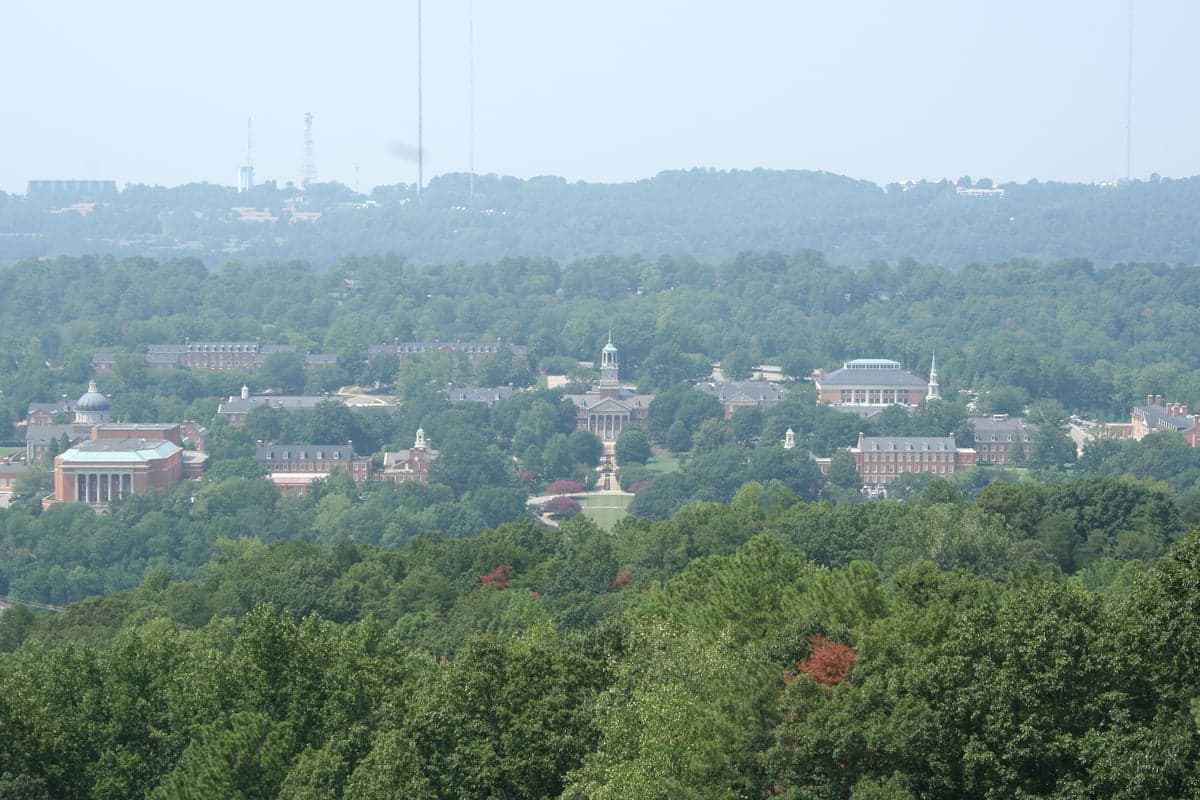
Photo: Wikipedia
Strategic Assessment of Homewood, AL
Meaningful friction. Expect exposure to either population pressure, blast zones, or natural disaster risk. Consider buying a retreat property.
What does the Strategic Assessment tell us?
Our Strategic Assessment grades tactical survivability of an area. Major population centers, military targets, fallout zones, natural disasters, and border exposure all drive risk — lower exposure means a more defensible position in a crisis.
This is heavily inspired by Joel Skousen's Strategic Relocation book. Highly recommended you checkout the book ($)What does this tell us?
Our Strategic Assessment grades tactical survivability of an area. Major population centers, military targets, fallout zones, natural disasters, and border exposure all drive risk — lower exposure means a more defensible position in a crisis.
This is heavily inspired by Joel Skousen's Strategic Relocation book. Highly recommended you checkout the book ($)Strategic Pillars

Key Distances
Regional Safe Places
Below is our recommended "safe zones" in Alabama and the surrounding area based on our strategic heuristics. For most people, it's unrealistic to live in a “safe zone” full-time due to work, family or other personal reasons. They tend to be more rural. However, many of these areas are perfect for second homes and retreat properties that double as a vacation home or even a short-term rental.
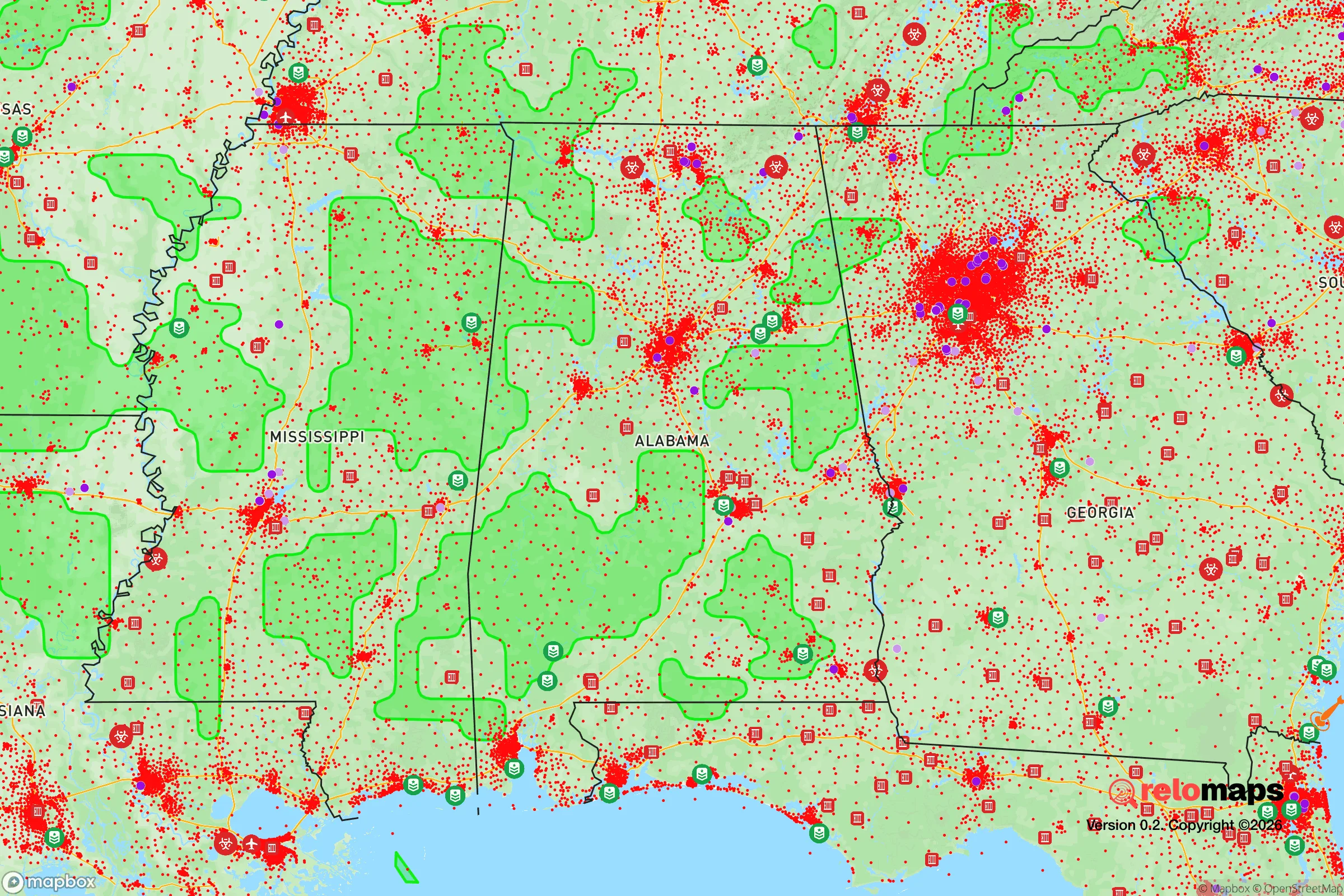
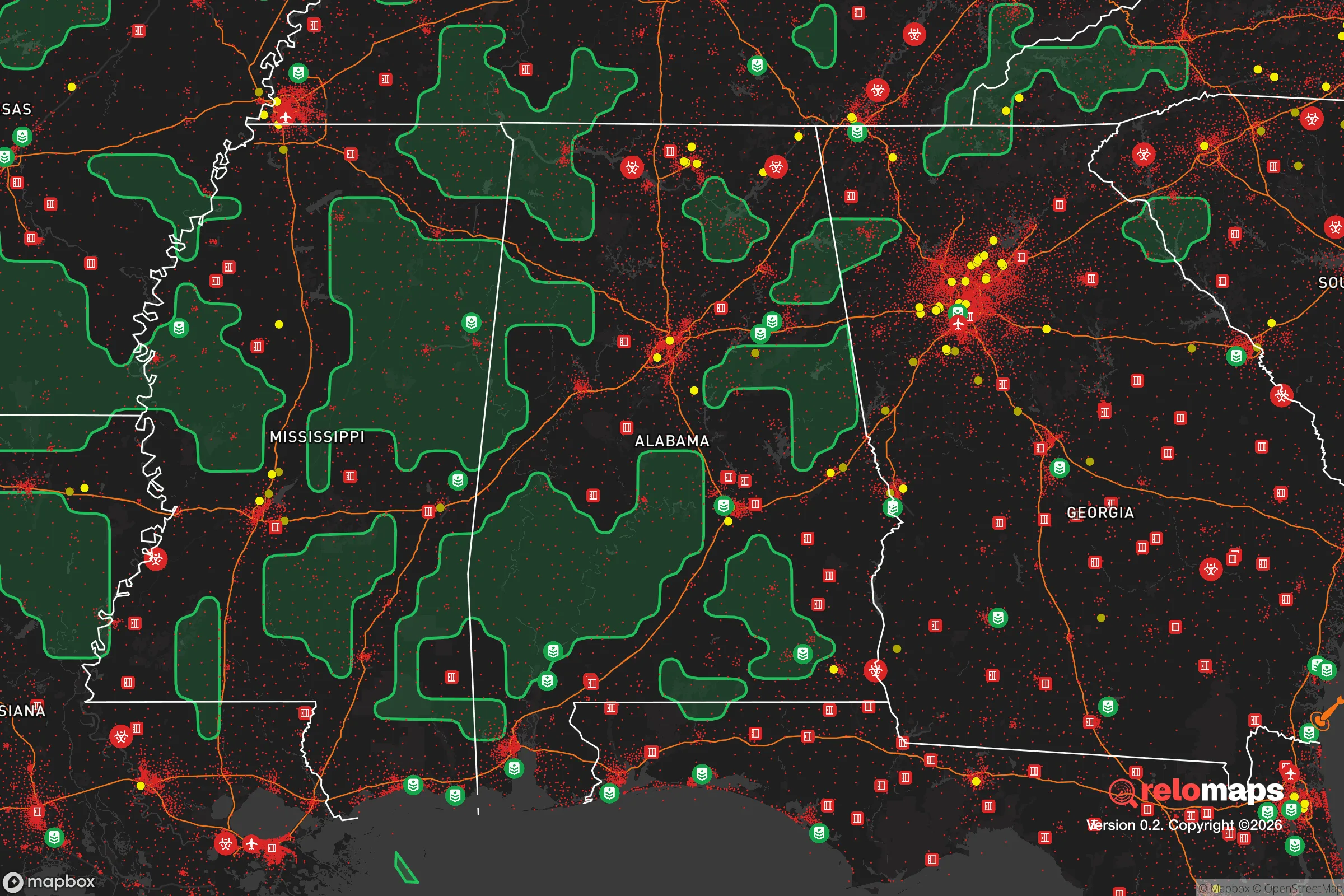


Important Note: For informational purposes only. This does not mean nothing bad ever happens in the green zones. Please use common sense. This is based on public data and modeled with AI. We tried to take a conservative approach but mistakes happen. We update this regularly as new information becomes available.
Solar Generator Recommendations
Backup power matters more here than in safer locations. We've picked three solar generators across budgets and capacity tiers — start with the budget unit if you only need a few essentials, or step up if you want to run a fridge and HVAC for days at a time.

Jackery Portable Power Station Explorer 300
Budget OptionPower on the Go: Weighing only 11 lbs, it's convenient to set up and store with book-sized foldable solar panels

BLUETTI Portable Power Station AC180
Designed for both indoor and outdoor scenarios, AC180 is highly capable as it has a robost capacity and continuous output power.

EF ECOFLOW DELTA Pro Ultra Power Station
Upgraded PickEcoFlow DELTA Pro Ultra is a whole-home energy system designed to grow with your family. Integrated with the Smart Home Panel 2, it scales to meet your evolving energy needs — keeping your home powered, intelligent, and secure through every stage of life.
We earn a commission, at no additional cost to you.
Strategic Assessment Analysis
Homewood, Alabama, sits in a precarious but potentially advantageous position for the strategic relocator. Its location on the southern edge of the Birmingham metro area offers proximity to regional resources, but its core value lies in its defensible geography and relative insulation from the most acute risks of a major urban collapse. For the prepper or survivalist, Homewood is not a bug-out location—it is a layered buffer zone that provides access to infrastructure while maintaining a realistic escape route to the more rural and resource-rich areas of central Alabama.
Geographic position and natural advantages for a strategic relocation
Homewood’s geography is its primary strategic asset. The city is situated on the Ridge-and-Valley system of the Appalachian foothills, which provides natural elevation advantages and multiple chokepoints for anyone approaching from the north or east. The area is drained by the Cahaba River and its tributaries, offering a reliable freshwater source that is less likely to be contaminated by industrial runoff compared to the Black Warrior River system closer to downtown Birmingham. The surrounding terrain is a mix of hardwood forest and limestone outcroppings, which supports game like white-tailed deer and wild turkey, and provides ample cover for a retreat. Homewood itself is built on a series of hills, with Red Mountain forming a natural barrier to the north. This elevation gives residents a visual and tactical advantage over the lower-lying areas of Birmingham proper, making it easier to monitor movement and defend a perimeter in a worst-case scenario. The city’s position also places it within a 30-minute drive of the Talladega National Forest and the Coosa River basin, both of which offer extended bug-out options with abundant water and timber.
Risks, exposures, and proximity to fallout-relevant landmarks
The most significant risk for Homewood is its proximity to Birmingham’s critical infrastructure and potential target zones. The city lies roughly 5 miles south of the Birmingham-Shuttlesworth International Airport, a major cargo and passenger hub that could become a focal point for civil unrest, supply chain disruption, or a mass casualty event. Additionally, the nearby U.S. Steel Fairfield Works and the Birmingham Water Works Board facilities are potential industrial hazards—chemical spills, explosions, or targeted attacks could contaminate local water or air. Homewood is also within the blast radius of a hypothetical conventional attack on the Birmingham federal building or the University of Alabama at Birmingham (UAB) medical complex, both of which are high-value targets. The city’s main thoroughfares—U.S. Highway 31 and Interstate 65—are evacuation routes that could become gridlocked during a crisis, trapping residents in the urban corridor. For the conservative prepper, the density of the Birmingham metro area (roughly 1.1 million people) is a liability; a sudden collapse would trigger a mass exodus southward, and Homewood would be in the direct path of that flow. The city’s reliance on the Birmingham water system and the Alabama Power grid also means that a regional blackout or water contamination event would hit Homewood hard, despite its local resources.
Practical resilience for a relocator: food, water, energy, and defensibility
For a relocator willing to invest in preparation, Homewood offers a surprisingly resilient base. The city has multiple independent grocery stores (Piggly Wiggly, Western Supermarket) and a strong local food scene that includes farmers’ markets and community gardens, which can be leveraged for barter and supply in a prolonged crisis. Water is the critical concern: Homewood’s municipal supply comes from the Birmingham Water Works, which is vulnerable to both cyberattack and physical sabotage. A prepper should install a rainwater catchment system and a Berkey or similar gravity filter, as the local water table is high enough to support shallow wells in some neighborhoods (check zoning and property lines). The city’s energy grid is tied to the Alabama Power network, but the area’s solar insolation is excellent—Homewood averages over 200 sunny days per year, making rooftop solar with battery backup a viable option for off-grid power. Defensibility is mixed: the city’s older neighborhoods (Edgewood, Hollywood) have narrow, winding streets that can be barricaded, but the newer developments near the Summit shopping center are more exposed. The Homewood Police Department is well-funded and responsive, but in a collapse scenario, law enforcement would be stretched thin. The best strategy is to establish a neighborhood watch or mutual-aid group with like-minded residents, focusing on the hilltop areas that offer natural chokepoints. For long-term food security, the surrounding Jefferson County soil is fertile for vegetables, and the Cahaba River provides fishing and irrigation, though you’ll need to secure access rights.
The overall strategic picture for Homewood is one of calculated risk with high upside. It is not a remote survivalist retreat—it is a suburban foothold that allows you to maintain a professional career and access to urban amenities while being positioned for a rapid transition to a more rural posture. The key is to treat Homewood as a Phase 1 location: a place to build skills, stockpile supplies, and establish relationships before a crisis forces a move to a more defensible property in the Coosa River valley or the Talladega National Forest. For the conservative relocator who values community, education, and a low-crime environment in normal times, Homewood delivers. But for the prepper, the real value is in its geographic buffer—close enough to the city to exploit its resources, far enough to avoid its worst collapse scenarios. The smart move is to buy on the south or east side of the city, near the Cahaba River, and invest in water independence and a reliable vehicle for a southward bug-out. Homewood is not a fortress, but it is a strategic staging ground for those who understand that survival is about positioning, not just supplies.

* Values derived from national, state, county, city and local statistics and may differ in a specific area. Last updated: 2026-04-19T18:53:28.000Z
Narrative content on this page is AI-generated and may contain mistakes. Verify any details that matter before acting on them.
ReloMaps may earn a commission from affiliate links at no extra cost to you.

