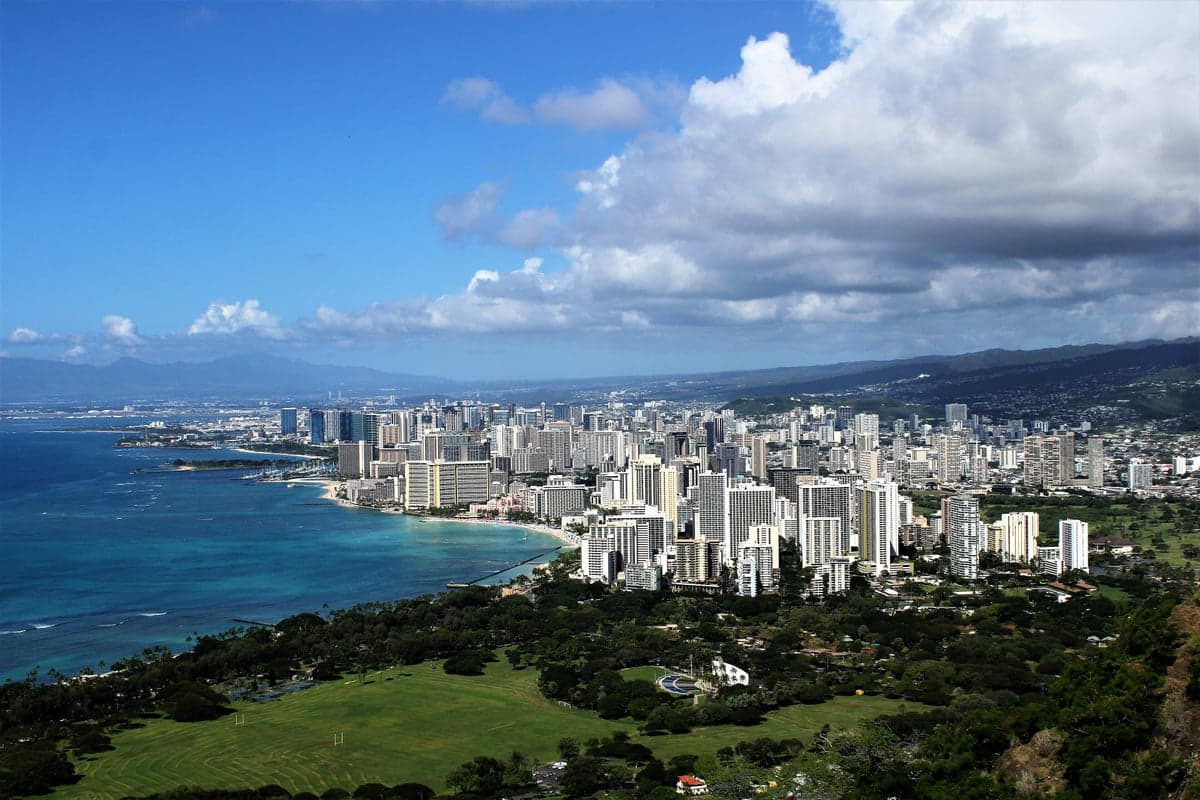
Photo: Wikipedia
Personal Sovereignty in Honolulu, HI
Moderate friction. Expect trade-offs in some aspect of personal liberty and independence.
What does Personal Sovereignty tell us?
Personal Sovereignty measures your capacity for self-reliance and independence with minimal government friction. Higher scores mean fewer barriers between you and the way you want to live... but it assumes you have the space you need and good neighbors.
What does this tell us?
Personal Sovereignty measures your capacity for self-reliance and independence with minimal government friction. Higher scores mean fewer barriers between you and the way you want to live... but it assumes you have the space you need and good neighbors.
State Policy
Energy independence: Importer (2% of energy produced in-state)
Personal Liberty
Homesteading

Personal Liberty Analysis
Honolulu presents a paradox for the individualist or prepper: breathtaking natural beauty and strategic Pacific positioning, but a regulatory and cultural environment that systematically erodes personal sovereignty. The city is the epicenter of a state government that consistently ranks among the most interventionist in the nation, with a cost of living and legal framework that make self-reliance a constant uphill battle. For those prioritizing autonomy—whether in finance, defense, or daily life—Honolulu demands a clear-eyed assessment of trade-offs, as the aloha spirit often masks a deep-seated bureaucratic control over nearly every aspect of personal freedom.
Tax burden and regulatory posture: the cost of living under a heavy hand
Hawaii’s tax structure is a primary obstacle to financial sovereignty. The state imposes a general excise tax (GET) of 4% on nearly all business transactions, which is passed directly to consumers, effectively functioning as a hidden sales tax on everything from groceries to rent. There is no local sales tax in Honolulu, but the GET, combined with some of the nation’s highest state income taxes (top marginal rate of 11%), creates a crushing cumulative burden. Property taxes are comparatively low for owner-occupied homes, but this is a double-edged sword: the state’s aggressive land use laws and zoning restrictions artificially inflate housing costs, making land ownership—a cornerstone of prepper strategy—prohibitively expensive. The regulatory posture extends to business: starting a small farm or home-based survival goods enterprise requires navigating a labyrinth of permits, with the state’s Department of Health and Department of Agriculture wielding broad authority. For the self-reliant individual, this means every step toward independence—from selling eggs to building a rainwater catchment system—is met with a fee, a form, or a denial.
Self-defense and gun law specifics: a near-total prohibition on personal arms
For those who view the Second Amendment as a bedrock of personal sovereignty, Honolulu is among the most hostile jurisdictions in the United States. Hawaii operates under a “may-issue” permitting system for concealed carry, and in practice, the Honolulu Police Department rarely issues licenses. Following the Bruen decision, the state attempted to restrict carry in “sensitive places” so broadly that it effectively nullified the ruling for most residents. Open carry is illegal. The state maintains a registry of all firearms and ammunition purchases, and a permit to acquire a handgun requires a background check, a four-hour class, and a 14-day waiting period. “Assault weapons” are banned by name, including many common semi-automatic rifles, and magazines are capped at 10 rounds. For the prepper, this means the ability to defend one’s home or property with a standard-issue defensive rifle is legally impossible. The state’s justification—a low violent crime rate in Honolulu relative to mainland cities—ignores the reality that law-abiding citizens are disarmed while criminals, who ignore these laws, face minimal consequences. The message is clear: the state does not trust its citizens with the tools of self-defense.
Self-reliance and homesteading viability: off-grid dreams, on-grid reality
The idea of a self-sufficient homestead in Honolulu is largely a fantasy for the average person. The city’s zoning is dominated by urban and suburban residential designations, with minimum lot sizes in many areas as small as 5,000 square feet. Agricultural land exists in the more rural parts of Oahu, like the North Shore or Waimanalo, but is subject to strict state agricultural district rules that limit residential structures and require active farming. Off-grid living is effectively illegal: the state mandates connection to the electrical grid for any habitable structure, and rainwater catchment systems are heavily regulated by the Department of Health, requiring permits and regular testing. Solar panels are common, but net metering policies have been revised to be less favorable to homeowners, and battery storage is expensive. Raising livestock—chickens, goats, or pigs—is restricted in most residential zones, and even beekeeping requires registration. For the prepper seeking a bug-out location or a self-reliant compound, Honolulu’s dense population, limited land, and regulatory choke points make it one of the least viable options in the country. The soil is fertile, but the government’s grip on land use is ironclad.
Personal liberties: parental rights, medical autonomy, and the erosion of choice
Honolulu’s progressive political culture has produced a legal environment that consistently prioritizes state authority over individual and family rights. Parental rights are significantly curtailed: Hawaii has some of the most expansive child abuse reporting laws in the nation, and the state’s Department of Human Services has broad latitude to investigate families without a warrant. The state mandates a comprehensive sex education curriculum in public schools that includes topics many conservative parents find objectionable, with no robust opt-out provision. Medical autonomy is similarly constrained. Hawaii imposed some of the nation’s strictest COVID-19 mandates, including prolonged indoor mask mandates and vaccine requirements for state employees and school children that lasted longer than in most states. Religious and philosophical exemptions to vaccine mandates are not recognized for school attendance, forcing families to either comply or homeschool—a choice that itself is regulated, with annual testing requirements and curriculum oversight. Property rights are weak: the state’s strong eminent domain powers and the Hawaii Housing Authority’s ability to impose rent controls and tenant protections mean that a landlord’s control over their own property is limited. Free speech is nominally protected, but the state’s “Hawaii Revised Statutes” include broad prohibitions on “harassment” and “disorderly conduct” that have been used to silence political protesters, particularly those with conservative or anti-government views. The cumulative effect is a society where the individual is expected to conform to state-dictated norms, and dissent is met with legal and social friction.
In the broader landscape of American personal sovereignty, Honolulu ranks near the bottom for those who value self-determination. The combination of a crushing tax burden, a near-total ban on civilian firearms, prohibitive land-use regulations that kill homesteading dreams, and a government that actively overrides parental and medical autonomy creates an environment where the prepper or survivalist is constantly swimming against the current. While the climate is mild and the location is strategic for Pacific contingencies, the price of admission is a surrender of the very freedoms that make self-reliance possible. For the conservative individualist, Honolulu is a beautiful place to visit, but a deeply compromised place to build a sovereign life.

* Values derived from national, state, county, city and local statistics and may differ in a specific area. Last updated: 2026-04-24T00:01:43.000Z
Narrative content on this page is AI-generated and may contain mistakes. Verify any details that matter before acting on them.
ReloMaps may earn a commission from affiliate links at no extra cost to you.

