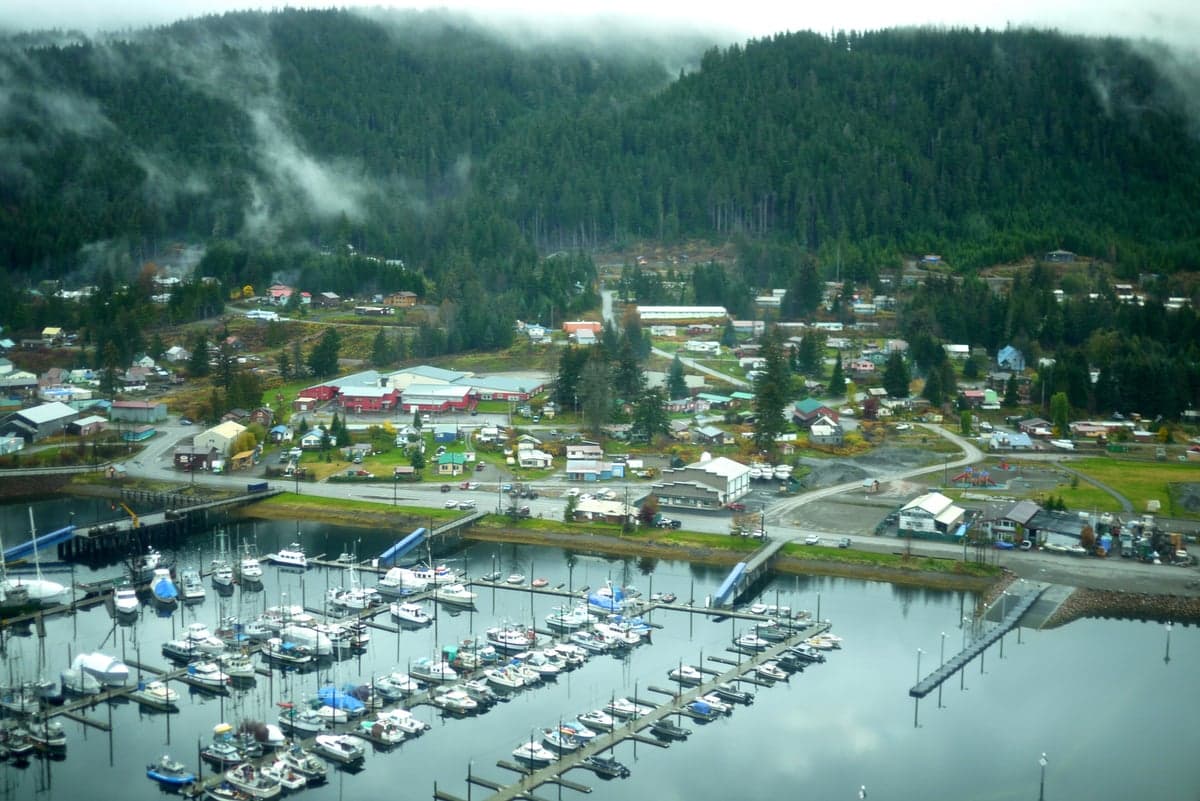
Photo: Wikipedia
Political ClimatePolitical Climate in Hoonah, AK
District shown is the primary district for this city’s centroid. Cities may span multiple districts.
Inherited from parent state — no local data available.
Local Political AnalysisPolitical Analysis of Hoonah, AK
Hoonah, Alaska, has long been a place where folks value their independence and don't take kindly to outsiders telling them how to live, and that's reflected in its political lean. The area carries a Cook PVI of R+6, meaning it votes about six points more Republican than the national average, which tracks with the conservative, self-reliant spirit you see in everyday life here. But like a lot of small towns, there's been a slow drift—nothing dramatic yet, but enough that longtime residents are starting to notice a shift in the air, especially among younger folks moving in from Juneau or even the Lower 48. The trajectory isn't a hard red wall anymore; it's more like a fading red line, and that's got some of us watching the local elections a little closer.
How it compares
If you want to see what Hoonah used to feel like politically, just hop over to Gustavus or even up to Skagway—those places have gone noticeably more progressive in the last decade, with more focus on environmental regulations and social programs that can feel like government overreach. Hoonah, by contrast, still holds onto that old-school Alaska independence, where you don't need a permit to fix your own dock or a dozen forms to hunt on your own land. Compare it to Juneau, the state capital, which is a whole different animal—solidly blue, with all the bureaucracy and red tape that comes with it. Here in Hoonah, we're closer to the rural conservative pockets like Yakutat or Angoon, where the attitude is more "leave us alone and let us live our lives." That R+6 rating puts us in a sweet spot where we're not a deep red stronghold like some Interior villages, but we're still comfortably right of center, and that matters when state policy starts creeping into local fishing quotas or land use.
What this means for residents
For folks living here, the political climate directly affects how much freedom you have to run your own life without a bunch of government paperwork. The conservative lean means there's generally less appetite for new taxes, stricter building codes, or overbearing environmental rules that can choke a small fishing town's economy. But there's a real concern that as the political winds shift—even a little—we could see more state or federal mandates on everything from subsistence hunting to school curriculum. That's the kind of thing that makes a longtime resident nervous, because once you let that progressive foot in the door, it's hard to push it back out. The local school board and borough assembly races are where this plays out most directly, and it's worth paying attention to who's running and what they believe about personal rights versus collective good.
One thing that sets Hoonah apart culturally is the strong Tlingit influence, which blends a respect for tradition with a practical, no-nonsense approach to governance—most folks here aren't interested in abstract ideology; they want to know if a policy helps them put food on the table or stay warm in winter. That's why you'll see a lot of support for resource development, like the local timber and fishing industries, even as outside groups push for more restrictions. The policy distinction that matters most is the attitude toward land use: Hoonah residents generally oppose federal overreach into Tongass National Forest management, and there's a deep skepticism of any plan that limits local access to traditional grounds. If you're thinking of moving here, understand that the political vibe is less about party labels and more about a fierce commitment to personal freedom—and that's something worth protecting as the world keeps trying to change us.

State Political ClimatePolitical Climate in Alaska
State Political AnalysisPolitical Environment in the State
Alaska has long been a politically unique state, leaning Republican in presidential elections but with a strong independent streak that makes it less predictable than many red states. Over the past 10-20 years, the state has shifted from a reliably conservative stronghold to a more volatile battleground, with the GOP still dominant but facing internal fractures and a growing progressive presence in its urban core. The 2024 presidential election saw Donald Trump win Alaska by about 13 points, a narrower margin than his 2020 victory, reflecting a slow but real erosion of Republican dominance driven by demographic changes and in-migration patterns.
Urban vs. rural divide
The political map of Alaska is starkly divided between its urban centers and everything else. Anchorage, home to roughly 40% of the state’s population, is the key battleground—it voted for Joe Biden in 2020 by a slim margin, but swung back to Trump in 2024, though still with a much tighter spread than the rest of the state. The Matanuska-Susitna Borough (the "Mat-Su" valley), just north of Anchorage, is the state’s conservative heartland, with towns like Wasilla and Palmer delivering massive Republican margins—often 70% or higher. Fairbanks leans Republican but is more moderate, while Juneau, the capital, is a progressive island surrounded by wilderness, consistently voting Democratic. The rural bush—places like Nome, Barrow (Utqiaġvik), and Bethel—historically voted Democratic due to strong Native Alaskan ties to the party, but those loyalties are fraying as the national Democratic brand becomes more culturally liberal. The divide isn’t just about party; it’s about lifestyle. Urban Alaskans in Anchorage and Juneau tend to prioritize government services and environmental regulation, while rural and suburban residents in the Mat-Su and Fairbanks see government overreach as a direct threat to their way of life—hunting, fishing, mining, and personal autonomy.
Policy environment
Alaska’s policy environment is a mixed bag for conservatives. On the plus side, there is no state income tax and no statewide sales tax, though local municipalities can levy their own sales taxes—Anchorage has a 0% sales tax, while Juneau charges 5%. The state’s Permanent Fund Dividend (PFD) gives every resident an annual check from oil revenues, a unique form of direct cash distribution that fosters a sense of ownership and skepticism toward government spending. However, the state’s reliance on oil revenue has led to chronic budget deficits, and recent legislatures have flirted with income taxes and cuts to the PFD—a red flag for fiscal conservatives. Education policy is a flashpoint: the state has a school choice program through correspondence study and charter schools, but the teachers’ union remains powerful, and per-pupil spending is high. Election laws are a major concern: in 2020, Alaska voters passed a ballot initiative establishing ranked-choice voting and open primaries, which has weakened the GOP’s ability to nominate conservative candidates. The system was used in 2022 and 2024, and it has produced more moderate winners, including Democrat Mary Peltola in the U.S. House. Gun rights are strong—Alaska is a constitutional carry state with no permit required for concealed carry—but there are no state-level preemption laws, meaning cities like Anchorage and Juneau have passed local gun restrictions, including bans on firearms in municipal buildings and parks. Healthcare is dominated by a few large systems, and the state has expanded Medicaid under Obamacare, a decision that rankles many conservatives.
Trajectory & freedom
Alaska is becoming less free in several key areas, and the trend is accelerating. The biggest blow to personal liberty was the adoption of ranked-choice voting (Ballot Measure 2 in 2020), which has diluted the power of conservative voters and made it harder for grassroots candidates to win. On parental rights, the state has not passed any major school transparency or curriculum transparency laws, unlike many red states, and the Anchorage School District has implemented policies on gender identity and critical race theory that alarm many parents. Medical autonomy took a hit with the state’s COVID-19 response: while Alaska never had a statewide mask mandate, the Anchorage municipality imposed strict mandates and vaccine requirements that lasted far longer than in the rest of the state. Property rights are under pressure from federal land management—over 60% of Alaska is federal land, and the Biden administration has restricted oil and gas leasing in the Arctic National Wildlife Refuge (ANWR) and the National Petroleum Reserve-Alaska, directly impacting local economies and individual livelihoods. On the positive side, the state legislature passed a Second Amendment Preservation Act in 2023, affirming that state law enforcement cannot enforce federal gun laws that violate the state constitution, and there is a strong nullification movement around federal land use. But the overall trajectory is concerning: the urban-rural divide is widening, and the state’s political institutions are becoming more aligned with progressive urban priorities.
Civil unrest & political movements
Alaska has seen relatively little civil unrest compared to the Lower 48, but the tensions are real and visible. The Anchorage area experienced several Black Lives Matter protests in 2020, which were smaller than in other states but still drew counter-protests from armed conservative groups. The Mat-Su Borough has become a hub for the Alaska Independence Party and secessionist rhetoric, with some residents openly discussing a "free Alaska" movement that rejects federal authority. Immigration politics are less prominent here than in border states, but there is a growing debate over the state’s refugee resettlement program, which has brought in families from Africa and the Middle East to Anchorage. Election integrity is a hot-button issue: the 2022 ranked-choice election saw widespread confusion and allegations of voter suppression, and many conservatives are pushing for a repeal of the system. The Palmer and Wasilla areas have seen organized "parents’ rights" groups that have successfully challenged school board policies on library books and gender identity. The most visible flashpoint for a new resident would be the constant tension between the state government in Juneau and the federal government over land use and resource extraction—a fight that plays out in local news and community meetings daily.
Projection
Over the next 5-10 years, Alaska is likely to become more politically divided and less reliably conservative. The in-migration pattern is key: people moving to Alaska from blue states (especially California and Washington) tend to settle in Anchorage and Juneau, bringing their progressive voting habits with them. Meanwhile, conservative families are moving to the Mat-Su and Fairbanks, creating a geographic sorting that will intensify the urban-rural split. The ranked-choice voting system is likely to stay in place for at least one more election cycle, which will continue to produce moderate or even Democratic winners in statewide races. The state’s fiscal crisis—driven by declining oil revenues—will force tough choices on taxes and the PFD, and any move to cut the dividend or impose an income tax will be a major political earthquake. On the freedom front, expect more local gun restrictions in Anchorage and Juneau, more federal land lockups, and a continued erosion of parental rights in urban school districts. However, the rural and suburban areas will push back hard, and there is a real possibility of a secessionist or nullification movement gaining steam if federal overreach continues. A new resident moving to the Mat-Su or Fairbanks will find a community that fiercely defends its way of life, but they will also see a state government that is increasingly out of step with their values.
For a conservative individual or family considering a move to Alaska, the bottom line is this: choose your location carefully. The Mat-Su Borough (Wasilla, Palmer) and the Fairbanks North Star Borough offer the strongest alignment with traditional conservative values—low taxes, strong gun rights, and a community that values self-reliance. Anchorage and Juneau are increasingly progressive and will feel like any blue city in the Lower 48. The state as a whole is still freer than most, but the trend lines are moving in the wrong direction, and the fight for Alaska’s soul is just beginning. If you value personal liberty and want to be part of a community that pushes back against government overreach, the Mat-Su is your best bet. If you want a more moderate environment with access to urban amenities, Fairbanks is a solid compromise. But don’t expect the Alaska of 20 years ago—it’s changing, and not all of it is for the better.
* Values derived from national, state, county, city and local statistics and may differ in a specific area. Last updated: 2026-04-19T19:21:29.000Z
Narrative content on this page is AI-generated and may contain mistakes. Verify any details that matter before acting on them.
ReloMaps may earn a commission from affiliate links at no extra cost to you.

