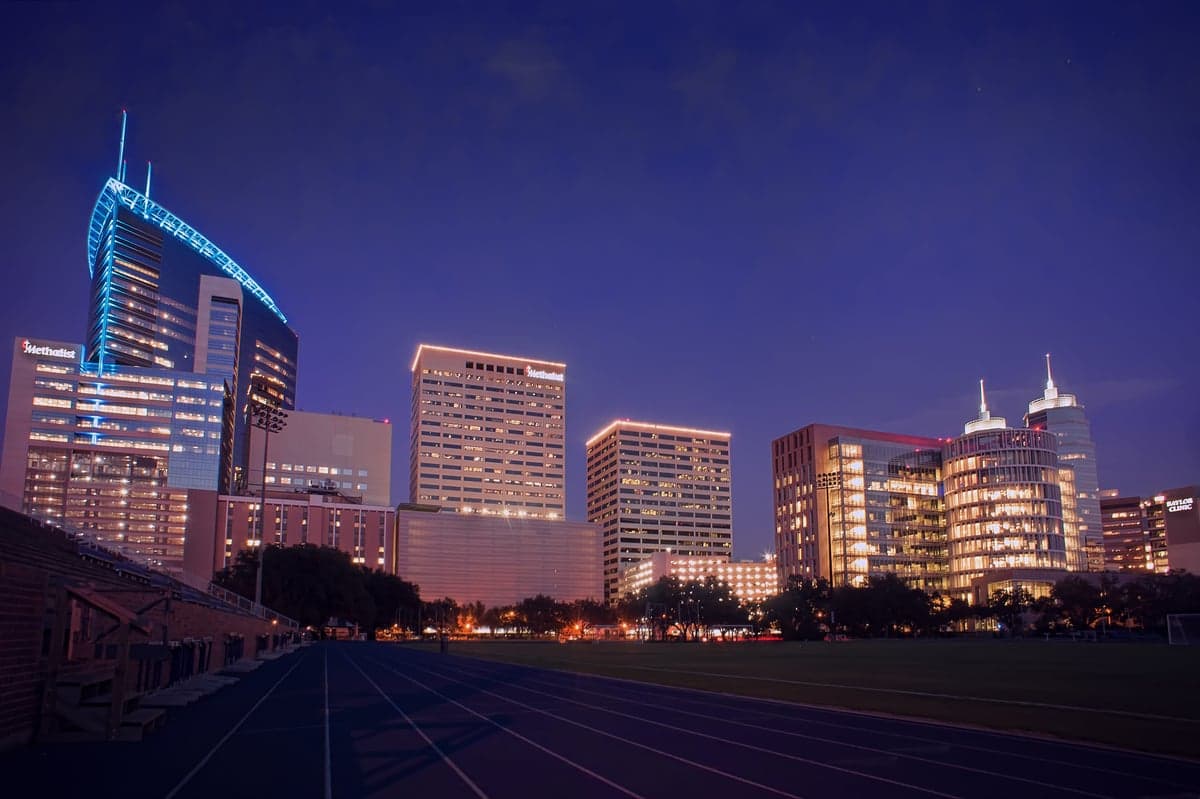
Photo: Wikipedia
Strategic Assessment of Houston, TX
High tactical risk. This location is likely close to major population centers, strategic targets, or sits in a high-disaster corridor. A retreat property and careful exit planning is required.
What does the Strategic Assessment tell us?
Our Strategic Assessment grades tactical survivability of an area. Major population centers, military targets, fallout zones, natural disasters, and border exposure all drive risk — lower exposure means a more defensible position in a crisis.
This is heavily inspired by Joel Skousen's Strategic Relocation book. Highly recommended you checkout the book ($)What does this tell us?
Our Strategic Assessment grades tactical survivability of an area. Major population centers, military targets, fallout zones, natural disasters, and border exposure all drive risk — lower exposure means a more defensible position in a crisis.
This is heavily inspired by Joel Skousen's Strategic Relocation book. Highly recommended you checkout the book ($)Strategic Pillars

Key Distances
Regional Safe Places
Below is our recommended "safe zones" in Texas and the surrounding area based on our strategic heuristics. For most people, it's unrealistic to live in a “safe zone” full-time due to work, family or other personal reasons. They tend to be more rural. However, many of these areas are perfect for second homes and retreat properties that double as a vacation home or even a short-term rental.

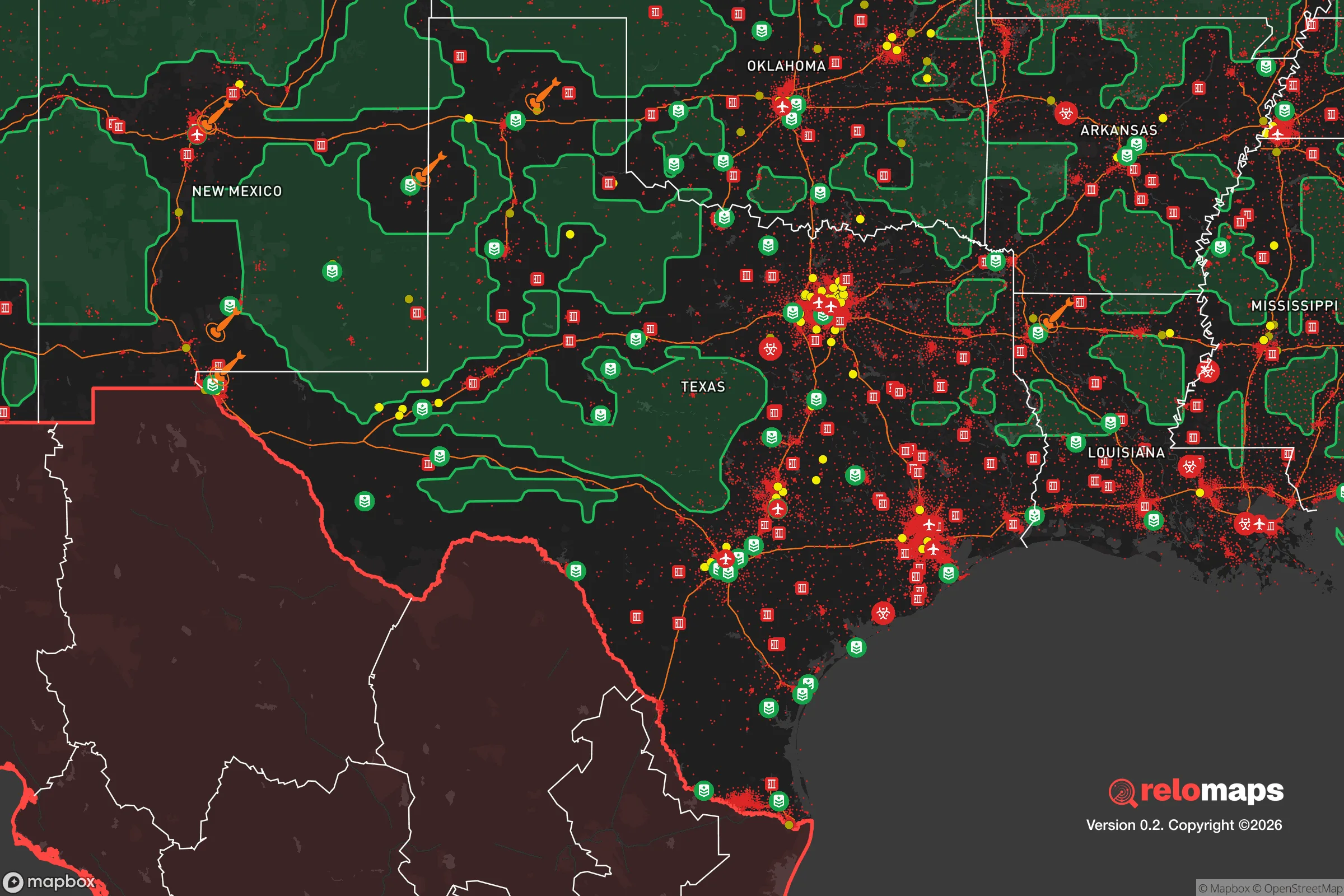


Important Note: For informational purposes only. This does not mean nothing bad ever happens in the green zones. Please use common sense. This is based on public data and modeled with AI. We tried to take a conservative approach but mistakes happen. We update this regularly as new information becomes available.
Solar Generator Recommendations
Backup power matters more here than in safer locations. We've picked three solar generators across budgets and capacity tiers — start with the budget unit if you only need a few essentials, or step up if you want to run a fridge and HVAC for days at a time.

Jackery Portable Power Station Explorer 300
Budget OptionPower on the Go: Weighing only 11 lbs, it's convenient to set up and store with book-sized foldable solar panels

BLUETTI Portable Power Station AC180
Designed for both indoor and outdoor scenarios, AC180 is highly capable as it has a robost capacity and continuous output power.

EF ECOFLOW DELTA Pro Ultra Power Station
Upgraded PickEcoFlow DELTA Pro Ultra is a whole-home energy system designed to grow with your family. Integrated with the Smart Home Panel 2, it scales to meet your evolving energy needs — keeping your home powered, intelligent, and secure through every stage of life.
We earn a commission, at no additional cost to you.
Strategic Assessment Analysis
Houston, Texas, presents a complex strategic picture for the conservative prepper or survivalist. While its massive size and proximity to the Gulf of Mexico offer undeniable logistical and resource advantages, those same factors create significant vulnerabilities that demand careful consideration. For a single individual or family prioritizing long-term resilience, Houston is not a retreat—it is a forward operating base with serious trade-offs, where the benefits of economic dynamism and energy independence must be weighed against the risks of population density, coastal exposure, and proximity to high-value government and industrial targets.
Geographic position and natural advantages for long-term survival
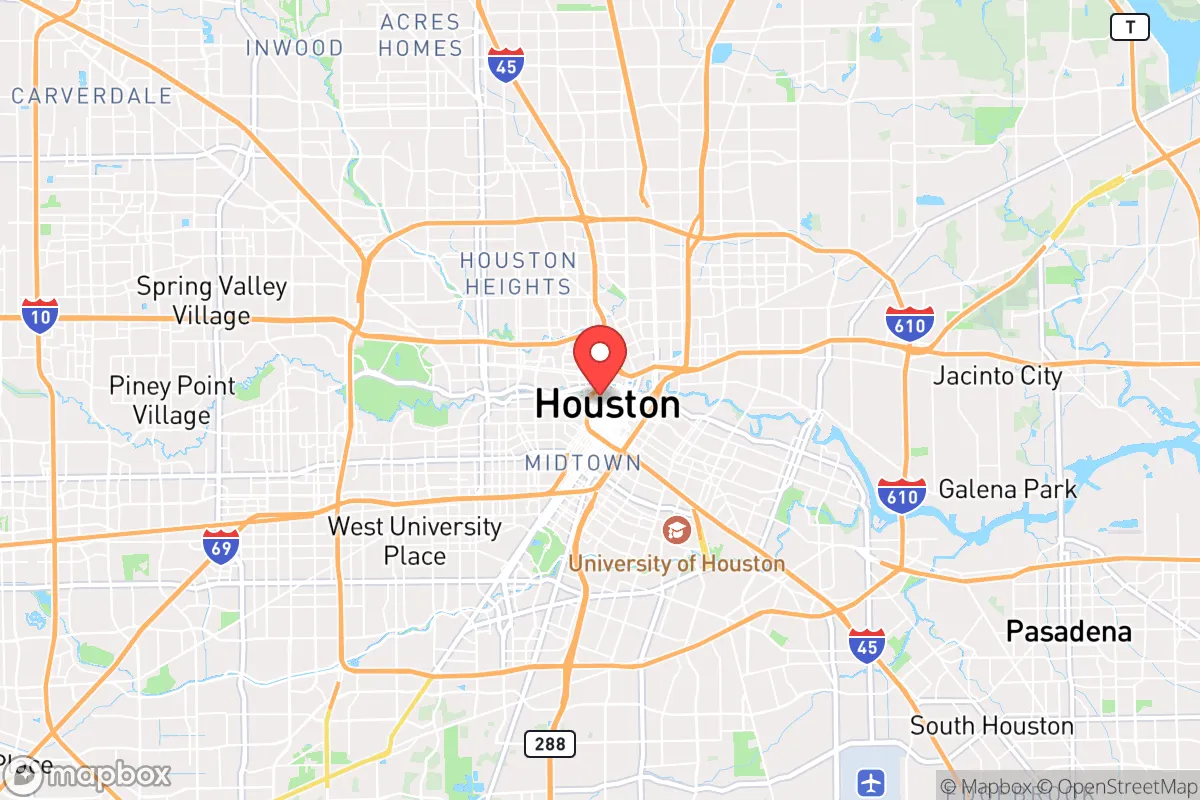
Houston’s geographic position is a double-edged sword. On the plus side, the city sits at the nexus of a vast energy and petrochemical complex, meaning access to refined fuels, industrial-grade equipment, and skilled labor is unmatched in the continental United States. The Port of Houston is a critical chokepoint for national supply chains, which in a crisis could translate into priority access to imported goods and materials. The region’s flat, coastal plain offers abundant groundwater and a long growing season—ideal for subsistence agriculture if you secure land outside the urban core. The city’s network of bayous and the Houston Ship Channel also provide alternative transportation routes for moving goods or people if highways become compromised. For a relocator, the key advantage is proximity to the Gulf Intracoastal Waterway and multiple interstate corridors (I-10, I-45, I-69), offering multiple egress options toward less populated areas in East Texas, Louisiana, or even the Hill Country to the west. The climate, while hot and humid, supports year-round food production and reduces heating fuel dependency in winter.
Risks, exposures, and proximity to fallout-relevant landmarks
The downsides are substantial and cannot be ignored. Houston is a prime target for both natural and man-made disruptions. Hurricane risk is existential—the city has been devastated by storms like Harvey (2017) and Ike (2008), and a major hurricane could collapse the grid, flood critical infrastructure, and trigger a mass evacuation that gridlocks every major highway. The petrochemical corridor along the Ship Channel is a high-value target for sabotage, terrorism, or military strike, with dozens of refineries and chemical plants that, if compromised, could release toxic plumes or cause cascading explosions. The city’s proximity to the Johnson Space Center and the Port of Houston also places it on any adversary’s target list. For the prepper, the sheer population density—over 7 million in the metro area—means that any major event will trigger a humanitarian crisis, with mass migration, resource hoarding, and civil unrest likely within days. The city’s sprawling, car-dependent layout makes it difficult to secure a defensible perimeter, and the flat terrain offers few natural chokepoints for controlling movement. Additionally, the area’s high water table and clay soils make underground bunkers or deep shelters impractical without significant engineering.
Practical resilience for a relocator: food, water, energy, and defensibility
For a relocator serious about self-sufficiency, Houston requires a deliberate, layered approach. Water is abundant but not clean—the city’s tap water comes from surface sources (Lake Houston, Lake Conroe) and is vulnerable to contamination from flooding or industrial spills. A robust filtration system (reverse osmosis, UV, or ceramic) is non-negotiable, and rainwater catchment is viable given the region’s 50+ inches of annual rainfall. Food production is feasible but land is expensive inside the urban core; look to exurban counties like Liberty, Waller, or Austin County for affordable acreage with good soil. The growing season is long enough for three crops per year of staples like corn, beans, and squash, but pest pressure and humidity require diligent management. Energy is a mixed bag: the grid is notoriously unreliable during storms (ERCOT’s failures are well-documented), but natural gas is cheap and plentiful. A backup generator with a 500-gallon propane tank or a solar array with battery storage is essential. Defensibility is the hardest challenge. Houston has no zoning laws, which means neighborhoods are a patchwork of uses—a blessing for blending in, but a curse for establishing a secure perimeter. The best strategy is to live on the urban fringe in a small, unincorporated community with a strong local network, where you can maintain a low profile and rely on mutual aid rather than police response (which is slow in the sprawl). Avoid high-visibility locations near major freeways, the Ship Channel, or the Galleria area, which will be looted first.
The overall strategic picture for Houston is one of high risk but high reward for the prepared relocator. It is not a place to ride out a societal collapse—the population density and target value are too great. However, it is an excellent location for a “gray man” strategy: a place to build wealth, acquire skills, and stockpile resources while maintaining a normal appearance. The key is to treat Houston as a staging ground, not a final destination. Have a bug-out plan to a secondary property in a lower-risk area (the Piney Woods of East Texas or the Hill Country are common choices), and keep a vehicle fueled and packed for a 48-hour evacuation. For the single individual or family who can afford the land and the gear, Houston offers the infrastructure to prepare—but only if you accept that you are living in a potential blast zone. The smart move is to use the city’s advantages to build your capability, then be ready to leave before the storm hits.

* Values derived from national, state, county, city and local statistics and may differ in a specific area. Last updated: 2026-04-13T20:13:33.000Z
Narrative content on this page is AI-generated and may contain mistakes. Verify any details that matter before acting on them.
ReloMaps may earn a commission from affiliate links at no extra cost to you.

