
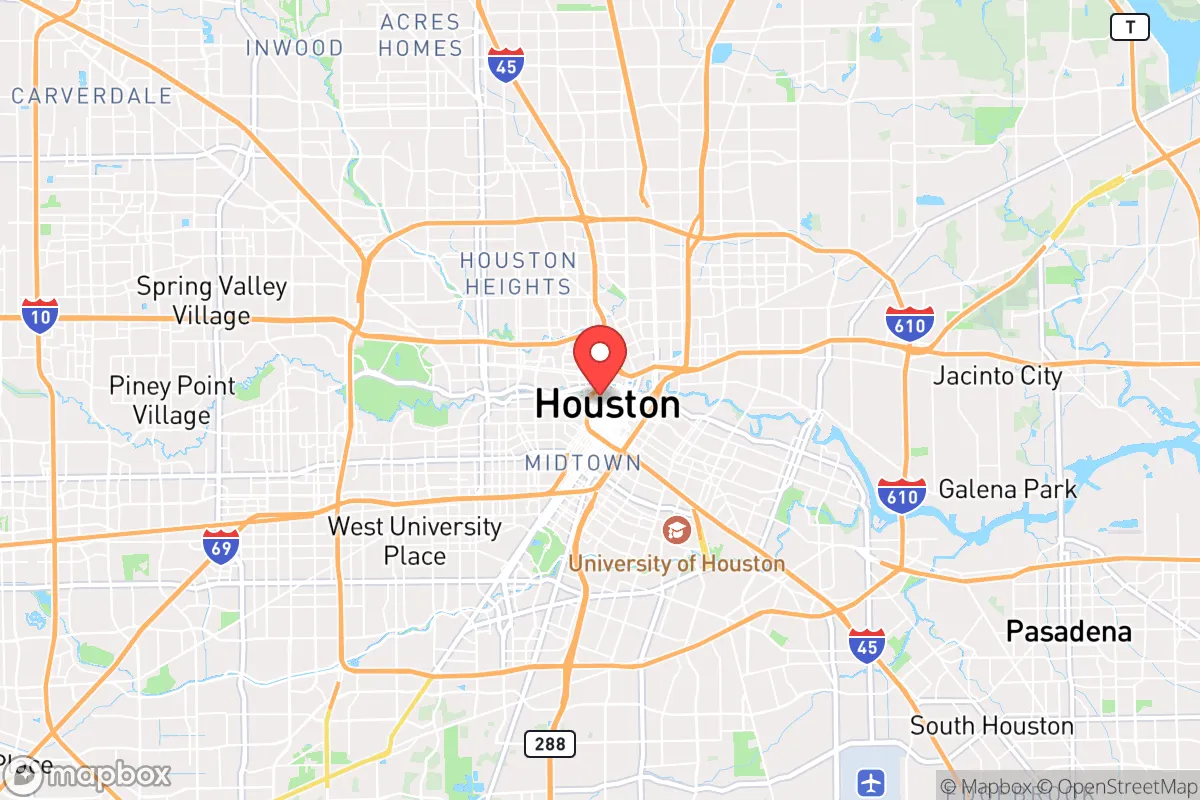
Photo: Wikipedia
Personal Sovereignty in Houston, TX
Viable for self-reliance. Generally workable, though some barriers may limit total independence.
What does Personal Sovereignty tell us?
Personal Sovereignty measures your capacity for self-reliance and independence with minimal government friction. Higher scores mean fewer barriers between you and the way you want to live... but it assumes you have the space you need and good neighbors.
What does this tell us?
Personal Sovereignty measures your capacity for self-reliance and independence with minimal government friction. Higher scores mean fewer barriers between you and the way you want to live... but it assumes you have the space you need and good neighbors.
State Policy
Energy independence: Net exporter (220% of energy produced in-state)
Personal Liberty
Homesteading

Personal Liberty Analysis
Houston, Texas, offers a personal sovereignty environment that is among the strongest in the United States for those who prioritize self-reliance and minimal government interference. The city’s sprawling geography, combined with Texas’s constitutional framework, creates a unique zone where individuals can exercise significant control over their lives, property, and security. While no major metropolitan area is free from regulatory friction, Houston’s lack of zoning laws, its status as a Second Amendment sanctuary city, and the state’s aggressive tax limitation policies make it a strategic base for those who view personal autonomy as the highest priority in an increasingly uncertain national landscape.
Tax burden and regulatory posture: How Texas law protects your wallet and choices
Texas’s absence of a state income tax is the cornerstone of its sovereignty appeal, and Houston residents benefit directly from this constitutional prohibition. The state’s reliance on property and sales taxes means that your earnings are not automatically siphoned before you see them—a critical advantage for those who distrust federal fiscal management. Harris County’s property tax rates are moderate for a major urban area, with effective rates around 2.0-2.2% of assessed value, but the Texas Taxpayer Bill of Rights and the state’s appraisal caps (10% annual increase for homesteads) provide a measure of predictability. The regulatory posture in Houston is notably laissez-faire compared to cities like Austin or Dallas. There are no citywide zoning ordinances, meaning you can operate a home business, keep livestock, or modify your property without navigating a thicket of land-use bureaucrats. This deregulated environment extends to occupational licensing, where Texas has rolled back many requirements that historically stifled entrepreneurship. For the prepper or survivalist, this means fewer barriers to establishing a self-sufficient operation—whether that’s a backyard workshop, a small farm, or a private training facility.
Self-defense and gun law specifics: What the Second Amendment actually looks like here
Houston is one of the most firearm-friendly major cities in America, and the legal framework supports a robust culture of armed self-defense. Texas law permits constitutional carry (permitless carry) for individuals 21 and older, meaning you can carry a handgun openly or concealed without a government-issued license. For those who still want a License to Carry (LTC), the process is straightforward and recognized in 36 states via reciprocity. The state’s “Stand Your Ground” law is unambiguous: you have no duty to retreat before using deadly force if you are lawfully present and reasonably believe force is necessary to prevent imminent death, great bodily harm, or a violent felony. This is not a theoretical protection—Harris County prosecutors have historically been reluctant to charge lawful self-defense shootings, though the current DA’s office has shown more progressive tendencies, so legal counsel is advised for any defensive incident. Magazine capacity restrictions do not exist in Texas, and suppressors are legal with a federal tax stamp. The city itself has a mixed record on gun violence, but the legal environment empowers law-abiding citizens to be their own first responders—a critical consideration when police response times in Houston’s sprawling suburbs can exceed 15 minutes.
Self-reliance and homesteading viability: Lot sizes, zoning, and off-grid feasibility
Houston’s lack of zoning is a game-changer for those seeking a homesteading lifestyle within a major metro. Residential lots in the outer suburbs and unincorporated Harris County can range from half an acre to several acres, with many subdivisions still allowing chickens, goats, and even small livestock. The city’s building codes are relatively permissive, and there are no blanket prohibitions on rainwater collection, solar panels, or composting toilets—though you’ll need to check specific municipal utility district (MUD) rules. Off-grid feasibility is highest in the exurban areas like Katy, Cypress, and Kingwood, where well water and septic systems are common. The Texas sun provides ample solar generation potential, and the state’s net metering policies allow you to sell excess power back to the grid. For the serious prepper, the ability to drill a private well, install a septic system, and generate your own power without city interference is a major sovereignty win. The biggest limitation is the Harris County floodplain regulations, which restrict where you can build and require elevation certificates—a necessary concession to the region’s hurricane risk. Overall, Houston offers a rare combination: urban job access with rural-level autonomy over your land.
Personal liberties: Parental rights, medical autonomy, speech, and property
Texas has positioned itself as a national leader in protecting parental rights, and Houston families benefit directly. The state’s Parents’ Bill of Rights, enacted in 2023, gives parents explicit authority over their children’s education, medical decisions, and moral upbringing. This means you can opt your child out of objectionable curriculum, access all school records, and refuse medical treatments without government override. Medical autonomy is a mixed bag: Texas has banned vaccine passports and prohibits employer mandates for COVID-19 vaccines, but the state’s medical board retains significant power over alternative treatments. For the sovereignty-minded, the key win is that you can refuse any medical intervention for yourself or your child without legal penalty, as long as it doesn’t constitute neglect. Free speech protections are robust under both the Texas Constitution and state law, which explicitly prohibits viewpoint discrimination on public property. Property rights are sacrosanct in Texas—eminent domain is tightly restricted, and the state’s “private property rights” laws make it difficult for local governments to impose restrictive covenants or land-use regulations without compensation. Houston’s lack of zoning means your property is truly yours to use as you see fit, within basic health and safety codes.
When measured against other major American cities, Houston stands out as a bastion of personal sovereignty for those who prioritize self-defense, economic freedom, and minimal government overreach. The combination of constitutional carry, no state income tax, no zoning, strong parental rights, and a legal culture that respects property ownership creates an environment where a determined individual can build a genuinely autonomous life. The trade-offs are real—traffic, humidity, flood risk, and the occasional progressive prosecutor—but for the survivalist or prepper who wants to be within striking distance of a global energy hub while maintaining maximum personal control, Houston offers a sovereignty profile that few other cities can match. It is not a libertarian utopia, but it is arguably the most freedom-respecting major metro in the United States today.

* Values derived from national, state, county, city and local statistics and may differ in a specific area. Last updated: 2026-04-13T20:13:33.000Z
Narrative content on this page is AI-generated and may contain mistakes. Verify any details that matter before acting on them.
ReloMaps may earn a commission from affiliate links at no extra cost to you.

