Photo: Wikipedia
Demographics of Houston, TX
Affluence Level in Houston, TX
A middle-class area roughly in line with national averages across income, home values, education, and employment.
People of Houston, TX
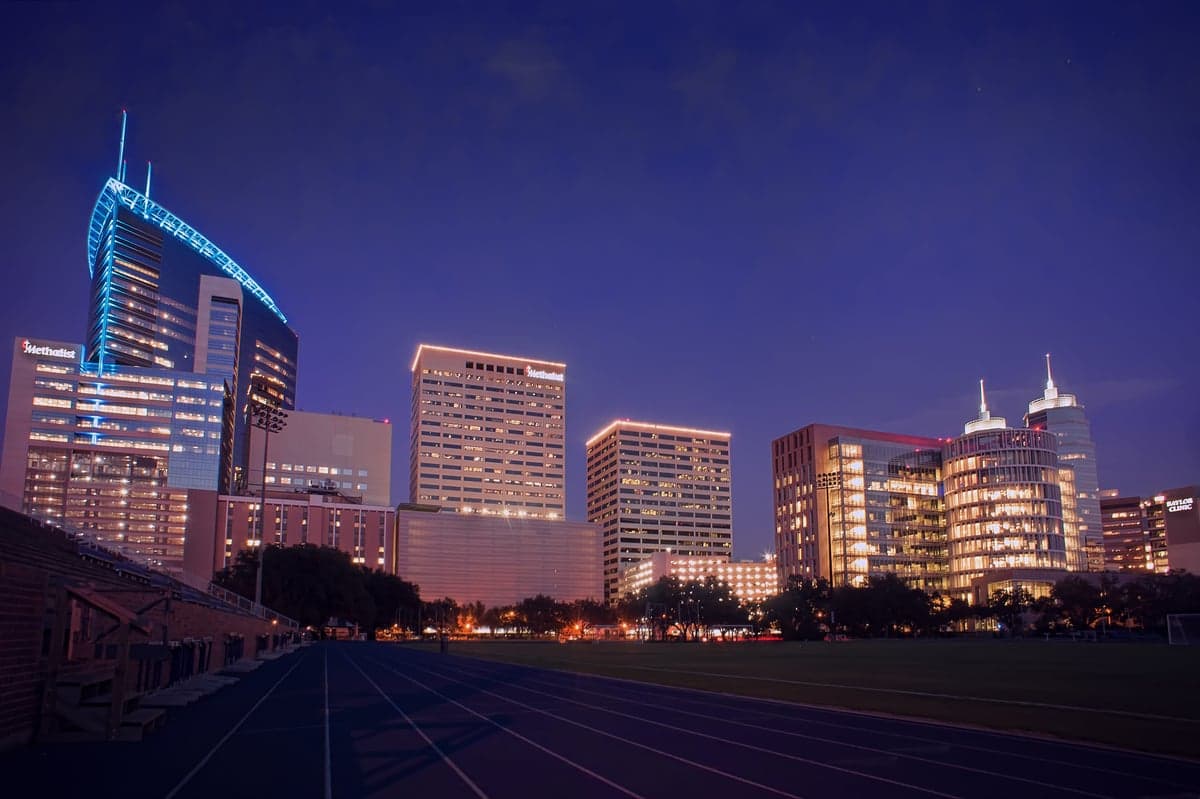
Houston today is a sprawling, majority-minority metropolis of 2.3 million people, defined by its extraordinary ethnic diversity and a distinctly pragmatic, opportunity-driven character. The city is 44.1% Hispanic, 23.6% White, 22.5% Black, 4.8% East/Southeast Asian, and 2.1% Indian, with 19.1% of residents foreign-born. It is a place where newcomers from across the globe and the American South have layered themselves atop one another, creating a dense patchwork of neighborhoods that reflect distinct waves of migration and economic ambition.
How the city was settled and grew
Houston was founded in 1836 by the Allen brothers, who marketed the swampy bayou as a commercial hub for the new Republic of Texas. The original population was a mix of Anglo-American settlers from the South, enslaved African Americans, and a small number of German and Irish immigrants who arrived via Galveston. The city’s first major growth spurt came after the 1901 Spindletop oil strike, which drew a wave of white and Black laborers from the rural South and Midwest. By the 1920s, the Fifth Ward had become a thriving Black commercial and residential district, while the Heights attracted German and Eastern European working-class families. The post-World War II boom, fueled by the petrochemical industry and the Johnson Space Center, brought another surge of white and Black migrants from Louisiana and East Texas, settling into neighborhoods like Sharpstown and Meyerland.
Modern era (post-1965)
The 1965 Hart-Celler Act fundamentally reshaped Houston’s population. The city’s oil-and-medicine economy drew large numbers of immigrants from Asia and Latin America. Bellaire and the Chinatown area on Bellaire Boulevard became the primary landing zone for East and Southeast Asian communities—primarily Chinese, Vietnamese, and Filipino—who now make up 4.8% of the city’s population. A separate, significant Indian-subcontinent population (2.1%) concentrated in West Houston and Katy, building temples and professional networks around the Energy Corridor. Meanwhile, domestic migration shifted: white flight to suburbs like The Woodlands and Sugar Land accelerated after the 1970s, while Black residents moved from the historic Third and Fifth Wards into Alief and Missouri City. Hispanic immigration—both from Mexico and Central America—swelled the city’s share from roughly 18% in 1980 to 44.1% today, with Gulfton and Southwest Houston becoming dense, working-class enclaves. The city’s foreign-born share (19.1%) is now higher than the national average, and Houston is one of the most ethnically diverse major cities in the United States.
The future
Houston’s population is trending toward further diversification, but with increasing geographic sorting by ethnicity and income. The Hispanic share is projected to continue rising, driven by both immigration and higher birth rates, while the White share (23.6%) is likely to decline further as suburbanization continues. The East/Southeast Asian and Indian populations are growing steadily, particularly in the western suburbs (Katy, Sugar Land) and near the Energy Corridor, where professional-class families are drawn to good schools and tech-sector jobs. The Black population share has plateaued at around 22.5%, with some out-migration to Atlanta and Dallas for economic reasons. Gentrification is reshaping inner-ring neighborhoods like the Third Ward and EaDo (East Downtown), displacing long-time Black and Hispanic residents while attracting younger, higher-income newcomers. The city is not homogenizing; rather, it is tribalizing into distinct ethnic corridors—Hispanic Southwest, Asian West, Black Southeast, and White outer-ring suburbs—with less mixing than the city’s overall diversity numbers suggest.
For someone moving to Houston now, the city offers a high degree of ethnic choice and economic opportunity, but also a landscape where where you live strongly predicts who your neighbors are. The city’s character remains that of a restless, immigrant-fueled boomtown—pragmatic, car-dependent, and culturally fragmented—where newcomers can find a ready-made community but may struggle to find a single, cohesive civic identity. The next decade will likely see continued growth in the Asian and Hispanic enclaves, steady Black population share, and a shrinking but still influential White professional class in the suburbs and gentrifying core.

* Values derived from national, state, county, city and local statistics and may differ in a specific area. Last updated: 2026-04-13T20:13:33.000Z
Narrative content on this page is AI-generated and may contain mistakes. Verify any details that matter before acting on them.
ReloMaps may earn a commission from affiliate links at no extra cost to you.

