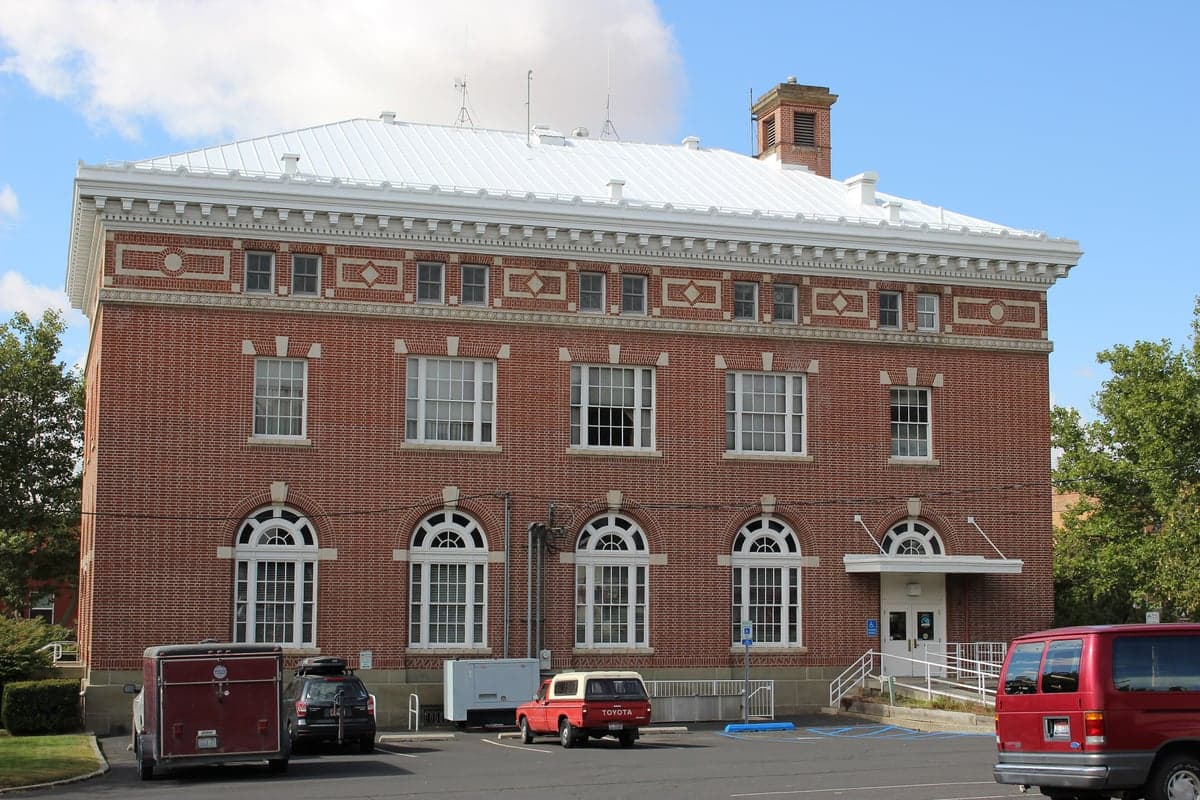
Photo: Wikipedia
Political ClimatePolitical Climate in Latah County
Showing district-level results — no local-only data available.
Local Political AnalysisPolitical Analysis of Latah County
Latah County is a striking political outlier in deep-red Idaho, voting reliably Democratic in presidential elections even as the state as a whole has moved sharply right. While Idaho carries a Cook PVI of R+18, Latah County’s PVI of R+22 might seem contradictory, but that number reflects the county’s conservative rural precincts relative to the nation; in practice, the county’s urban core—Moscow—has voted blue in every presidential election since 2000, often by double digits. The 2020 results tell the story: Joe Biden won Latah County with 52.5% of the vote, while Donald Trump carried Idaho with 63.9%. That 11-point gap between county and state is the largest in Idaho, driven almost entirely by the University of Idaho’s presence in Moscow.
How it compares
Latah County’s political geography is a textbook case of the urban-rural divide. Moscow, home to roughly half the county’s population, leans heavily Democratic—precincts near the university campus routinely deliver 70-80% of the vote to Democratic candidates. In contrast, the county’s smaller towns and unincorporated areas vote overwhelmingly Republican. Troy, with about 900 residents, went for Trump by a 2-to-1 margin in 2020. Potlatch, a former timber town of 800, voted similarly. The swing precincts are in the rural-urban fringe around Moscow, particularly along the Paradise Ridge area, where moderate voters can tip local races. Statewide, Idaho’s Republican dominance is so entrenched that Latah County’s Democratic lean has little effect on state-level outcomes—the county’s two state representatives and one senator are all Republicans, though they tend to be more moderate than their colleagues from eastern Idaho. The county’s PVI of R+22, compared to the state’s R+18, actually understates the local divide: Latah County is more conservative than the state average in its rural parts, but its urban core is far more liberal than any other Idaho city of comparable size.
What this means for residents
For liberal residents, Latah County offers a rare blue oasis in a red state. Moscow’s city council and school board are reliably progressive, and the university provides a steady influx of like-minded people. Local policies reflect this: Moscow has a non-discrimination ordinance protecting LGBTQ+ residents, a plastic bag ban, and a strong focus on pedestrian and bike infrastructure. Conservative residents, particularly in Troy and Potlatch, often feel their values are sidelined in countywide decisions, but they dominate the Latah County Republican Central Committee and have real influence over local GOP primaries. The practical effect is a constant, low-grade tension over land use, school funding, and public health mandates—the county commission, currently split 2-1 Republican, often clashes with Moscow’s city council. For newcomers, the key takeaway is that your experience of Latah County’s politics depends almost entirely on where you live: Moscow feels like a Pacific Northwest college town, while the rest of the county resembles rural Idaho.
Culturally, this split means Latah County residents navigate two distinct worlds. Moscow’s farmers market, art walks, and university lectures coexist with 4-H livestock shows and NRA-certified shooting ranges in the county’s smaller communities. The county’s political trajectory is toward greater polarization: as the university grows and attracts out-of-state students and faculty, Moscow’s blue tint deepens, while the rural precincts hold steady or drift rightward. Longtime locals will tell you that twenty years ago, a moderate Republican could win countywide office; today, that’s nearly impossible. The near-term future likely means more of the same—a blue island in a red state, with the cultural and policy friction that implies.

State Political ClimatePolitical Climate in Idaho
State Political AnalysisPolitical Environment in the State
Idaho is one of the most reliably Republican states in the nation, carrying a Cook PVI of R+18, meaning it votes about 18 points more Republican than the country as a whole. The state hasn't voted for a Democratic presidential candidate since 1964, and that margin has only widened in recent cycles—Donald Trump won the state by 31 points in 2020 and by roughly 37 points in 2024. The dominant coalition is a mix of native-born conservatives, Mormon voters in the southeast, and a massive wave of out-of-state transplants from California, Washington, and Oregon who have moved here specifically for lower taxes and a less restrictive regulatory environment.
Urban vs. rural divide
The political map of Idaho is a textbook case of the urban-rural split, but with a twist: even the "cities" here lean right compared to their counterparts elsewhere. The Treasure Valley, anchored by Boise, Meridian, and Nampa, is the population engine and the state's political battleground. Boise itself has drifted left—Ada County went for Trump by only 3 points in 2020, and the city proper has elected Democratic mayors—but the surrounding suburbs like Meridian and Caldwell remain solidly conservative, keeping the county red overall.
Outside the Treasure Valley, the map is a sea of deep red. Idaho Falls and Rexburg in the east anchor a heavily LDS region that votes Republican at rates approaching 80 percent. Coeur d'Alene and the northern panhandle are more competitive—Kootenai County has a strong libertarian streak and has seen some close races—but it still leans right. The truly rural counties, like Lemhi and Clark, routinely go 85-90 percent Republican. The only reliably blue pockets are the college towns: Moscow, home to the University of Idaho, and parts of Boise's North End. If you're moving to Idaho expecting a purple state, you'll be disappointed—the rural vote simply overwhelms the urban centers.
Policy environment
Idaho's policy environment is built around a simple proposition: keep government small, taxes low, and regulations light. There is no state income tax on Social Security benefits, and the flat income tax rate was cut to 5.8 percent in 2024, with a path toward further reductions. Property taxes are local and relatively modest, though they've crept up as home values have skyrocketed. The state is a "right-to-work" state, meaning union membership is optional, and it has some of the weakest labor protections in the country.
On education, Idaho is a mixed bag. The state spends near the bottom nationally per pupil, and teacher salaries rank in the lower third. However, the 2024 legislature passed a $1 billion school facilities fund and expanded the state's "empowerment scholarship" program, which provides tax credits for private school tuition. Healthcare is where things get interesting: Idaho has not expanded Medicaid under the Affordable Care Act, though voters passed a ballot initiative in 2018 to do so, which the legislature then partially rolled back. The state has some of the most restrictive abortion laws in the nation, with a near-total ban passed in 2020 that took effect after the Dobbs decision in 2022.
Recent policy direction
The last five years have seen Idaho lurch decisively to the right, and the 2025 legislative session doubled down. On guns, Idaho is a constitutional carry state—no permit needed to carry concealed—and in 2024 it passed a "Second Amendment Sanctuary" law that prohibits state enforcement of federal gun restrictions. On parental rights, the state passed the "Parental Rights in Education" law in 2023, which restricts classroom discussion of gender identity and sexual orientation in grades K-3, and a 2024 law requires schools to notify parents of any changes to a student's gender identity.
On speech and privacy, Idaho passed a law in 2024 requiring age verification for adult websites and has been aggressive in suing the federal government over data surveillance programs. Property rights are strongly protected—the state has a "right to farm" law that shields agricultural operations from nuisance lawsuits, and it passed a 2023 law restricting foreign ownership of agricultural land. On voting, Idaho requires a photo ID to vote, has same-day voter registration, and in 2024 passed a law requiring hand-counting of ballots in some rural counties, which has drawn criticism from election integrity groups. The trajectory is clear: Idaho is moving toward a maximalist version of conservative governance, and the legislature shows no signs of slowing down.
Civil unrest & political movements
Idaho has a visible and organized activist scene on both ends of the spectrum, though the right is far more prominent. The state has been a hub for the "constitutionalist" movement—the Ammon area, just east of Idaho Falls, gained national attention in 2014 when a group of armed citizens staged a standoff with federal agents over grazing rights. The Ruby Ridge incident in 1992, which occurred just across the border in northern Idaho, still looms large in the state's political memory and fuels a persistent strain of anti-federal sentiment.
On the left, Boise has seen recurring protests over abortion restrictions and LGBTQ rights, with the 2024 "Transgender Visibility" rally drawing several thousand attendees. Immigration politics are tense but not explosive—Idaho has no sanctuary cities, and the legislature passed a law in 2024 requiring local law enforcement to cooperate with federal immigration authorities. The state has seen a steady influx of conservative migrants from California, which has shifted the political center of gravity even further right, but it has also created friction between newcomers and long-time residents over housing costs and cultural change. You'll see "Don't California My Idaho" bumper stickers, but the reality is that the newcomers are often more conservative than the natives.
Projection
Looking ahead five to ten years, Idaho is likely to get more Republican, not less. The state is growing faster than almost any other in the nation—it added over 100,000 residents between 2020 and 2024—and the vast majority of that growth is from domestic migration, not births. These migrants are disproportionately conservative, drawn by the tax structure and cultural climate. The Boise metro will continue to drift left as it urbanizes, but the rural counties will keep their overwhelming margins, and the legislature's rural bias (each county gets at least one representative regardless of population) ensures that conservative control is structurally entrenched.
The wildcard is the libertarian strain. Idaho has a strong "leave me alone" ethos that sometimes clashes with the social conservative agenda—the 2024 hand-counting law, for example, was opposed by some rural county clerks who saw it as an unfunded mandate. If the legislature overreaches on social issues, you could see a split between the "live and let live" libertarians and the "family values" social conservatives. But for now, the two factions are united by a shared distrust of federal power, and that's not going away.
For a new resident, the bottom line is this: if you're conservative, you'll find Idaho to be a place where your values are reflected in law and culture, and you'll have a genuine voice in how things are run. If you're liberal, you'll be in a distinct minority, and you'll need to accept that your vote will rarely be decisive—but you'll also find that the state's libertarian streak means you're largely left alone to live your life. The housing market is tight and getting tighter, especially in the Treasure Valley, but the trade-off is a state that is stable, safe, and politically predictable. Idaho is not a place of political drama; it's a place where the conservative consensus is so settled that the real debates are about how fast to move, not which direction.
* Values derived from national, state, county, city and local statistics and may differ in a specific area. Last updated: 2026-08-25T13:55:50.000Z
Narrative content on this page is AI-generated and may contain mistakes. Verify any details that matter before acting on them.
ReloMaps may earn a commission from affiliate links at no extra cost to you.

