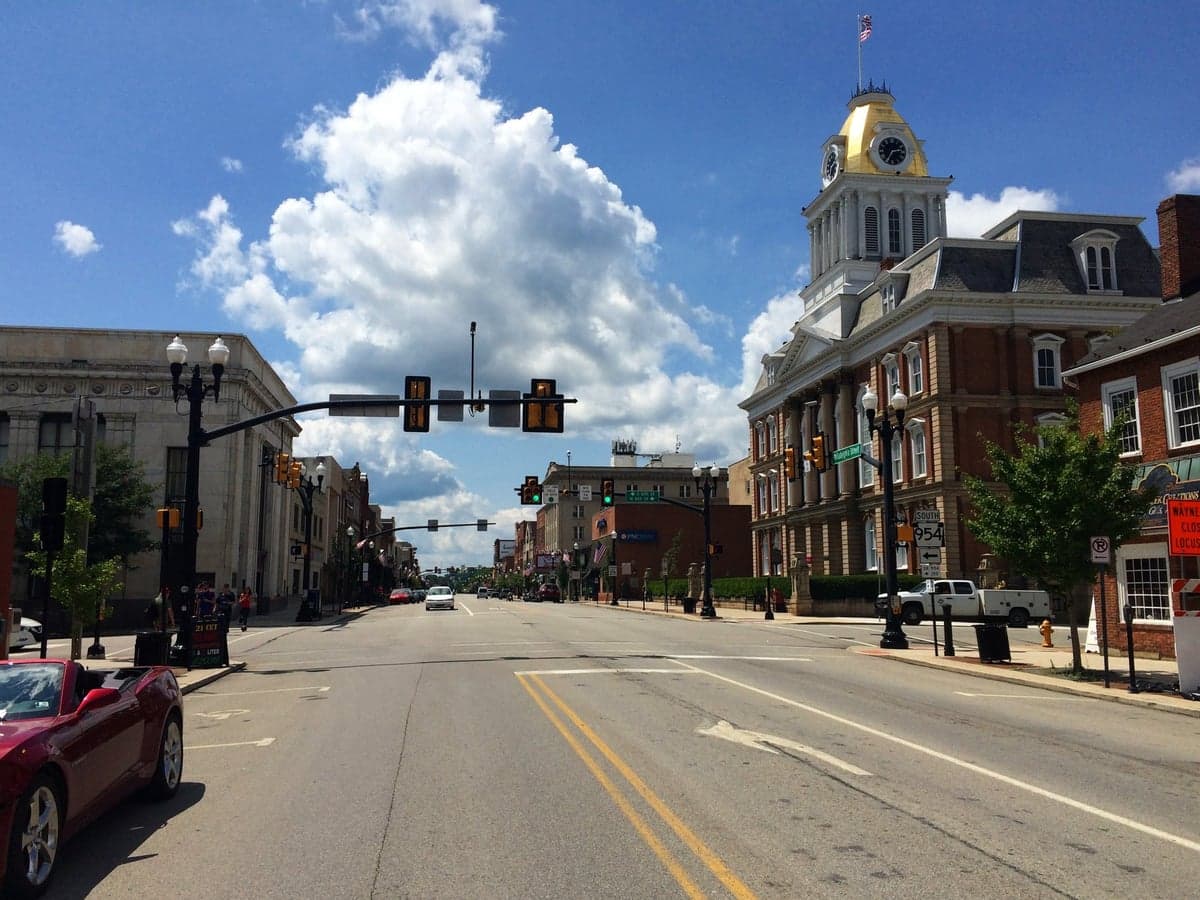
Photo: Wikipedia
Demographics of Indiana, PA
Affluence Level in Indiana, PA
A below-average socioeconomic profile. Incomes, home values, and educational attainment trail the U.S., with higher poverty and unemployment.
People of Indiana, PA
The people of Indiana, Pennsylvania, today form a tight-knit, predominantly white college town of 14,170 residents, anchored by Indiana University of Pennsylvania (IUP) and a strong sense of local heritage. The city is notably well-educated, with 51.0% of adults holding a bachelor's degree or higher, yet it retains a small-town, family-oriented character distinct from larger Pennsylvania metros. The population is overwhelmingly native-born (97.2%), with a modest foreign-born share of 2.8%, and the community is characterized by a blend of long-standing local families, university faculty and staff, and students who often put down roots after graduation.
How the city was settled and grew
Indiana was founded in 1805 as the seat of Indiana County, drawing its first wave of settlers—primarily Scots-Irish and German farmers—who were granted land in the fertile valleys of the region. These early families established the town's agricultural base and built the original homes and churches in the Downtown Historic District, centered around Philadelphia Street and the courthouse square. The arrival of the Pennsylvania Railroad in the 1850s spurred a second wave of growth, bringing Irish and Italian laborers who settled in the working-class East End neighborhood, building row houses and small cottages near the rail yards. The founding of Indiana State Normal School (now IUP) in 1875 transformed the town's character, drawing faculty and students from across the state and creating a demand for boarding houses and new housing in the College Hill area, where many professors built Victorian homes that still stand today. By the early 20th century, the discovery of coal and natural gas in the surrounding county brought a small influx of Eastern European miners, who settled in the South Side along Wayne Avenue, though Indiana itself remained primarily a service and education hub rather than a mining town.
Modern era (post-1965)
The post-1965 era saw Indiana's population stabilize as the coal industry declined and IUP became the dominant economic force. The city's white population remains high at 87.6%, reflecting limited in-migration from outside the region. The Black population, at 5.5%, is concentrated in the West End neighborhood, a legacy of mid-20th-century African American families who moved to Indiana for work at the university and local hospitals. The Hispanic population (2.4%) and East/Southeast Asian community (0.7%) are small but visible, with many Asian residents affiliated with IUP as international students or faculty, living in rental properties near campus on Oakland Avenue and Pratt Drive. The Indian-subcontinent population (0.4%) is similarly tied to the university, with families often settling in the newer subdivisions of North Hills for their larger homes and good school access. Suburbanization has been limited within city limits, as most new residential development since the 1990s has occurred in adjacent White Township, leaving Indiana's historic neighborhoods largely intact but aging.
The future
Indiana's population is projected to remain stable or decline slightly over the next decade, as the city's housing stock is constrained and younger families continue to move to outlying townships. The foreign-born share (2.8%) is unlikely to grow significantly, as the city lacks the industrial or service-sector jobs that attract larger immigrant populations in other Pennsylvania cities. The white population will likely remain dominant, though the Black and Hispanic shares may inch upward as IUP continues modest diversity recruitment efforts. The city is not tribalizing into distinct ethnic enclaves; rather, the small minority populations are dispersed, with the strongest clustering remaining among Black residents in the West End and international students near campus. For someone moving in now, Indiana offers a stable, safe, and education-focused community where the population is aging slowly, and new arrivals are most likely to be retirees, remote workers, or university employees seeking a low-cost, walkable town with strong schools and a conservative-leaning cultural baseline.
Indiana is becoming a quieter, more residential version of its former self—a college town where the student population still brings energy, but the permanent residents are increasingly homeowners and families who value stability, safety, and tradition. For a conservative-leaning individual or parent, this means a community with low crime, strong public schools, and a population that is unlikely to undergo rapid demographic change, making it a predictable and family-friendly place to put down roots.

* Values derived from national, state, county, city and local statistics and may differ in a specific area. Last updated: 2026-05-01T08:33:18.000Z
Narrative content on this page is AI-generated and may contain mistakes. Verify any details that matter before acting on them.
ReloMaps may earn a commission from affiliate links at no extra cost to you.

