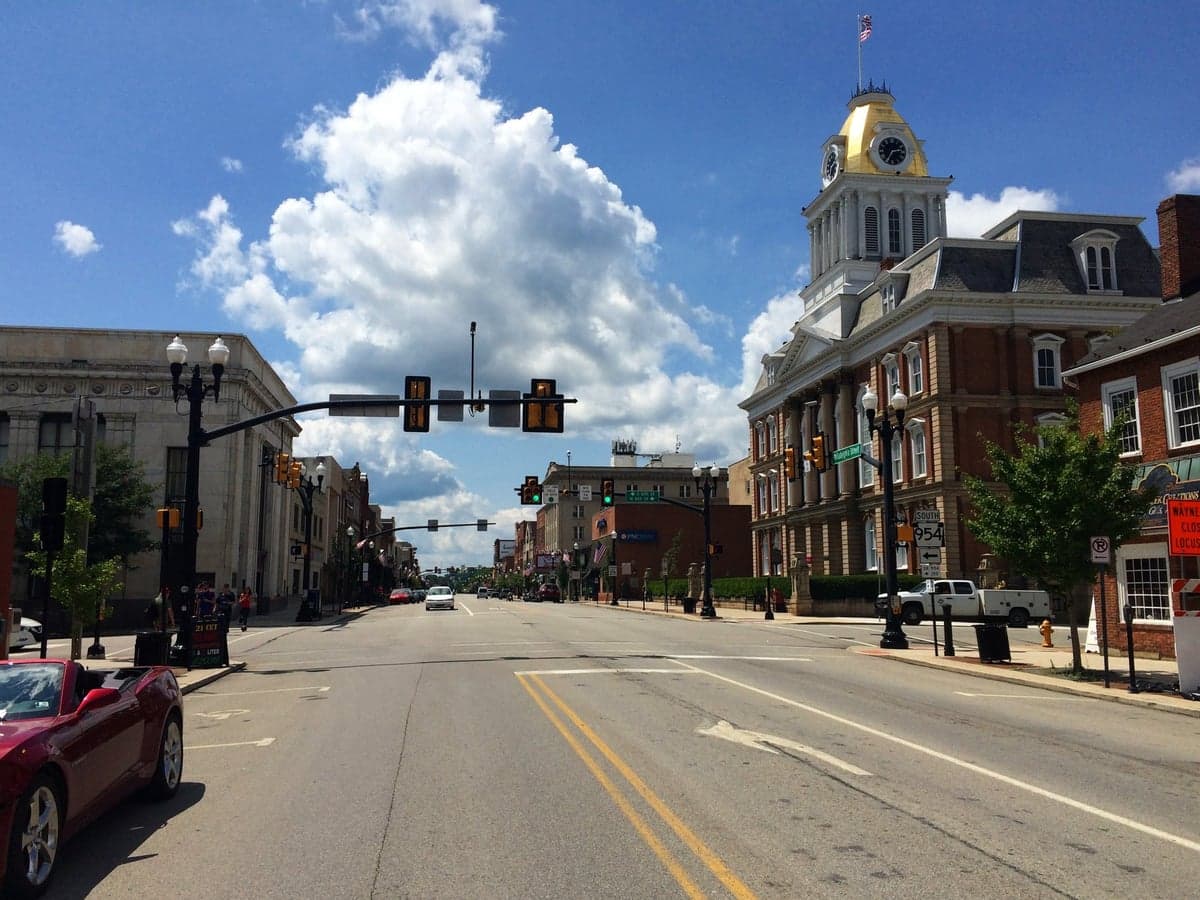
Photo: Wikipedia
Personal Sovereignty in Indiana, PA
Strong independent fundamentals that actively favor personal liberty and low regulation.
What does Personal Sovereignty tell us?
Personal Sovereignty measures your capacity for self-reliance and independence with minimal government friction. Higher scores mean fewer barriers between you and the way you want to live... but it assumes you have the space you need and good neighbors.
What does this tell us?
Personal Sovereignty measures your capacity for self-reliance and independence with minimal government friction. Higher scores mean fewer barriers between you and the way you want to live... but it assumes you have the space you need and good neighbors.
State Policy
Energy independence: Net exporter (150% of energy produced in-state)
Personal Liberty
Homesteading

Personal Liberty Analysis
Indiana, Pennsylvania, offers a notably high degree of personal sovereignty compared to many areas in the Northeast, largely due to Pennsylvania’s status as a “state preemption” jurisdiction for firearms and its relatively light-touch regulatory environment outside of major cities. For a single individual or family operating from a survivalist or prepper mindset, the town provides a strategic balance: it sits in a rural county (Indiana County) with a strong tradition of self-reliance, yet remains within striking distance of larger medical and supply hubs like Pittsburgh. The key question for anyone prioritizing autonomy here is whether the state-level legal framework and local culture genuinely support the kind of independent, low-interference lifestyle that conservative-leaning individuals seek. The answer is largely yes, but with specific caveats around property use and local zoning that require careful navigation.
Tax burden and regulatory posture: How much does the state take and restrict?
Pennsylvania’s tax structure is a mixed bag for those seeking to maximize retained income and minimize government entanglement. The state levies a flat personal income tax of 3.07%, which is among the lowest flat rates in the nation, and there is no tax on military pensions or Social Security benefits—a significant plus for retirees or those planning for long-term resilience. However, the state’s sales tax is 6%, and Indiana County adds a local 1% sales tax, bringing the total to 7% on most goods (food and clothing are exempt). Property taxes in Indiana County are moderate: the millage rate for the county itself is around 5.5 mills, but when combined with school district and municipal taxes, effective rates typically land between 20 and 30 mills on assessed value. For a $200,000 home, that translates to roughly $4,000–$6,000 annually—not trivial, but far lower than in neighboring New York or New Jersey. The regulatory posture is where Indiana shines for the prepper: Pennsylvania has no state-level building code enforcement in most rural townships (only the Uniform Construction Code applies in municipalities that adopt it), meaning you can often build sheds, barns, or even small dwellings without permits in unzoned areas. The state also has no annual vehicle inspection for emissions in Indiana County (it’s a “non-emissions” county), and no state income tax on capital gains beyond the flat rate. For someone looking to minimize bureaucratic friction, Indiana County’s regulatory environment is permissive, though you must still contend with federal EPA rules on wetlands and the state’s Department of Environmental Protection for any significant earth disturbance.
Self-defense and gun law specifics: What are the actual rules for carrying and storing firearms?
Pennsylvania is a “shall issue” state for concealed carry permits, meaning Indiana County’s sheriff must issue a License to Carry Firearms (LCF) to any applicant who passes a background check and is not prohibited by law—no subjective “good cause” requirement. The process is straightforward: apply in person at the sheriff’s office, pay a fee (typically $20–$25), and receive the permit within 45 days. Open carry is legal without a permit anywhere in the state except Philadelphia, and vehicle carry is legal without a permit as long as the firearm is in the glove compartment or center console (not on your person). For the prepper, the key advantage is that Pennsylvania has strong state preemption laws: no municipality, including Indiana Borough, can pass its own gun restrictions that are stricter than state law. This means you won’t face local bans on “assault weapons” or magazine capacity limits, as you would in cities like Pittsburgh or Philadelphia. Stand-your-ground laws are in effect—there is no duty to retreat in any place where you are lawfully present—and the Castle Doctrine applies to both your home and your vehicle. One nuance: Pennsylvania does not recognize out-of-state concealed carry permits from all states, so if you travel frequently, check reciprocity maps. For storage, there is no state law requiring gun safes or trigger locks, though federal law applies to dealers. Overall, Indiana County is a stronghold for Second Amendment rights, with a sheriff’s office that is generally pro-owner and a local culture that treats firearms as normal tools for self-defense and hunting.
Self-reliance and homesteading viability: Lot sizes, zoning, and off-grid feasibility
For the survivalist looking to establish a homestead, Indiana County offers some of the best conditions in the state. Outside of the borough limits of Indiana itself, most townships have minimal or no zoning ordinances. In townships like White, Center, or Armstrong, you can typically buy a 2- to 5-acre lot for $10,000–$30,000, and there are no county-level restrictions on keeping chickens, goats, or even a few head of cattle. Off-grid living is legally feasible: Pennsylvania has no state law requiring connection to the electrical grid, and many rural properties already rely on well water and septic systems. Solar panels are allowed without special permits in most townships, though you must follow the state’s Uniform Construction Code for structural mounting. The biggest hurdle is the Pennsylvania Department of Environmental Protection (DEP) for any water or sewage work—you must obtain a permit for a new well or septic system, and the process can take 2–4 months. Rainwater collection is legal and unregulated at the state level, though some townships may have local rules. For gardening and food production, the growing season is about 150 days (May to October), and the soil in Indiana County is generally loamy and fertile, especially in the Conemaugh River valley. The county also has a strong network of farm supply stores and feed mills, making it easy to source seeds, tools, and livestock feed. For the prepper, the main limitation is the cold winters: average January lows are around 18°F, so any off-grid setup must include robust heating (wood stoves are common) and freeze-proof water lines. Overall, Indiana County is highly viable for a self-reliant lifestyle, provided you buy land in an unzoned township and budget for the DEP permitting process.
Personal liberties: Parental rights, medical autonomy, speech, and property
Pennsylvania’s legal framework for personal liberties is a mixed landscape, but Indiana County’s local culture leans heavily toward individual freedom. On parental rights, the state has no “parental bill of rights” law like some conservative states, but the Pennsylvania Supreme Court has long recognized parents’ fundamental right to direct their children’s upbringing. In practice, Indiana County’s school districts (Indiana Area, Homer-Center, etc.) are generally deferential to parents on issues like curriculum objections and medical decisions, though you should expect standard state-mandated vaccinations for school attendance (medical and religious exemptions are available, but philosophical exemptions are not). Medical autonomy is more constrained: Pennsylvania has no law explicitly protecting the right to refuse medical treatment, and the state’s Department of Health has broad emergency powers (as seen during COVID-19). However, Indiana County’s rural character means that alternative medicine practitioners and holistic health providers are available, and there is a strong local network of chiropractors and naturopaths. On speech and property rights, the state has no “right-to-farm” law that specifically protects agricultural operations from nuisance lawsuits, but Indiana County’s zoning is so permissive that property disputes are rare. The biggest threat to property rights comes from the state’s use of eminent domain for pipeline projects (the Mariner East pipeline runs through the county), which has been a source of tension. For the prepper, the key takeaway is that while Pennsylvania’s state-level laws are not as aggressively pro-liberty as, say, Texas or Montana, the local enforcement in Indiana County is lax, and the community is largely self-policing. You can speak your mind at town hall meetings, post signs on your property, and keep to yourself without government interference—as long as you don’t draw attention from the DEP or the state police.
In the broader context of personal sovereignty, Indiana, PA, ranks as a strong mid-tier option for the conservative prepper. It lacks the constitutional protections of a state like Alaska or New Hampshire, but it offers a far more permissive environment than most of the Northeast, especially when compared to New York, New Jersey, or Massachusetts. The combination of low taxes, strong gun rights, minimal zoning, and a culture of self-reliance makes it a viable base for anyone looking to build a resilient, independent lifestyle. The main trade-offs are the cold winters, the need to navigate DEP permitting for off-grid systems, and the ever-present risk of state-level overreach during emergencies. For a single individual or family willing to put in the work, Indiana County provides a solid foundation for sovereignty—just don’t expect the state to stay out of your way entirely.

* Values derived from national, state, county, city and local statistics and may differ in a specific area. Last updated: 2026-05-01T08:33:18.000Z
Narrative content on this page is AI-generated and may contain mistakes. Verify any details that matter before acting on them.
ReloMaps may earn a commission from affiliate links at no extra cost to you.

