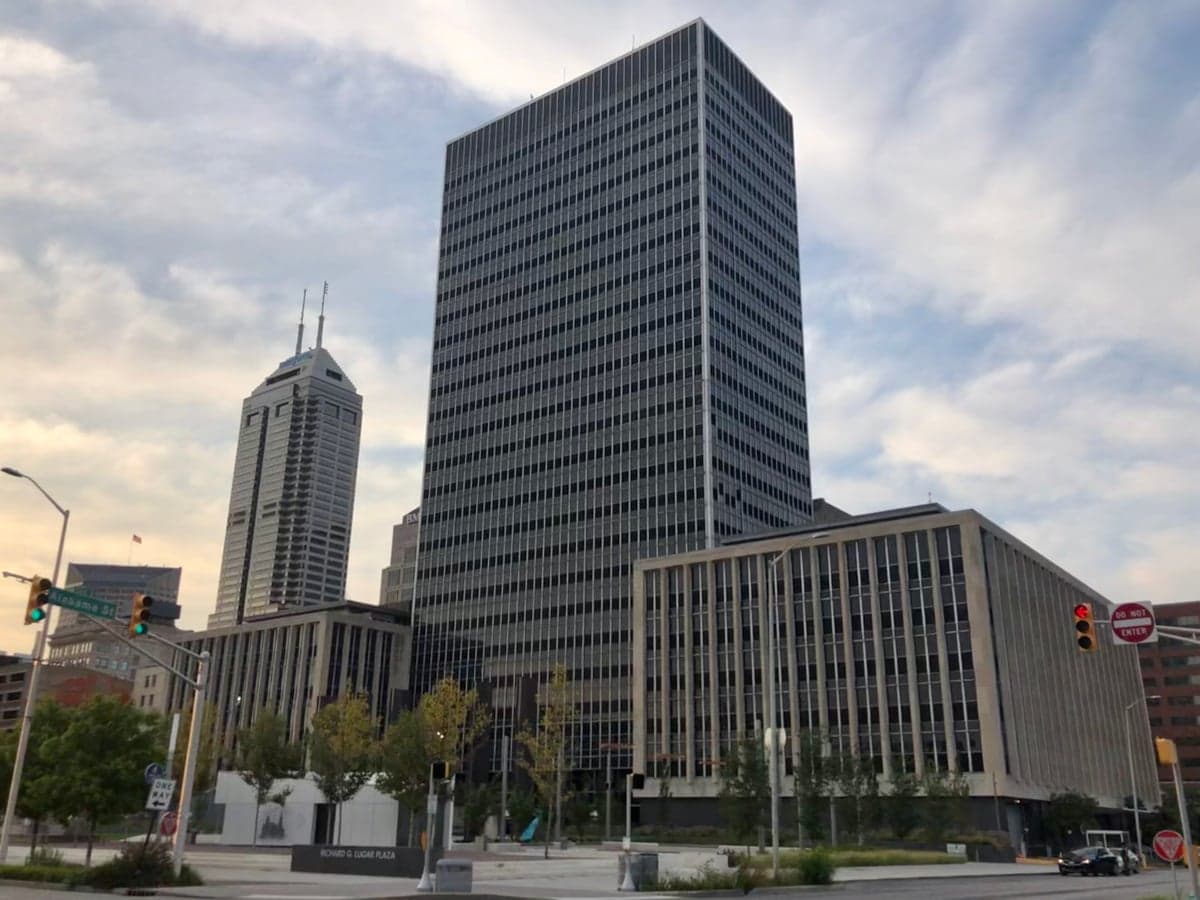
Photo: Wikipedia
Demographics of Marion County
Affluence Level in Marion County
A middle-class area roughly in line with national averages across income, home values, education, and employment.
People of Marion County
Marion County, Indiana, centered on Indianapolis, is a densely populated urban-suburban region of nearly one million people that embodies both Midwestern industriousness and growing diversity. Its population today is roughly half non-Hispanic White (50.5%), with a significant Black community (27.3%), a rising Hispanic presence (13.4%), and smaller but growing East/Southeast Asian (2.7%) and Indian subcontinent (1.2%) populations. Just 7.6% of residents are foreign-born, below the national average, yet the county’s identity is shaped by successive waves of domestic migration and immigration that have layered distinct cultural enclaves across its 27 square miles and numerous suburban towns.
Settlement & growth (pre-1960)
Long before European settlement, the area now known as Marion County was inhabited by the Miami and Delaware (Lenape) nations, who used the White River as a trade route. French traders passed through in the 17th and 18th centuries, but permanent American settlement began only after the 1818 Treaty of St. Mary’s, which forced Native tribes to cede central Indiana. Indianapolis was founded in 1821 as the state capital, deliberately placed at the geographic center of the state, attracting early settlers primarily from Kentucky, Ohio, and Pennsylvania — largely of Scots-Irish and English stock.
By the mid-19th century, the National Road and the arrival of railroads turned Indianapolis into a transportation hub. German and Irish immigrants poured in between 1840 and 1880, settling in neighborhoods like Holy Cross (German) and Irish Hill near the downtown core. They worked in railroad yards, breweries, and the emerging manufacturing sector. St. Mary’s Catholic Church on South New Jersey Street, built by German immigrants in the 1850s, still stands as a marker of that era. A smaller but notable wave of Polish immigrants arrived after the Civil War, concentrating around the Fountain Square and St. Clair Street areas.
The Great Migration reshaped Marion County dramatically. Between 1910 and 1960, tens of thousands of African Americans moved from the rural South to Indianapolis, seeking industrial jobs at companies like Allison Transmission, Chrysler, and RCA. They established a vibrant cultural and commercial corridor along Indiana Avenue (now near IUPUI), and later spread to neighborhoods like Martindale-Brightwood and Riverside. By 1960, the Black population had grown to roughly 22% of the county, concentrated on the near-north and east sides. White flight to suburban towns accelerated after World War II: Speedway, Beech Grove, Lawrence, and Southport grew rapidly as single-family homes sprouted on farmland. These four incorporated cities within the county became havens for European-ethnic Catholic and Protestant families leaving the urban core.
Modern era (post-1965)
The 1965 Hart-Cellar Immigration Act fundamentally altered Marion County’s ethnic landscape, though the change came more slowly than on the coasts. The first post-1965 arrivals were medical professionals and engineers from Asia, drawn by the expanding healthcare and pharmaceutical sectors (especially Eli Lilly and Company). East and Southeast Asian immigrants — Vietnamese, Chinese, and Korean — concentrated in the northern suburbs of Carmel and Fishers (both in Hamilton County adjacent to Marion County) but also established a smaller presence within Indianapolis proper, notably around Castleton and near the Keystone at the Crossing area. Indian subcontinent immigrants arrived in force after 1990, attracted by tech jobs and medical residencies; today they cluster heavily in Carmel and Fishers, but also within Marion County in the Geist Reservoir area and parts of Lawrence.
Hispanic immigration, predominantly Mexican but with growing numbers from Central America, accelerated in the 1990s and 2000s. The Hispanic population now makes up 13.4% of the county, with major enclaves on the west side of Indianapolis (around Lafayette Road and Michigan Road) and in Speedway and Beech Grove, where many work in warehousing, construction, and food processing. Domestic migration patterns also shifted after 1970: Rust Belt outflow and Sun Belt growth bypassed Marion County for decades, but since 2010 the county has added population, driven by a revival of urban amenities downtown and in Broad Ripple and Fletcher Place, attracting younger college graduates. The county’s college-educated share now stands at 34.1%, above the national average, concentrated in the historic suburban borough of Irvington and the Meridian-Kessler neighborhood.
Racial and ethnic change has been steady but not disruptive. White non-Hispanic residents dropped from roughly 75% in 1980 to 50.5% today, while Black, Hispanic, and Asian shares rose correspondingly. African American population growth has flattened, with many Black middle-class families moving to the same north-side suburbs as immigrant groups, contributing to an increasingly multiethnic suburban landscape in places like Lawrence and Southport.
The future
Marion County is not homogenizing but instead sorting into distinct, overlapping enclaves. The White population is aging and suburbanizing further, while younger, more diverse cohorts fill the urban core. East/Southeast Asian and Indian communities are growing rapidly, especially in the north-side suburbs that already have the schools and amenities attracting professional families. Hispanic growth is steady and spreading beyond traditional west-side neighborhoods into the southern and eastern parts of the county. The Black population remains substantial but is increasingly suburbanizing into Lawrence and Franklin Township.
Foreign-born numbers are rising modestly, but Marion County remains a region dominated by native-born residents, meaning new immigrants are likely to be absorbed culturally over time rather than forming permanent insular enclaves. The next decade will likely see the county approach a “majority-minority” status for its under-18 population, while older adult cohorts remain Whiter. Economic pull from tech and healthcare will continue to attract educated newcomers from both coasts and abroad, reinforcing the professional-class character of northern suburbs while the southern and western parts of the county remain more working-class and ethnically mixed. Politically, this sorting may deepen existing divides: urban core and close-in suburbs lean left, while exurban edge towns lean right.
For someone moving into Marion County today, the region offers a city that is becoming more diverse and cosmopolitan in its core, while wide suburban options exist for those seeking more homogenous or family-oriented settings. The county’s identity is no longer simply “Indianapolis” — it is a constellation of distinct communities, each with its own history and trajectory, bound together by a shared Midwestern practicality and a growing awareness of its multiethnic future.

* Values derived from national, state, county, city and local statistics and may differ in a specific area. Last updated: 2026-06-01T13:06:35.000Z
Narrative content on this page is AI-generated and may contain mistakes. Verify any details that matter before acting on them.
ReloMaps may earn a commission from affiliate links at no extra cost to you.

