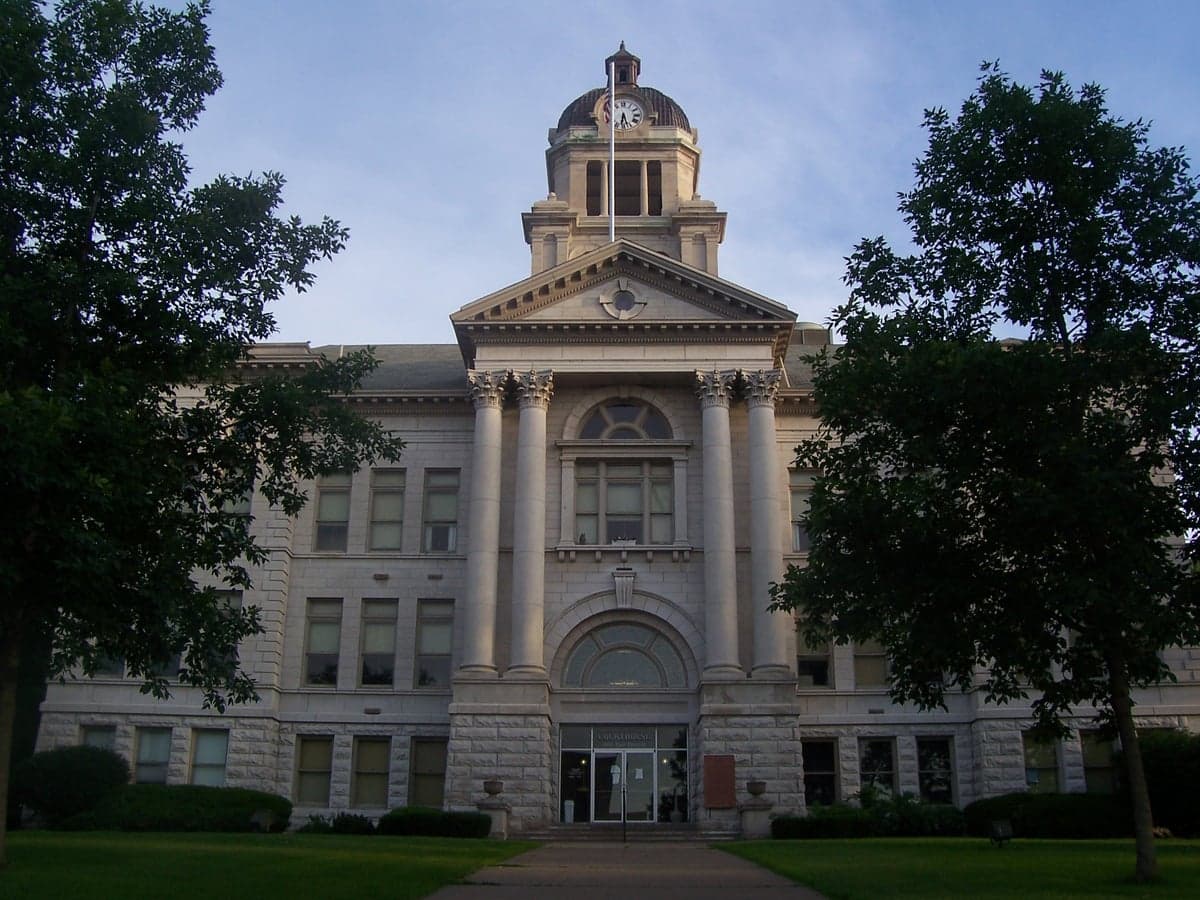
Photo: Wikipedia
Political ClimatePolitical Climate in Muscatine County
Showing district-level results — no local-only data available.
Local Political AnalysisPolitical Analysis of Muscatine County
Muscatine County has long been a reliably conservative place, but it’s not as deep red as the rest of Iowa. The Cook PVI here is R+4, while the state as a whole sits at R+6, meaning we’re a couple points more competitive than the average Iowa county. That gap has been shrinking, though—the county voted for Trump by about 10 points in 2020, down from 18 points in 2016, and the shift is mostly coming from the city of Muscatine itself, where younger voters and transplants from the Quad Cities are nudging things left. The rural towns like Wilton, West Liberty, and Nichols still vote like they did in the 1990s: solidly Republican, with local issues like farm policy and school funding driving turnout more than national culture wars.
How it compares
Compared to Iowa’s R+6 average, Muscatine County is a genuine swing county in a state that’s trending redder. The difference is stark when you look at precinct-level results. In the 2024 primary, the city of Muscatine’s Ward 2 and Ward 3 precincts—around the riverfront and the old industrial core—went for moderate Republican candidates, while the rural precincts outside Fruitland and Stockton backed the most conservative contenders by 2-to-1 margins. West Liberty, with its growing Latino population and meatpacking workforce, is the only town that consistently votes Democratic in local races, but it’s small enough that it doesn’t flip the county. The real story is that the county’s R+4 PVI is a compromise between the deep red of eastern Iowa’s farm country and the purplish tilt of the Quad Cities metro area. If you’re worried about government overreach, the good news is that the county commission and school boards here are still dominated by folks who believe in limited government and local control—but the progressive creep is real, especially in the city council races where “equity” language is starting to show up in zoning and housing policies.
What this means for residents
For a conservative resident, the political climate here is a mixed bag. On one hand, the county’s R+4 lean means you’re not going to see the kind of radical school board takeovers or mask mandates that plague deep-blue counties. The sheriff’s office in Muscatine County has been vocal about not enforcing federal gun laws they see as unconstitutional, and the county board has repeatedly rejected proposals for “sanctuary city” policies, even as neighboring Johnson County (Iowa City) embraces them. On the other hand, the city of Muscatine itself is a battleground. The city council recently passed a resolution supporting “diversity, equity, and inclusion” training for city employees—a small step, but one that signals a shift away from the colorblind, merit-based approach most locals grew up with. Property taxes are also a flashpoint: the county’s levy is moderate, but the city’s is creeping up to fund new bike lanes and a riverfront park that many rural residents see as wasteful. The long-term trajectory is concerning: if the city of Muscatine keeps trending left, the county could flip to D+1 or D+2 within a decade, especially as the Quad Cities’ influence spreads west along Highway 61.
What sets Muscatine County apart culturally is its stubborn independence. We don’t have the libertarian streak of western Iowa, but there’s a deep skepticism of both Des Moines and Washington D.C. The county’s economy—still anchored by the Muscatine Foods plant and a handful of family farms—means most folks see government as a necessary evil, not a solution. The biggest policy distinction is on land use: the county has resisted state-level pressure to adopt uniform zoning codes, keeping rural property rights strong. That’s a win for personal freedom, but it also means you’ll see more “No Trespassing” signs than “In This House We Believe” signs. For now, the balance holds, but keep an eye on the city council elections in 2026—if the progressive slate wins a majority, the county’s R+4 PVI could start looking like a relic of a more sensible time.

State Political ClimatePolitical Climate in Iowa
State Political AnalysisPolitical Environment in the State
Iowa has been a reliably Republican state for the past decade, with a Cook PVI of R+6, but it wasn’t always this way. As recently as 2012, the state was a true swing state, backing Barack Obama twice before swinging hard to Donald Trump in 2016 and 2020. The shift has been driven by a combination of rural realignment, suburban flight from progressive policies, and a growing conservative grassroots movement that now dominates state politics. For a conservative looking to relocate, Iowa offers a solid red foundation, but the fight to keep it that way is ongoing, especially in the state’s growing urban centers.
Urban vs. rural divide
The political map of Iowa is a classic story of red countryside versus blue cities, but with a twist. The Des Moines metro area, including Polk County and parts of Dallas County, has become a Democratic stronghold, with Polk County voting +18 for Biden in 2020. Meanwhile, the rural counties that make up the rest of the state—like Sioux County in the northwest, which voted +55 for Trump—are deeply conservative. The real battleground is in the suburbs of Des Moines, like Ankeny and Waukee, which have been trending left as young professionals and out-of-state transplants move in. However, smaller cities like Cedar Rapids and Council Bluffs remain more moderate, often splitting tickets. The eastern part of the state, including Dubuque and the Quad Cities (Davenport), leans more Democratic due to union influence and older industrial roots, but those areas are shrinking relative to the growing conservative rural and exurban populations.
Policy environment
Iowa’s policy environment is a mixed bag for conservatives, but the trend is positive. The state has a flat income tax rate of 3.8% (down from 8.98% in 2021), with a plan to drop to 3.65% by 2026, making it one of the most tax-friendly states in the Midwest. Property taxes are relatively low, and there is no inheritance tax. Governor Kim Reynolds signed a six-week abortion ban in 2023 (HF 732), which was upheld by the Iowa Supreme Court in 2024, making it one of the strictest in the nation. On education, the state passed a universal school choice program in 2023 (HF 68), allowing any family to use state funds for private or homeschool expenses. This is a huge win for parental rights. However, the state still has a state-run healthcare exchange under the Affordable Care Act, and Medicaid expansion remains in place, which some conservatives view as government overreach. Election integrity is strong: Iowa requires voter ID, has strict absentee ballot rules, and purges inactive voters regularly.
Trajectory & freedom
Iowa is becoming more free for conservatives, but the battle is constant. The 2021 permitless carry law (SF 507) allows any law-abiding adult to carry a concealed firearm without a permit, a major expansion of Second Amendment rights. The 2023 “Parents Bill of Rights” (HF 604) requires schools to notify parents of any curriculum involving sexual orientation or gender identity, and bans instruction on these topics in K-6. This is a direct response to progressive overreach in school districts like Iowa City and Ames. On the downside, the state has seen a push for carbon capture pipelines (Summit Carbon Solutions) that use eminent domain to seize private land, which has sparked a fierce property rights backlash. The state legislature has also resisted federal vaccine mandates and COVID-19 lockdowns, with Governor Reynolds suing the Biden administration over mask mandates on public transit. Overall, the trajectory is toward more personal liberty, but the pipeline issue and urban growth in Des Moines are threats.
Civil unrest & political movements
Iowa has not seen the level of civil unrest seen in coastal states, but there have been flashpoints. In 2020, Des Moines and Iowa City saw Black Lives Matter protests, with some property damage, but they were smaller than in larger cities. The most visible political movement in recent years has been the fight against the carbon capture pipelines, which has united farmers, ranchers, and libertarians across party lines. There have been multiple protests at the state capitol, and the issue has become a litmus test for local candidates. Immigration politics are relatively quiet, as Iowa has a small foreign-born population (about 5%), but there have been tensions in towns like Storm Lake and Perry, where meatpacking plants employ large numbers of immigrants. There is no sanctuary city policy in Iowa; in fact, the state passed a law in 2018 requiring local law enforcement to cooperate with federal immigration authorities (SF 481). Election integrity has been a hot topic, with the 2020 audit in Linn County (Cedar Rapids) finding no widespread fraud, but conservatives remain vigilant about mail-in voting.
Projection
Over the next 5-10 years, Iowa will likely remain a solidly Republican state, but the margins could tighten. The Des Moines metro is growing faster than the rest of the state, and if that trend continues, Polk County’s influence could turn the state purple by 2032. However, the rural counties are not shrinking as fast as in other Midwestern states, and the influx of conservative retirees from Illinois and Minnesota is offsetting urban growth. The key battleground will be the suburbs of Des Moines, like Ankeny and West Des Moines, where school choice and tax policy will decide elections. If the state can keep its tax cuts and school choice programs intact, it will continue to attract conservative families. But if the urban machine in Des Moines pushes for higher taxes and progressive education policies, the state could see a repeat of the 2018 governor’s race, which was very close. For now, the trajectory is positive for conservatives, but vigilance is required.
For a new resident, the bottom line is this: Iowa is a great place to live if you value low taxes, gun rights, and parental control over education. The state is politically stable, with a conservative majority that has delivered on key issues. But don’t expect a libertarian paradise—the state still has a strong agricultural subsidy system and a history of corporate welfare for big ag. If you’re moving from a blue state, you’ll find a refreshing respect for personal freedom, but you’ll also need to get involved locally to keep it that way. The fight is real, but the foundation is solid.
* Values derived from national, state, county, city and local statistics and may differ in a specific area. Last updated: 2026-05-12T11:13:28.000Z
Narrative content on this page is AI-generated and may contain mistakes. Verify any details that matter before acting on them.
ReloMaps may earn a commission from affiliate links at no extra cost to you.

