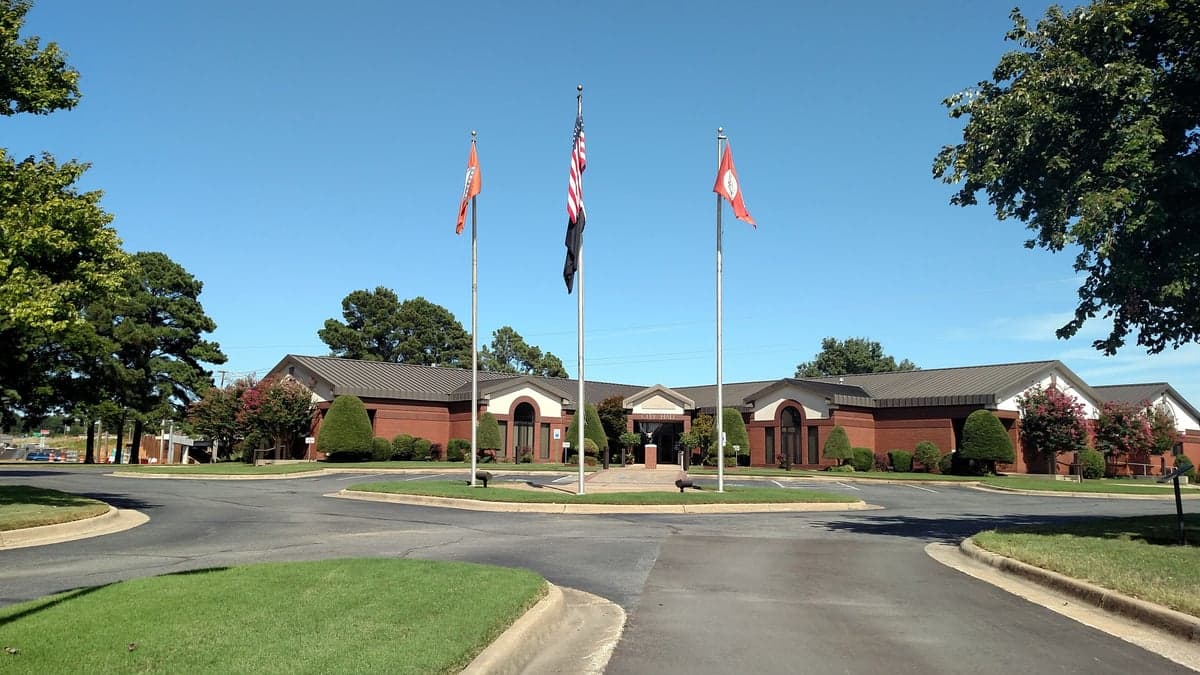
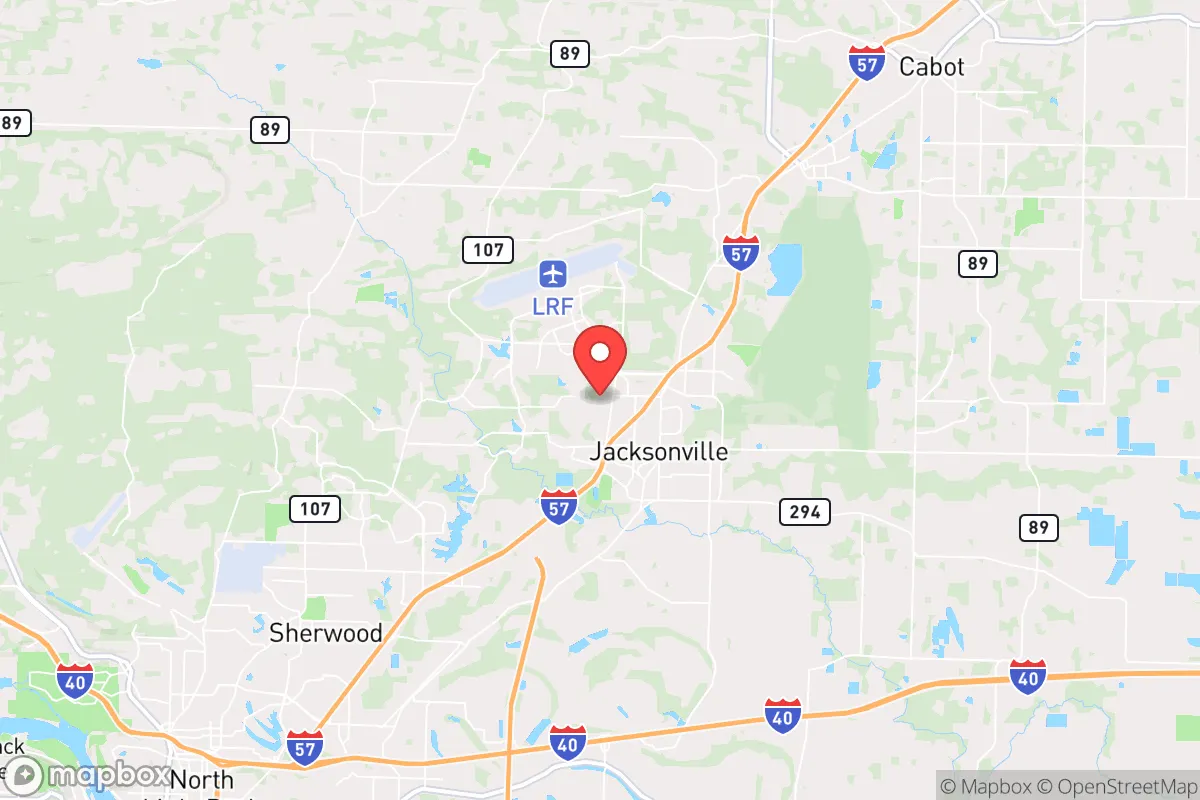
Photo: Wikipedia
Demographics of Jacksonville, AR
Affluence Level in Jacksonville, AR
A low-income area with significant economic hardship. Household wealth and educational attainment are well below national averages.
People of Jacksonville, AR
The people of Jacksonville, Arkansas, today form a majority-Black community (46.6%) with a substantial White minority (36.6%) and a growing Hispanic population (9.4%), creating a demographic profile distinct from most other central Arkansas suburbs. With 29,285 residents and a foreign-born share of just 2.0%, the city remains overwhelmingly native-born, shaped by decades of military and industrial migration rather than international immigration. The city’s identity is anchored by Little Rock Air Force Base, a major employer that has drawn waves of military families and civilian workers, and by a working-class, family-oriented character that leans conservative. Jacksonville is a place where racial and economic diversity coexist within a relatively compact footprint, with distinct neighborhoods reflecting different eras of settlement.
How the city was settled and grew
Jacksonville was founded in the 1870s as a railroad town along the Cairo and Fulton Railroad, later part of the Missouri Pacific line. The original population was overwhelmingly White, drawn by timber and railroad jobs, and the early settlement clustered around the depot and Main Street in what is now the Historic Downtown Jacksonville district. The city remained a small, rural service center through the early 20th century, with a population under 1,000 as late as 1940. The decisive turning point came in 1955, when the U.S. Air Force established Little Rock Air Force Base just north of the city. The base brought an influx of military personnel, civilian contractors, and support workers, many of whom settled in the Bishop Park and Graham Road neighborhoods, areas developed in the 1960s and 1970s with single-family homes and apartment complexes. The base’s presence also attracted Black families from rural Arkansas and the Delta, who moved to Jacksonville for steady employment and better schools, settling primarily in the South Jacksonville area and along Redmond Road. By 1970, the population had surged past 20,000, and the city had become a racially mixed, military-dependent community.
Modern era (post-1965)
After the 1965 Hart-Cellar Act, Jacksonville saw little direct international immigration—its foreign-born share remains just 2.0%—but domestic migration reshaped the city’s racial geography. The 1970s and 1980s brought continued White flight from inner-city Little Rock to suburbs like Jacksonville, but the base’s presence also anchored a stable Black middle class. The Bayou Meto area, east of the base, developed as a predominantly White, newer subdivision community in the 1990s and 2000s, while the Southwest Jacksonville neighborhoods near the base’s main gate became more racially mixed, with a growing Hispanic population arriving for construction and service jobs. The Hispanic share rose from under 3% in 2000 to 9.4% today, concentrated in the Dupree Park and Oak Park areas, where affordable housing and proximity to base-related employment drew families. The Black population, meanwhile, consolidated in the older core neighborhoods around Redmond Road and South Jacksonville, where homeownership rates are lower and rental housing predominates. The Asian population (1.4%) is small and scattered, with no distinct ethnic enclave, and the Indian-subcontinent population is effectively zero. The college-educated share (23.5%) is below the national average, reflecting the city’s blue-collar and military-service character.
The future
Jacksonville’s population is likely to continue its gradual diversification, with the Hispanic share projected to rise toward 12-15% over the next decade, driven by natural increase and continued in-migration for construction, logistics, and service jobs. The Black share may stabilize or grow slightly, as the city remains one of the few affordable, family-oriented suburbs in central Arkansas with a majority-Black population. The White share will likely continue to decline slowly, as younger White families gravitate toward newer exurbs like Cabot or Beebe. The city is not tribalizing into rigid enclaves—neighborhoods like Bishop Park and Graham Road remain racially mixed—but economic sorting is visible, with newer subdivisions like Bayou Meto drawing higher-income residents and older core areas seeing more rental turnover. The foreign-born share will remain low, as Jacksonville lacks the industrial or refugee-resettlement infrastructure that drives immigration in other Arkansas cities. The base’s long-term stability is the key variable: any major realignment or closure would sharply alter the city’s demographic trajectory.
Jacksonville is becoming a more diverse, working-class suburb where military ties and affordability anchor the community. For a conservative-leaning family or individual moving in now, the city offers a stable, family-oriented environment with a strong sense of local identity, but limited upward mobility for those without college degrees or base connections. The population is likely to remain majority-Black and native-born, with a growing Hispanic minority, in a city that values practicality over prestige.

* Values derived from national, state, county, city and local statistics and may differ in a specific area. Last updated: 2026-04-29T21:57:10.000Z
Narrative content on this page is AI-generated and may contain mistakes. Verify any details that matter before acting on them.
ReloMaps may earn a commission from affiliate links at no extra cost to you.

