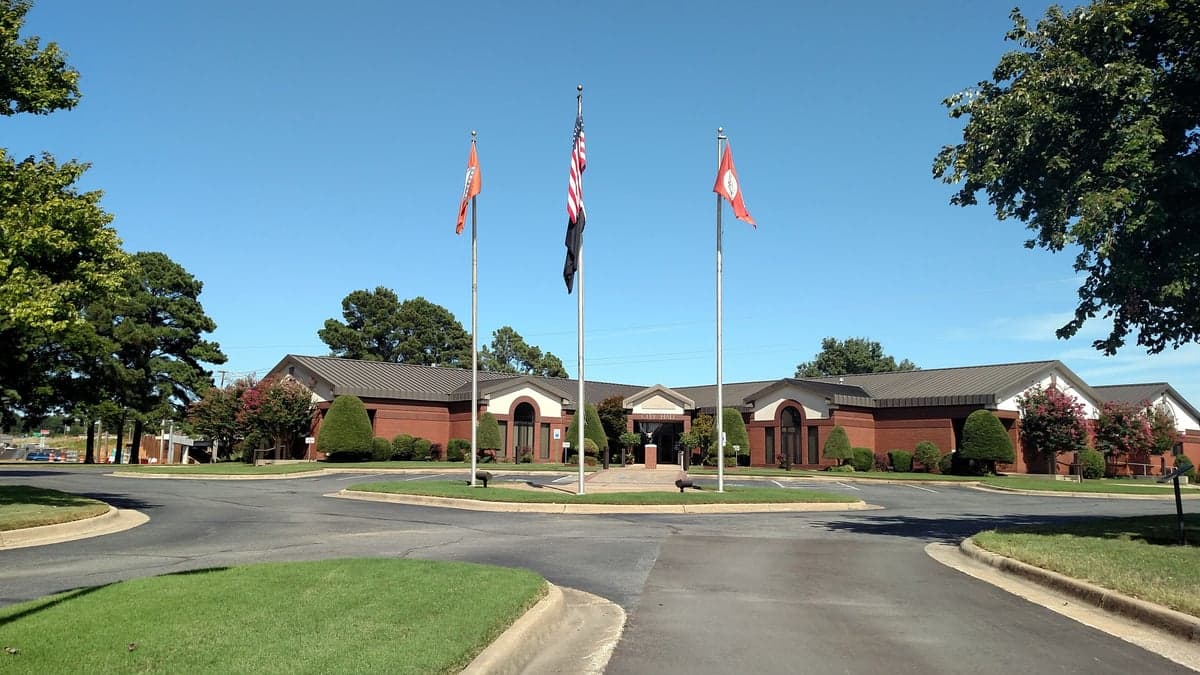
Photo: Wikipedia
Personal Sovereignty in Jacksonville, AR
Viable for self-reliance. Generally workable, though some barriers may limit total independence.
What does Personal Sovereignty tell us?
Personal Sovereignty measures your capacity for self-reliance and independence with minimal government friction. Higher scores mean fewer barriers between you and the way you want to live... but it assumes you have the space you need and good neighbors.
What does this tell us?
Personal Sovereignty measures your capacity for self-reliance and independence with minimal government friction. Higher scores mean fewer barriers between you and the way you want to live... but it assumes you have the space you need and good neighbors.
State Policy
Energy independence: Importer (35% of energy produced in-state)
Personal Liberty
Homesteading

Personal Liberty Analysis
Jacksonville, Arkansas offers a notably high degree of personal sovereignty for those prioritizing autonomy, particularly when compared to the regulatory density of the West Coast or Northeast. The city sits within a state that has actively pushed back against federal overreach in areas like gun rights, medical freedom, and property use, creating an environment where individual decision-making is broadly respected. For the survivalist or prepper, this translates to fewer legal hurdles when stockpiling supplies, building resilience, and living according to your own schedule, though it's not without its local nuances.
Tax burden and regulatory posture: How much the state and city take
Arkansas maintains a relatively low tax burden that supports self-reliance. There is no state property tax on vehicles or boats, and the state income tax is a flat 4.9% as of 2025, with ongoing legislative pushes to reduce it further. Property taxes in Jacksonville are moderate, typically around 0.6% to 0.8% of assessed value, which is significantly lower than the national average. This keeps the cost of land ownership manageable for those wanting to invest in acreage or a larger homestead. The regulatory posture is similarly light: there are no state-level mandates requiring businesses to collect sales tax on essential preparedness items like bulk food, water storage, or medical supplies, and the city does not impose its own income tax. However, Jacksonville does have standard building codes and zoning ordinances, so you cannot simply erect a bunker without permits. The key advantage is that the state government generally defers to local control, meaning you can often negotiate with the city council on variances for things like chicken coops, sheds, or alternative energy systems without facing a hostile state bureaucracy.
Self-defense and gun law specifics: What you can carry and where
Arkansas is a constitutional carry state, meaning no permit is required to carry a concealed or open handgun for anyone legally allowed to possess a firearm. Jacksonville fully respects this, with no local ordinances that restrict carry beyond state law. The state also has strong Stand Your Ground and Castle Doctrine laws, which means you have no duty to retreat from any place you are lawfully present, including your home, vehicle, or workplace. For preppers, this is critical: you can defend your property and family without fear of prosecution for using force in a justified situation. Magazine capacity is unrestricted, and there are no state-level bans on specific firearms like AR-15s or suppressors. The only notable restriction is that firearms are prohibited in certain government buildings and schools, but private businesses can choose their own policies. The local gun culture is robust, with several gun shops and ranges in the area, and the sheriff's office is known for being supportive of Second Amendment rights. For those concerned about federal overreach, Arkansas has passed a Second Amendment Sanctuary Act, which prohibits state resources from being used to enforce federal gun laws that violate the state constitution.
Self-reliance and homesteading viability: Lot sizes, zoning, and off-grid feasibility
Jacksonville offers a mix of suburban and rural zoning that makes self-reliance practical without requiring a massive land purchase. Standard residential lots in the city limits are typically a quarter-acre to half-acre, which is enough for a substantial garden, a few chickens, and a small workshop. Outside the city limits in Pulaski County, you can find lots ranging from one to five acres at prices well under $10,000 per acre, making it feasible to buy land outright. Zoning is generally permissive: you can keep up to four chickens per household within city limits without a permit, and larger livestock like goats or bees are allowed on parcels over one acre with a simple registration. Off-grid living is legally viable, though you must comply with basic health codes. Rainwater collection is legal and encouraged, and there are no state laws prohibiting solar panels or wind turbines, though the city does require a building permit for structural installations. Composting toilets are allowed on properties without sewer access, and you can drill a well for water on most rural parcels without a complex permitting process. The main limitation is that the city does require connection to municipal water and sewer if available, so true off-grid living is easier on unincorporated land just outside town.
Personal liberties: Parental rights, medical autonomy, speech, and property
Arkansas has been a national leader in protecting parental rights, with a 2023 law that prohibits schools from withholding information about a child's health or well-being from parents. This means you have full access to your child's medical and educational records, and schools cannot promote gender transition without parental consent. Medical autonomy is also strong: the state has banned vaccine passports and prohibits employers from mandating COVID-19 vaccines as a condition of employment. There is no state-level mask mandate or lockdown authority that can be imposed without legislative approval, which is a significant check on executive overreach. Speech protections are robust under the Arkansas Constitution, which explicitly protects the right to peaceably assemble and petition the government. Property rights are similarly strong, with the state having passed a law prohibiting the enforcement of federal regulations that restrict the use of private land for farming or timber production. The main concern for preppers is that the city does have a noise ordinance that could theoretically be used to restrict generator use during extended power outages, but enforcement is rare and typically only triggered by complaints. Overall, the legal framework in Jacksonville and Arkansas is designed to maximize individual discretion while minimizing government interference in daily life.
Compared to other parts of the country, Jacksonville offers a sovereignty profile that is well above average for a city of its size. The combination of constitutional carry, low taxes, permissive zoning, and strong parental rights creates a legal environment where a survivalist or prepper can operate with minimal friction. The main trade-off is that you are still within commuting distance of Little Rock, which means you have access to urban resources but also some urban regulations. For those willing to live just outside the city limits, the autonomy increases significantly. If you are looking for a place where you can build a resilient lifestyle without constantly fighting the government, Jacksonville is a solid choice that balances affordability with freedom.

* Values derived from national, state, county, city and local statistics and may differ in a specific area. Last updated: 2026-04-29T21:57:10.000Z
Narrative content on this page is AI-generated and may contain mistakes. Verify any details that matter before acting on them.
ReloMaps may earn a commission from affiliate links at no extra cost to you.

