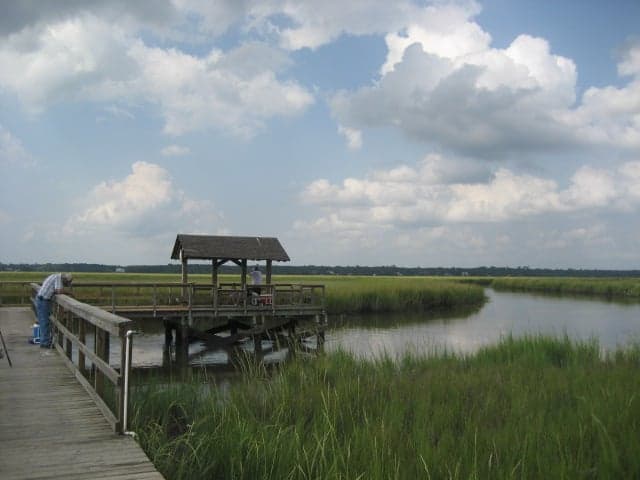
Photo: Wikipedia
Personal Sovereignty in James Island, SC
Viable for self-reliance. Generally workable, though some barriers may limit total independence.
What does Personal Sovereignty tell us?
Personal Sovereignty measures your capacity for self-reliance and independence with minimal government friction. Higher scores mean fewer barriers between you and the way you want to live... but it assumes you have the space you need and good neighbors.
What does this tell us?
Personal Sovereignty measures your capacity for self-reliance and independence with minimal government friction. Higher scores mean fewer barriers between you and the way you want to live... but it assumes you have the space you need and good neighbors.
State Policy
Energy independence: Importer (25% of energy produced in-state)
Personal Liberty
Homesteading

Personal Liberty Analysis
James Island, South Carolina, offers a notably high degree of personal sovereignty compared to many coastal enclaves, largely due to the state’s constitutional protections and a cultural baseline that values individual autonomy. While it is not a libertarian free zone—local zoning and HOA restrictions are real—the legal framework of South Carolina provides a strong foundation for self-reliance, with low taxes, permissive gun laws, and a hands-off approach to parental and medical decisions. For the survivalist or prepper evaluating this area, the key trade-off is between the convenience of suburban infrastructure and the ability to truly live off-grid or ungoverned, which is more feasible in the rural counties inland but still achievable here with careful property selection.
Tax burden and regulatory posture: How South Carolina’s low-tax environment protects your autonomy
South Carolina’s tax structure is a major asset for anyone seeking to minimize government extraction from their income and property. The state’s income tax is a flat 3% on most income, with a top marginal rate of 6.4% on high earners—still far lower than neighboring North Carolina or most Northeastern states. Property taxes in Charleston County, which includes James Island, are assessed at just 4% of market value for owner-occupied homes, with a millage rate around 0.3–0.4%, meaning a $500,000 home carries roughly $1,500–$2,000 in annual property taxes. There is no state tax on Social Security benefits, and military pensions are fully exempt. The regulatory posture is equally favorable: South Carolina is a right-to-work state with minimal business licensing hurdles, and there is no state-level red flag law or universal background check requirement. However, James Island itself is subject to Charleston County’s stormwater and building codes, which can be more stringent than rural areas—so if you plan to build a bunker or install a large solar array, you’ll need to navigate local permitting. The overall message: the state respects your wallet, but the island’s suburban overlay adds a layer of bureaucracy you won’t find in, say, rural Colleton County.
Self-defense and gun law specifics: What the Second Sanctuary state means for your right to keep and bear arms
South Carolina is a constitutional carry state as of 2024, meaning no permit is required to carry a concealed firearm for anyone legally allowed to possess one. This is a direct expression of personal sovereignty—you are not dependent on government permission to defend yourself. James Island, being in Charleston County, has no local ordinances that override state preemption on firearms, so you can carry openly or concealed without fear of local bans. The state also has a strong Stand Your Ground law, with no duty to retreat in any place you have a legal right to be. Magazine capacity is unrestricted, and there is no state-level assault weapons ban. For preppers, this means you can stockpile ammunition and firearms without worrying about sudden legislative changes at the county level. The only caveat: federal laws still apply, and Charleston’s proximity to federal facilities (the Naval Weapons Station, the airport) means you should be aware of prohibited carry zones. But for daily life, your right to self-defense is robust. The state has also passed a Second Amendment Sanctuary resolution, signaling legislative intent to resist federal overreach—a meaningful signal for those concerned about future national gun control.
Self-reliance and homesteading viability: Lot sizes, zoning, and off-grid feasibility on James Island
This is where James Island’s suburban character imposes the most constraints. Typical residential lots range from 0.15 to 0.5 acres, with many neighborhoods governed by HOAs that restrict livestock, outbuildings, and even clotheslines. Zoning is predominantly R-1 (single-family residential), which allows vegetable gardens and small sheds, but chickens are often limited or banned, and larger animals like goats or pigs are generally prohibited. Off-grid living is legally difficult: the island is served by Dominion Energy and Charleston Water System, and building codes require grid connection for new construction. Solar panels are allowed but must be grid-tied in most cases, and rainwater collection for potable use is restricted by state health codes. For a serious homesteader, James Island is a compromise—you can grow a substantial garden, compost, and install a backup generator, but you cannot achieve true self-sufficiency on a quarter-acre lot with HOA covenants. The better play is to buy a property with a larger lot (rare on the island, but possible in the Sol Legare or Riverland Terrace areas) or look to the outer reaches of Charleston County, where 1–5 acre parcels are still affordable and zoning is more permissive. That said, the island’s proximity to the coast means you can supplement with fishing and crabbing, which is a real prepper advantage—food security from the water is a resource few inland locations offer.
Personal liberties: Parental rights, medical autonomy, speech, and property protections
South Carolina has a strong track record on parental rights, with a 2023 law requiring school districts to notify parents of any changes in a student’s health or well-being, including mental health services and gender-related issues. This aligns with the conservative view that parents, not the state, are the primary authority over children. Medical autonomy is also respected: there is no state vaccine mandate for adults, and while school vaccine requirements exist, religious and medical exemptions are available. The state has not expanded Medicaid under the ACA, which some see as a limit on government healthcare intrusion. Free speech is protected under the state constitution, and there are no local hate speech ordinances that could chill political expression—a relevant factor for those who want to discuss controversial topics without fear of government retaliation. Property rights are strong, with South Carolina’s eminent domain laws strictly limited to public use (not economic development), and the state has a robust right-to-farm law that protects agricultural activities from nuisance lawsuits. However, James Island’s historic district overlay in certain neighborhoods can impose design review on exterior modifications, which is a minor infringement on property autonomy. Overall, the legal environment respects individual choice in parenting, medicine, and speech, with the caveat that local HOAs and historic districts can override some property freedoms.
In the broader context of the Southeast, James Island offers a solid baseline of personal sovereignty—better than any coastal city in California or the Northeast, but not as unregulated as rural Texas or Idaho. The state’s low taxes, constitutional carry, and parental rights laws provide a buffer against federal overreach, while the island’s suburban infrastructure means you trade some self-reliance for convenience and coastal access. For the prepper or survivalist who values community resilience and legal autonomy, James Island is a viable option if you are willing to work within the HOA and zoning constraints. If your priority is absolute off-grid independence, look inland to Berkeley or Dorchester counties, where land is cheaper, regulations are looser, and you can truly build your own world. But for those who want a defensible, legally protected base within striking distance of the coast, this island holds its ground.

* Values derived from national, state, county, city and local statistics and may differ in a specific area. Last updated: 2026-04-30T04:07:00.000Z
Narrative content on this page is AI-generated and may contain mistakes. Verify any details that matter before acting on them.
ReloMaps may earn a commission from affiliate links at no extra cost to you.

