
Photo: Wikipedia
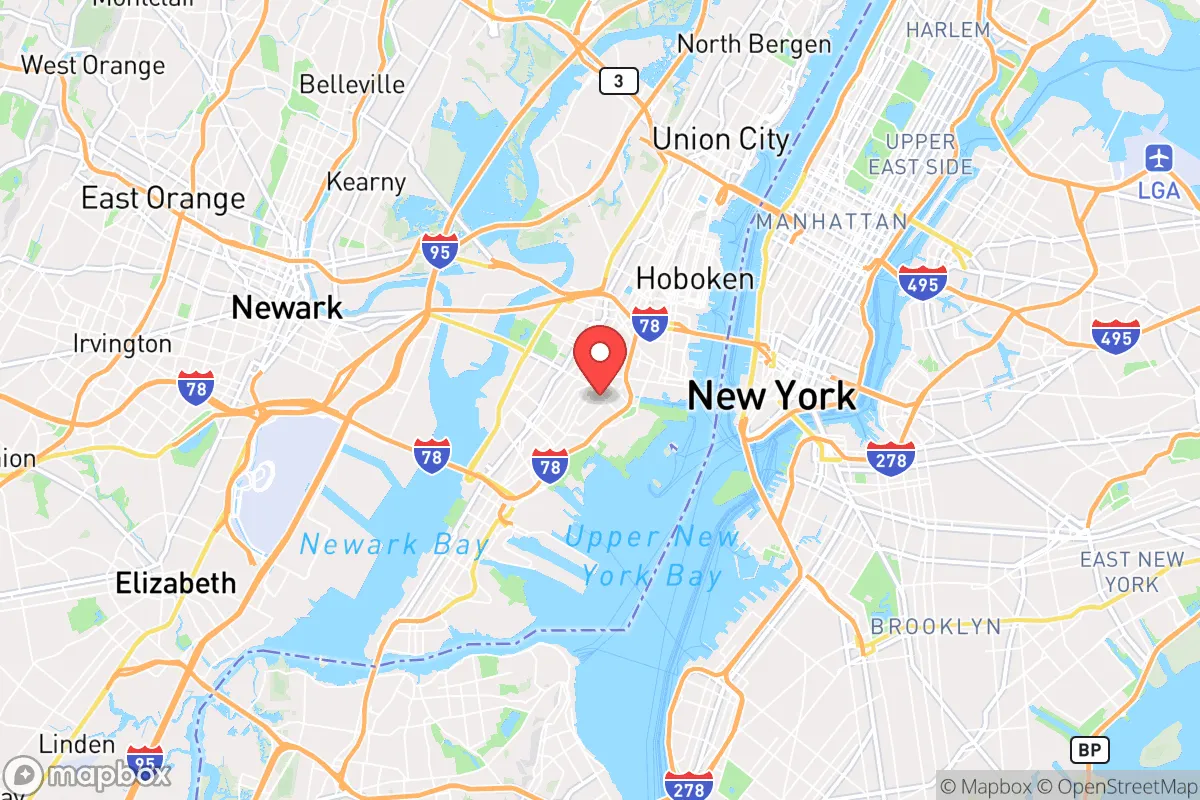
Personal Sovereignty in Jersey City, NJ
Viable for self-reliance. Generally workable, though some barriers may limit total independence.
What does Personal Sovereignty tell us?
Personal Sovereignty measures your capacity for self-reliance and independence with minimal government friction. Higher scores mean fewer barriers between you and the way you want to live... but it assumes you have the space you need and good neighbors.
What does this tell us?
Personal Sovereignty measures your capacity for self-reliance and independence with minimal government friction. Higher scores mean fewer barriers between you and the way you want to live... but it assumes you have the space you need and good neighbors.
State Policy
Energy independence: Importer (8% of energy produced in-state)
Personal Liberty
Homesteading

Personal Liberty Analysis
For the liberty-minded individual or family evaluating Jersey City as a potential relocation point, the personal sovereignty picture is one of significant constraint within a high-density, high-regulation urban environment. While New Jersey’s constitutional framework theoretically protects certain rights, the practical reality in Hudson County is shaped by aggressive state-level preemption, a heavy tax burden, and a political culture that prioritizes collective outcomes over individual autonomy. This analysis examines the specific levers of personal freedom—taxation, self-defense, self-reliance, and civil liberties—to determine whether Jersey City offers a viable base for a life built on independence and preparedness, or whether it represents a net loss of sovereignty compared to other regions.
Tax burden and regulatory posture: how much of your income and choices are your own
Jersey City’s tax environment is a primary drag on personal sovereignty. New Jersey consistently ranks among the highest-taxed states in the nation, and Hudson County is no exception. The combined state and local tax burden can approach 12-14% of income for middle-to-upper earners, with property taxes in Jersey City averaging around 2.5% of assessed value—among the highest in the country. For a $500,000 home, that’s roughly $12,500 annually in property tax alone, money that could otherwise fund your own preparedness, land, or equipment. The state’s progressive income tax tops out at 10.75% for income over $1 million, but even at $100,000, you’re looking at roughly 5-6% state income tax. Sales tax is 6.625%, with no local add-ons. The regulatory posture is equally dense: New Jersey’s building codes, environmental regulations, and business licensing requirements are among the most stringent in the Northeast. Starting a home-based business, installing a backup generator, or even making significant structural changes to a property requires multiple permits and inspections. This creates a high barrier to self-directed economic activity and property modification—a direct hit to personal sovereignty for anyone who values the ability to act without government permission.
Self-defense realities: gun laws, carry restrictions, and home protection in Hudson County
For the survivalist or prepper, New Jersey’s gun laws are a major red flag. The state operates under a “may issue” framework for concealed carry, and despite the Supreme Court’s Bruen decision (2022), the practical reality in Hudson County remains restrictive. Jersey City residents must obtain a Firearms Purchaser Identification Card (FPIC) to buy long guns and a separate permit for each handgun purchase, with a 30-day waiting period between handgun purchases. The state’s “sensitive places” law, passed in 2022, effectively bans carry in most public spaces—including parks, public transit, restaurants that serve alcohol, and private property without explicit owner permission. Magazine capacity is capped at 10 rounds, and “assault weapons” are broadly defined, banning many common semi-automatic rifles. For home defense, you can keep a handgun or shotgun in your residence, but the legal hurdles to acquiring them are substantial. The permitting process involves fingerprinting, background checks, references, and a mental health records review—often taking 3-6 months. In a crisis scenario, this delay is unacceptable. For those prioritizing self-defense as a core component of personal sovereignty, Jersey City and New Jersey as a whole represent a significant erosion of that right. The state’s posture is one of distrust toward the armed citizen, and the legal landscape reflects that.
Self-reliance and homesteading viability: lot sizes, zoning, and off-grid feasibility
Jersey City is one of the most densely populated cities in the United States, with over 28,000 people per square mile. This density fundamentally limits self-reliance. The typical residential lot is a narrow row house or a condo unit with no private land. Single-family homes with yards are rare and extremely expensive—a 3-bedroom house with a small yard in a decent neighborhood starts at $700,000+. Zoning is strictly residential-commercial, with no allowance for agricultural use, livestock, or even substantial gardening on most properties. Community gardens exist but are regulated by the city. Off-grid feasibility is essentially zero: New Jersey law requires connection to municipal water and sewer systems in urban areas, and solar panel installation requires permits and grid-tie agreements. Rainwater collection is technically legal but limited to 50 gallons per property under state water rights law. For the prepper looking to grow food, store water, or generate power independently, Jersey City offers almost no practical options. The best you can do is a small container garden on a balcony or a rooftop, but even that is subject to building management or HOA rules. If self-reliance means having land, water, and energy autonomy, this city is a non-starter.
Personal liberties: parental rights, medical autonomy, speech, and property in practice
On paper, New Jersey protects free speech and religious exercise. In practice, Jersey City’s political climate leans heavily progressive, and the local government has shown willingness to regulate speech in public spaces—such as requiring permits for large gatherings or limiting protest activities near schools and government buildings. Parental rights are a mixed bag. New Jersey has a strong tradition of local control over schools, but the state also mandates comprehensive sex education (including LGBTQ+ content) and has a “parental notification” law for abortion that is effectively nullified by the state’s broad reproductive rights protections. Medical autonomy is sharply limited: New Jersey has strict vaccine mandates for school attendance (including COVID-19 for healthcare workers, though not for K-12 students as of 2025), and the state’s medical aid-in-dying law is tightly regulated. The COVID-19 era saw aggressive executive orders from Governor Murphy, including mask mandates, business closures, and vaccine passports—actions that many liberty-minded individuals view as overreach. Property rights are also constrained by the state’s strong eminent domain powers and rent control ordinances in Jersey City (which apply to buildings built before 1987). If you own rental property, you face strict eviction rules and annual rent increase caps. For the individual who values the ability to make medical decisions for themselves and their children, speak freely without government approval, and control their property without interference, Jersey City’s environment is one of persistent friction.
In the broader landscape of American personal sovereignty, Jersey City ranks low. It sits at the intersection of high taxes, restrictive gun laws, dense urban zoning, and a political culture that favors collective regulation over individual autonomy. For the survivalist or prepper, the city offers no meaningful path to self-reliance, and the legal framework actively discourages the tools and habits of independence—firearms, off-grid infrastructure, and unpermitted economic activity. Compared to states like Texas, New Hampshire, or even parts of upstate New York, Jersey City represents a net loss of personal sovereignty. If your priority is to live with minimal government interference, to defend yourself and your family on your own terms, and to build a life of genuine self-reliance, this is not the place. It is a place to earn a high income and then leave—or to accept that your autonomy will be significantly circumscribed by the state and the city in which you live.

* Values derived from national, state, county, city and local statistics and may differ in a specific area. Last updated: 2026-04-25T03:04:57.000Z
Narrative content on this page is AI-generated and may contain mistakes. Verify any details that matter before acting on them.
ReloMaps may earn a commission from affiliate links at no extra cost to you.

