Photo: Wikipedia
Demographics of Jersey City, NJ
Affluence Level in Jersey City, NJ
A middle-class area roughly in line with national averages across income, home values, education, and employment.
People of Jersey City, NJ
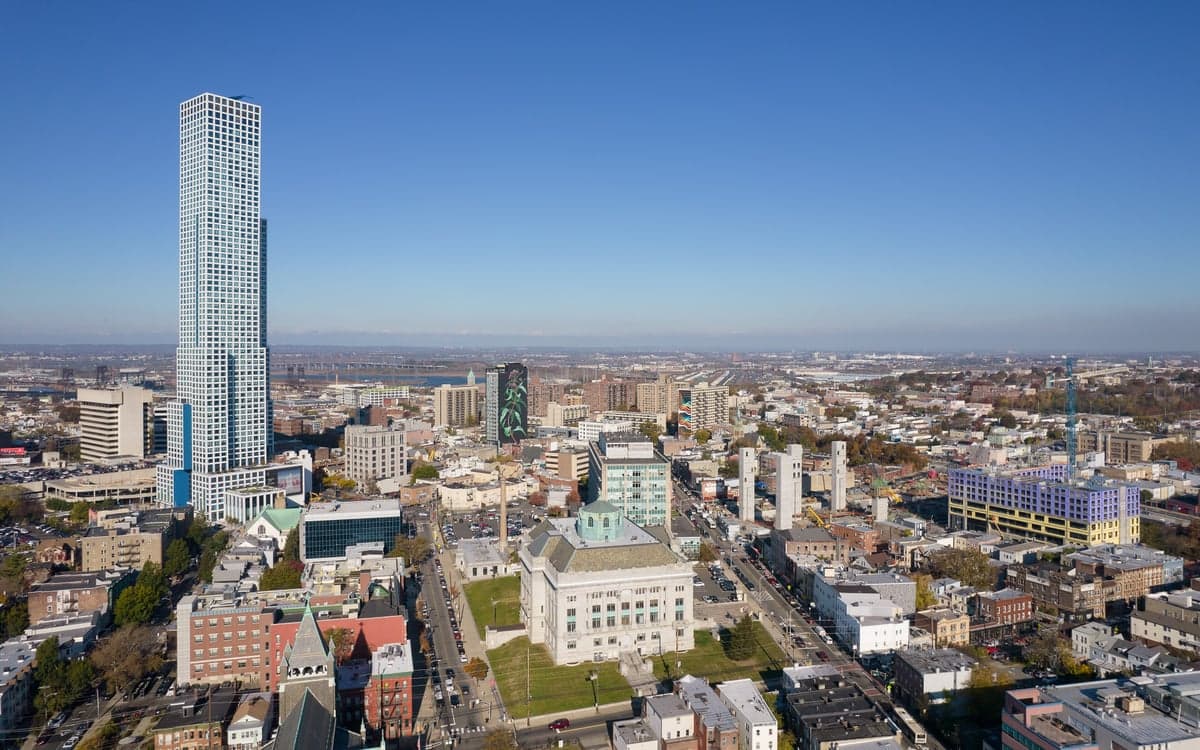
Jersey City’s 289,691 residents form one of the most ethnically diverse and densely populated cities in the United States, with no single racial or ethnic group holding a majority. The city is a patchwork of historic immigrant enclaves and newly gentrified districts, where 21.7% of the population is foreign-born and 53.1% hold a college degree. Its character is defined by a blend of working-class roots, rapid high-rise development along the waterfront, and deeply rooted ethnic neighborhoods that have persisted for generations.
How the city was settled and grew
Jersey City’s population history begins with the Lenape people, but the city’s modern fabric was woven by European immigrants drawn by industry and transportation. Founded in 1804 as a ferry terminal opposite Manhattan, the city exploded after the 1830s with the arrival of the Morris Canal and later the railroads. Irish immigrants built the canal and settled in Paulus Hook and The Heights, establishing the city’s first large ethnic enclave. Germans followed in the 1840s–1860s, clustering in Bergen-Lafayette and Journal Square, where they worked in breweries and manufacturing. By 1900, Eastern European Jews and Italians dominated the city’s industrial wards, with Jews concentrated in Greenville and Italians in The Hilltop and Five Corners. These groups built the dense row-house neighborhoods and parish churches that still define much of the city’s architecture. The city peaked at 316,715 residents in 1930, then began a long decline as manufacturing jobs left and white families suburbanized.
Modern era (post-1965)
The 1965 Hart-Cellar Act reshaped Jersey City’s population dramatically. The city’s white population, which had been over 90% in 1950, fell sharply as Black families from the South and Puerto Rican migrants moved into Greenville and Bergen-Lafayette. By 1980, the city was majority-minority. The 1990s and 2000s brought a new wave: East/Southeast Asian immigrants (11.7% of the population today) settled in Journal Square and The Heights, opening restaurants and grocery stores that gave those neighborhoods a distinctly Filipino and Korean character. Simultaneously, Indian subcontinent immigrants (13.8% of the population) established a dense corridor along Newark Avenue in India Square (also called Little India), one of the largest Indian enclaves in the United States. Hispanic residents (25.7%) are concentrated in Greenville and West Side, with a mix of Puerto Rican, Dominican, and Central American communities. Black residents (19.8%) remain heavily in Greenville and Bergen-Lafayette, though gentrification is pushing some families southward. The city’s white population (24.0%) has rebounded since 2000, driven by young professionals moving into luxury towers in Downtown and Paulus Hook, drawn by the PATH train and Manhattan skyline views.
The future
Jersey City is not homogenizing; it is tribalizing into distinct enclaves that are becoming more economically polarized. The Downtown waterfront and Paulus Hook are increasingly white, wealthy, and college-educated, while Greenville and West Side remain majority-minority and lower-income. Indian and East/Southeast Asian communities in Journal Square and India Square are stable or growing, sustained by chain migration and family reunification. Hispanic growth is plateauing, while the Black population has declined slightly since 2010 due to displacement. The foreign-born share (21.7%) is likely to remain steady or rise modestly, as new immigrants from South Asia and Latin America replace aging European-descended residents. Over the next 10–20 years, expect continued gentrification pressure on Bergen-Lafayette and The Heights, with rising rents pushing lower-income families to Bayonne or Newark. The city will likely become more bifurcated: a wealthy, white-majority Downtown and a diverse, working-class interior.
For someone moving in now, Jersey City offers a rare mix of hyper-diversity and Manhattan proximity, but the experience depends heavily on which neighborhood you choose. The city is becoming more expensive and more segregated by income, even as its ethnic enclaves remain vibrant. A conservative-leaning resident will find stable, family-oriented communities in India Square and The Heights, but should expect high taxes and a Democratic political machine that has dominated local government for decades.

* Values derived from national, state, county, city and local statistics and may differ in a specific area. Last updated: 2026-04-25T03:04:57.000Z
Narrative content on this page is AI-generated and may contain mistakes. Verify any details that matter before acting on them.
ReloMaps may earn a commission from affiliate links at no extra cost to you.

