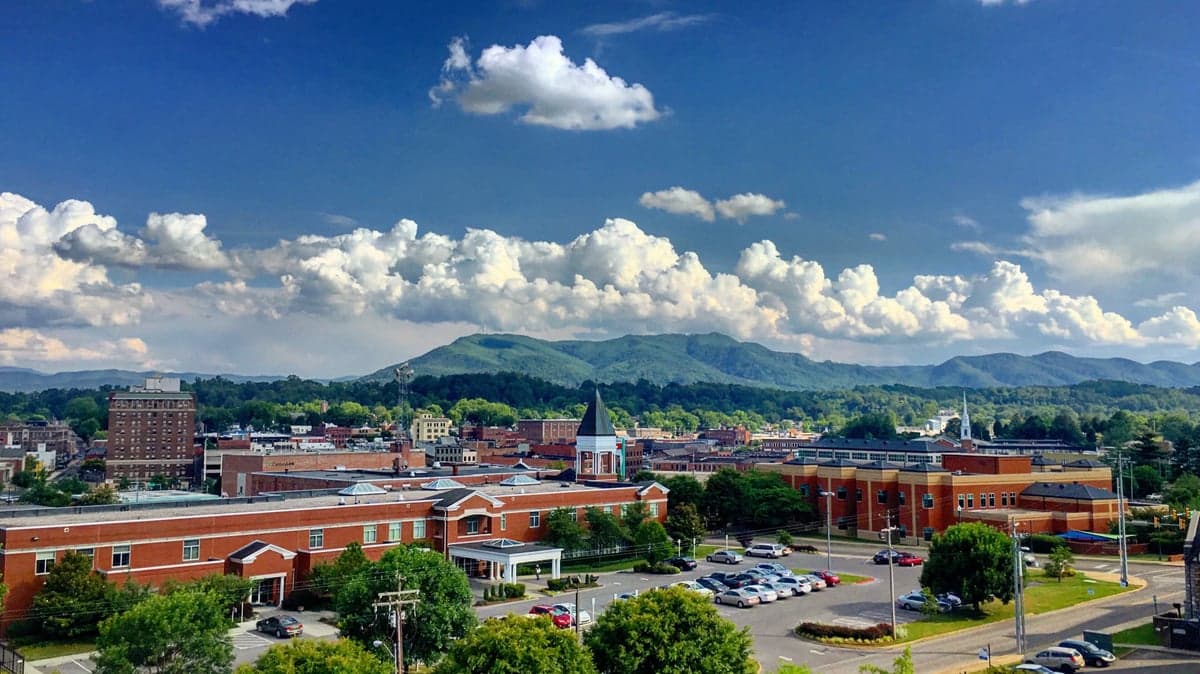
Photo: Wikipedia
Political ClimatePolitical Climate in Johnson City, TN
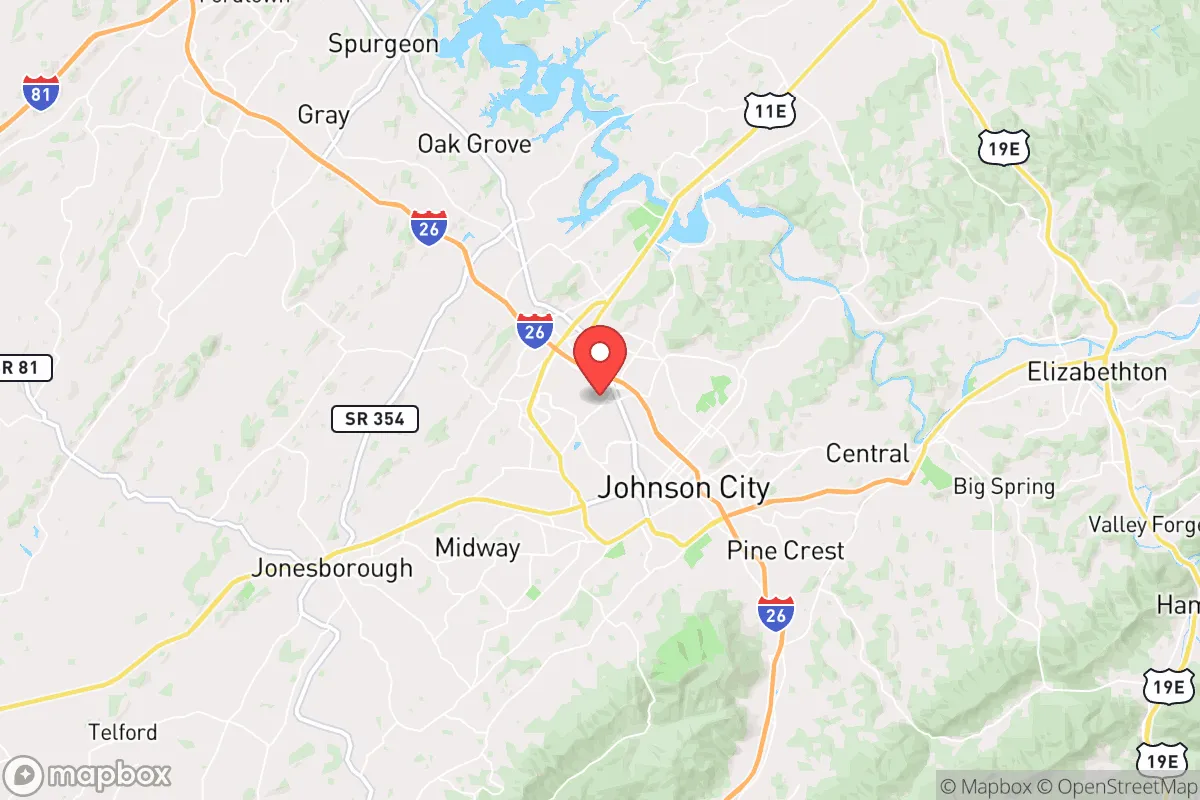
District shown is the primary district for this city’s centroid. Cities may span multiple districts.
Local Political AnalysisPolitical Analysis of Johnson City, TN
Johnson City sits deep in the heart of Tennessee’s First Congressional District, and politically, it’s about as red as they come. The Cook PVI clocks it at R+29, meaning the area votes nearly 30 points more Republican than the national average, and that’s not just a fluke—it’s a tradition. For decades, this has been a place where folks take personal freedom seriously, where the Second Amendment is a given, and where government overreach is met with a healthy dose of skepticism. The trajectory here hasn’t really shifted much in the last ten years, but you can feel a subtle tension as nearby cities like Asheville, North Carolina, and even Knoxville to the west start leaning more progressive. Johnson City remains a conservative stronghold, but the cultural winds are blowing, and long-time residents are keeping a close eye on any signs of that creeping influence.
How it compares
If you drive an hour east to Asheville, you’re in a completely different world—think artisanal coffee shops, rainbow crosswalks, and a city council that’s all-in on progressive zoning and climate mandates. That’s not Johnson City. Here, the county commission and city council still lean heavily Republican, and local elections tend to hinge on property taxes, school funding, and keeping regulations light. Compared to Bristol or Kingsport, Johnson City is actually a bit more moderate on social issues—you’ll find a few more young professionals and college folks from East Tennessee State University who lean left—but the overall vibe is still firmly conservative. The real contrast is with Nashville or Memphis, where state-level policies often clash with local progressive pushes. Johnson City doesn’t have that problem; the local government generally aligns with the state’s conservative priorities, which means less friction over things like mask mandates or business closures.
What this means for residents
For someone moving here, the political climate translates into a few concrete realities. First, taxes stay low—there’s no state income tax, and property taxes are among the lowest in the nation, partly because the electorate consistently votes against new spending. Second, you’re not going to see a lot of red tape on building a home, starting a business, or carrying a firearm. The local sheriff’s office is pro-Second Amendment, and the city hasn’t gone down the road of “sensitive places” restrictions like you see in blue states. Third, the school system—Washington County Schools—still emphasizes traditional values, with a curriculum that hasn’t been overhauled by progressive ideology. That said, there are rumblings: a few younger families moving in from out of state are pushing for more bike lanes, denser housing, and “equity” initiatives. It’s still a small minority, but it’s worth watching if you’re concerned about government overreach creeping in through zoning or school board policies.
One cultural distinction that stands out is the area’s deep-rooted sense of self-reliance. You won’t find a lot of hand-holding from the government here—people expect to solve their own problems, and they vote that way. The local Republican Party is active but not radical; it’s more about fiscal conservatism and individual liberty than culture war theatrics. In the long term, Johnson City will likely stay red, but the margin could narrow as ETSU grows and attracts more out-of-state students and faculty. If you’re looking for a place where your rights aren’t up for debate and the government stays out of your business, this is still one of the safest bets in the Southeast. Just keep an eye on those city council meetings—that’s where the real battles over personal freedom will play out in the next decade.

State Political ClimatePolitical Climate in Tennessee
State Political AnalysisPolitical Environment in the State
Tennessee has long been a reliably red state, with a strong Republican trifecta controlling the governorship and both legislative chambers for over a decade. The state’s overall partisan lean is roughly +15 to +20 points Republican in presidential elections, a shift that has accelerated since 2016 as rural and suburban voters consolidated behind the GOP while Democratic strength became increasingly confined to a handful of urban cores. Over the past 20 years, Tennessee has moved from a competitive purple state—where Al Gore won it in 2000—to a solidly conservative stronghold, driven by in-migration of families and retirees seeking lower taxes and fewer regulations, as well as a steady exodus of progressive-leaning residents from its major cities.
Urban vs. rural divide
The political map of Tennessee is a classic story of urban islands surrounded by a deep red sea. Nashville (Davidson County) and Memphis (Shelby County) are the two Democratic strongholds, with Nashville trending leftward fast—it voted for Biden by 35 points in 2020—while Memphis remains reliably blue but with lower turnout. Knoxville (Knox County) and Chattanooga (Hamilton County) are more competitive but still lean Republican at the county level, though their urban cores are becoming younger and more liberal. The real engine of Tennessee’s conservatism is the vast rural and exurban expanse: counties like Williamson (south of Nashville), Rutherford (east of Nashville), and Wilson (east of Nashville) have grown explosively and vote 65-75% Republican. Franklin and Brentwood in Williamson County are among the wealthiest and most conservative suburbs in the South, while Murfreesboro in Rutherford County is a fast-growing college town that still leans right. The divide is stark: drive 20 minutes outside any city center and you’re in deep red territory where Trump flags and “Don’t Tread on Me” plates are common.
Policy environment
Tennessee’s policy environment is aggressively conservative, with a focus on low taxes, limited government, and cultural traditionalism. The state has no income tax on wages, a major draw for relocators, and its sales tax is high (around 9.5% average) but applies broadly. Property taxes are low by national standards, especially in rural counties. The legislature has passed a series of school choice expansions, including Education Savings Accounts (ESAs) for low-income families in 2023, and a universal school voucher program is expected in 2025. Parental rights are a priority: Tennessee was one of the first states to ban transgender procedures for minors (2023) and to restrict classroom discussion of sexual orientation and gender identity (the “Don’t Say Gay” law). The state also has a constitutional carry law (permitless carry, 2021) and a strong Right-to-Work law. Election laws have tightened: voter ID requirements are strict, and the state purged inactive voters aggressively after 2020. There is no state-level rent control, and zoning is largely local, though Nashville has seen some upzoning battles. Healthcare policy is limited—Tennessee did not expand Medicaid under the ACA, leaving a coverage gap for about 300,000 low-income adults, but the state has a robust private insurance market.
Trajectory & freedom
Tennessee is becoming more free in many traditional conservative senses, but with some concerning trends. On the plus side, gun rights have expanded: permitless carry (2021) and the removal of handgun permit fees (2023) mean no government permission slip is needed to carry. Parental rights were strengthened with the “Parental Bill of Rights” (2022), giving parents explicit authority over their children’s education and medical decisions. Property rights got a boost with the “Tennessee Property Protection Act” (2021), which limits eminent domain for private economic development. On the downside, taxation remains high on consumption, and the state’s business regulations have crept up in areas like data privacy (the Tennessee Information Protection Act, 2023) and environmental permitting. The medical freedom landscape is mixed: vaccine mandates were banned for state employees (2021), but the state did not pass a broad medical freedom bill. The biggest freedom concern for conservatives is local government overreach: Nashville’s metro council has pushed progressive policies like sanctuary city resolutions (later blocked by the state) and a $5.4 billion transit plan (defeated by voters in 2024). The state legislature has responded by preempting local control on issues like mask mandates, gun laws, and housing policy, which many see as a necessary check on urban overreach.
Civil unrest & political movements
Tennessee has seen its share of political flashpoints. The 2023 Nashville Covenant School shooting sparked massive protests at the state capitol, with thousands demanding gun control—a rare moment of visible left-wing activism in a red state. The legislature responded by passing a law to keep guns away from mentally ill individuals, but did not pass red flag laws or universal background checks. Immigration politics are heated: the state passed a law requiring local law enforcement to cooperate with ICE (2024), and there have been high-profile raids in Morristown and Nashville. Election integrity remains a live issue: the 2020 election saw no major fraud in Tennessee, but the legislature created a new election integrity unit (2022) and passed a law requiring signature verification for absentee ballots. Secession/nullification rhetoric is rare but present in some rural counties—a few local GOP resolutions have floated “constitutional carry” as a form of nullification of federal gun laws. The most visible political movement is the MAGA-aligned grassroots, which dominates county party meetings and school board races, especially in suburban counties like Williamson and Rutherford. Left-wing activism is concentrated in Nashville and Memphis, with groups like Indivisible and Showing Up for Racial Justice (SURJ) organizing around police reform and housing affordability.
Projection
Over the next 5-10 years, Tennessee will likely become more conservative at the state level, but with growing friction between the rural/ suburban base and the urbanizing cities. In-migration from California, Illinois, and New York is accelerating—Nashville alone added 100,000 new residents between 2020 and 2024—and these newcomers tend to be younger, more diverse, and more moderate-to-liberal. However, they are moving to the suburbs (Franklin, Brentwood, Murfreesboro) that are already red, so the net effect may be to reinforce the existing political balance rather than flip it. The state’s demographic future is mixed: the white population is aging, but Hispanic and Asian populations are growing fast, especially in construction and service industries. These groups tend to vote more Republican in Tennessee than nationally, due to cultural conservatism and economic aspirations. The biggest wild card is Nashville’s trajectory: if it continues to grow and become more progressive, the state legislature will likely continue to preempt its policies, creating a “state vs. city” dynamic that could lead to a constitutional showdown over home rule. Expect more laws on school choice, parental rights, and gun rights, and possibly a push for a state-level income tax ban (already in the constitution, but a supermajority would be needed to repeal it). The 2026 gubernatorial election will be a key test: if a moderate Republican wins, the state may soften some edges; if a hardline conservative wins, expect more preemption and cultural battles.
For a new resident, the bottom line is that Tennessee offers a high degree of personal freedom in the traditional conservative sense—low taxes, strong gun rights, parental control over education, and limited government intrusion into daily life. The trade-off is that you’ll live in a state where the political conversation is dominated by cultural wars, and where urban areas are increasingly at odds with the state government. If you value low regulation, school choice, and a community that shares your values, you’ll find plenty of that in the suburbs and rural areas. If you’re looking for a place where government stays out of your business and your family’s decisions, Tennessee is one of the best bets in the country—just be prepared for the occasional fight over what that freedom actually means.
* Values derived from national, state, county, city and local statistics and may differ in a specific area. Last updated: 2026-05-02T03:06:26.000Z
Narrative content on this page is AI-generated and may contain mistakes. Verify any details that matter before acting on them.
ReloMaps may earn a commission from affiliate links at no extra cost to you.

