 Popular
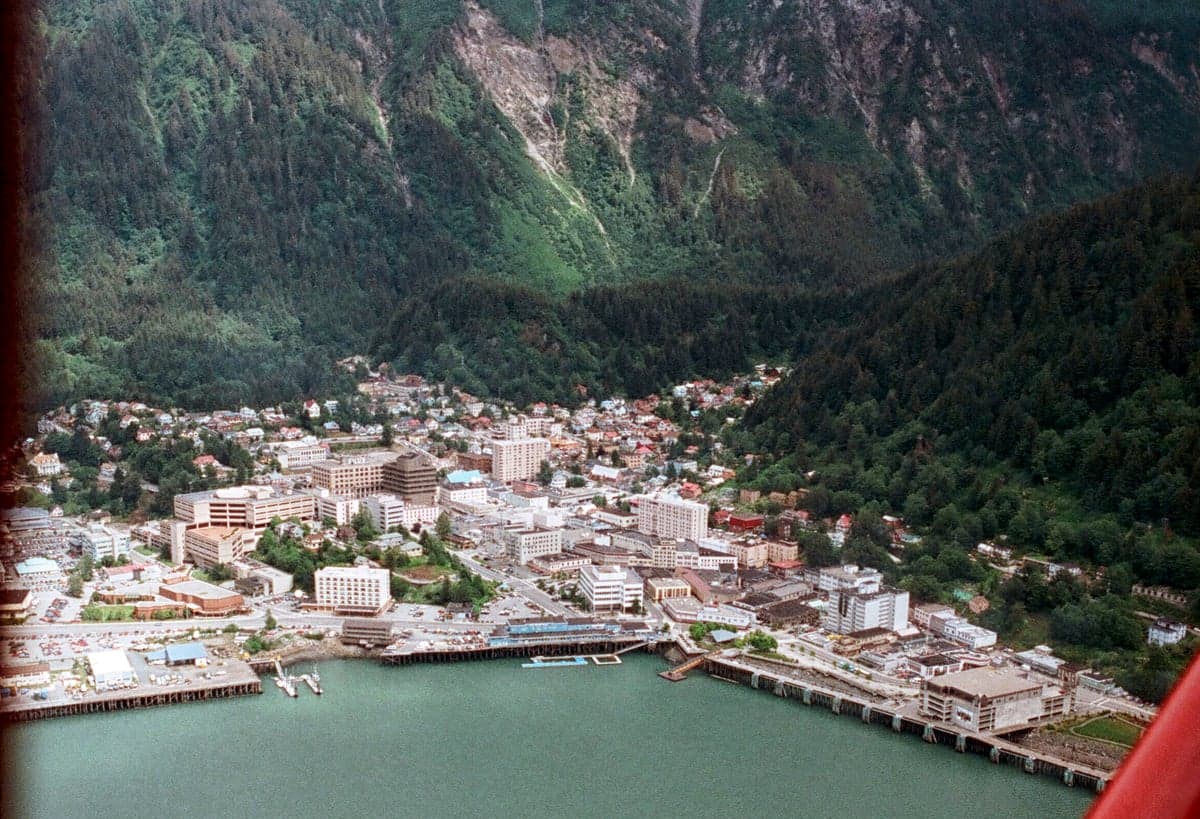
Photo: Wikipedia
Demographics of Juneau, AK
Affluence Level in Juneau, AK
An upper-middle-class area. Household wealth, education levels, and homeownership run ahead of national benchmarks.
People of Juneau, AK
Juneau’s 31,969 residents form a compact, state-capital workforce where government employment dominates and outdoor recreation defines daily life. The city is 61.8% white, with a notable 6.8% East and Southeast Asian population and a 7.0% Hispanic share, while the foreign-born rate sits at just 2.4% — well below the national average. Distinctive identity markers include a high college attainment rate of 40.5%, a strong Tlingit Native presence in the broader region, and a population density that clusters tightly along the Gastineau Channel’s narrow shoreline. This is a place shaped by gold, government, and geography, where successive waves of miners, bureaucrats, and service workers have built a stable but slowly aging community.
How the city was settled and grew
Juneau’s human history begins with the Auke and Taku Tlingit peoples, who used the Gastineau Channel’s fish camps and trade routes for centuries before European contact. The city’s recorded settlement started in 1880 when Joe Juneau and Richard Harris, guided by Tlingit Chief Kowee, discovered gold in Silver Bow Basin. That strike triggered a rush of white American and European prospectors, who built the original downtown core along Franklin Street and the waterfront — today’s Historic Downtown Juneau district, where many original false-front buildings still stand. By 1900, the gold boom had drawn a diverse mix of Scandinavian miners, Chinese laborers (who worked placer claims and laundries), and a small number of Black and Filipino workers in support roles. The Douglas Island neighborhood, across the channel, grew as a company town for the Treadwell Mine complex, housing mostly white miners and their families in tight rows of wooden houses. The end of large-scale mining by the 1920s stalled growth until 1959, when Alaska statehood made Juneau the capital and triggered a wave of government workers — mostly white, college-educated transplants from the Lower 48 — who settled in the Mendenhall Valley area, where flat land allowed for suburban-style subdivisions.
Modern era (post-1965)
The post-1965 period saw Juneau’s population stabilize as the state government expanded. The Alaska Native Claims Settlement Act of 1971 brought some Tlingit families into formal land ownership, but the city’s Native population remains modest within city limits (most live in nearby villages like Auke Bay). The Lemon Creek neighborhood became a landing point for Filipino and Southeast Asian immigrants arriving in the 1970s and 1980s, many working in canneries and the fishing industry; today, East and Southeast Asian residents make up 6.8% of the city, concentrated in service and healthcare roles. Hispanic growth has been slower — the 7.0% share includes a mix of Mexican-origin families in construction and tourism, scattered across the Mendenhall Valley and West Juneau areas. The Black population remains tiny at 0.7%, mostly military-affiliated or government professionals. The Indian subcontinent population is negligible at 0.1%, reflecting Juneau’s limited tech and academic sectors. White out-migration of younger adults to Anchorage or the Lower 48 has been offset by an influx of mid-career government hires, keeping the white share stable but aging. The Downtown core has seen some gentrification, with condos replacing older working-class housing, while the Mendenhall Valley remains the primary family-oriented suburb, with strip malls and single-family homes.
The future
Juneau’s population is slowly homogenizing in age but diversifying modestly in ethnicity. The foreign-born share (2.4%) is unlikely to rise sharply due to the high cost of living and limited entry-level job base. The East and Southeast Asian community, anchored by Filipino families in Lemon Creek, is stable but not growing rapidly, as younger generations often leave for Anchorage or Seattle. Hispanic growth may continue at a moderate pace, driven by tourism and construction jobs, but will likely remain below 10%. The white population, while still the majority, is aging — the median age is around 40, and the city’s school enrollment has declined slightly over the past decade. The next 10-20 years will likely see Juneau remain a predominantly white, government-dependent city with small, stable ethnic enclaves. New arrivals will mostly be state employees and retirees, not immigrants or young families seeking opportunity. The city is not tribalizing into distinct ethnic neighborhoods; rather, it is becoming a more uniform, older, and slightly more Hispanic place.
For someone moving to Juneau now, the bottom line is this: you are joining a stable, educated, government-centric community where ethnic diversity is present but modest, and where the population is aging in place. The city offers safety, natural beauty, and a predictable social fabric, but it is not a destination for rapid demographic change or immigrant-driven growth. If you value a quiet, outdoors-oriented life with a reliable public-sector economy, Juneau fits that profile — just know that the population you see today will look very similar a decade from now.

* Values derived from national, state, county, city and local statistics and may differ in a specific area. Last updated: 2026-04-20T23:18:26.000Z
Narrative content on this page is AI-generated and may contain mistakes. Verify any details that matter before acting on them.
ReloMaps may earn a commission from affiliate links at no extra cost to you.

