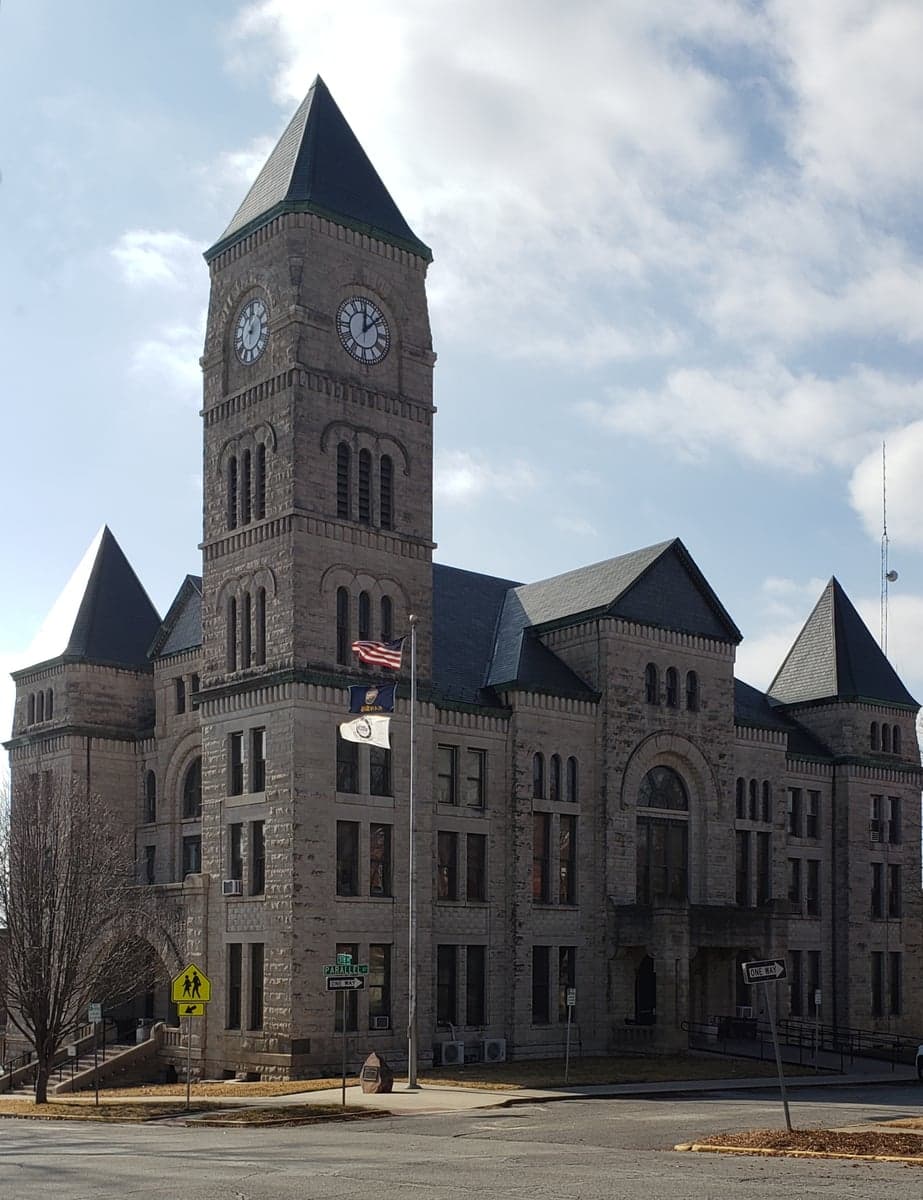
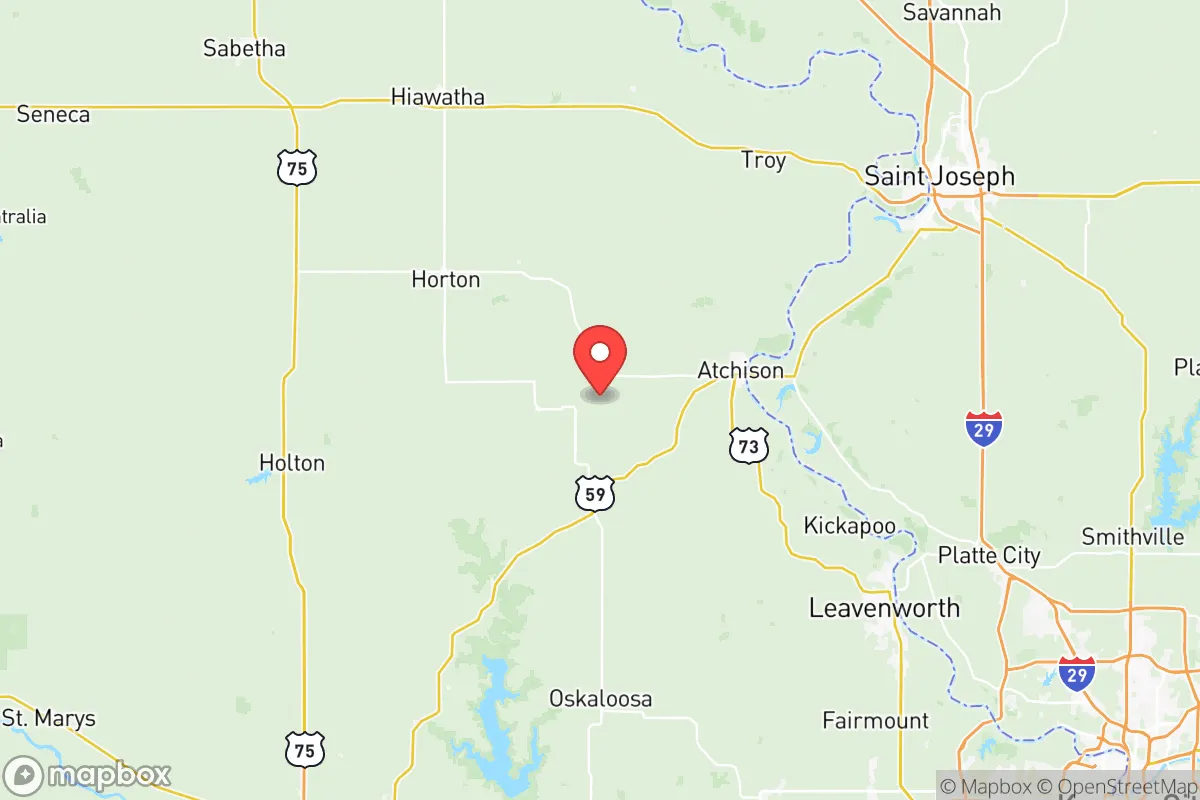
Photo: Wikipedia
Political ClimatePolitical Climate in Atchison County
Showing district-level results — no local-only data available.
Local Political AnalysisPolitical Analysis of Atchison County
Atchison County has long been a solidly conservative stronghold, with a Cook PVI of R+10 that actually puts it a tick redder than the state of Kansas as a whole, which sits at R+9. That might not sound like a huge gap, but when you’ve lived here as long as I have, you feel the difference in the air. The county has held steady for decades, but like everywhere else, you can see the cracks forming—especially in the county seat of Atchison itself, where a small but vocal progressive element has been trying to push things like diversity initiatives and climate action plans that feel out of step with the rest of us. The rural towns like Effingham and Huron are still rock-ribbed Republican, but the precincts around Benedictine College and the older parts of downtown Atchison have started to trend bluer in recent cycles, which is a real concern for anyone who values limited government and personal freedom.
How it compares
Compared to the rest of Kansas, Atchison County is a bit of a bellwether for the state’s cultural divide. The state as a whole is R+9, but that number is pulled down by the deep-blue pockets of Johnson County and Lawrence. Here in Atchison County, we don’t have that kind of urban anchor—our biggest town is Atchison itself, with about 10,000 people, and even there the conservative vote usually carries the day, though by narrower margins than you’d see in the surrounding townships. For example, in the 2024 presidential race, the precinct covering the rural areas west of Atchison city limits went +35 for the Republican candidate, while the precinct around the college campus was only +5. That’s a 30-point swing within a single county, and it tells you everything about where the pressure points are. The state legislature has been reliably conservative, but we’ve seen some concerning bills out of Topeka lately—like efforts to expand Medicaid or loosen gun laws in ways that feel like federal overreach by another name. Atchison County’s commissioners have been pushing back, but it’s a constant fight to keep the government out of our lives.
What this means for residents
For folks living here, the political climate means you can still mostly live your life without the government breathing down your neck—for now. Property taxes are low, there’s no county-level income tax, and the local schools (like Atchison Public Schools and the smaller districts in Effingham and Lancaster) are run by locally elected boards that answer to parents, not bureaucrats in Washington. But the creeping influence of progressive ideology is real. You see it in the push for “equity” training for county employees, or in the pressure to adopt zoning changes that favor dense housing over single-family homes. These are small things individually, but they add up to a loss of the personal freedoms that drew many of us here in the first place. The county’s Second Amendment sanctuary status, passed in 2021, was a direct response to that—a signal that we won’t let state or federal overreach dictate how we protect our families.
Culturally, Atchison County is still a place where neighbors help neighbors and the local churches (like First Baptist in Atchison and the small Methodist congregation in Huron) are the social backbone. The annual Atchison County Fair in Lancaster is a gathering where politics takes a backseat to livestock judging and pie contests. But the policy distinctions are sharpening: while Kansas has moved to expand Medicaid and legalize medical marijuana, Atchison County has resisted both, seeing them as federal-style programs that create dependency. The long-term trajectory depends on whether the rural towns can hold the line against the progressive drift coming out of the county seat. If I had to guess, I’d say we’ll stay red for another decade, but the margin will keep shrinking unless we get serious about defending our way of life.

State Political ClimatePolitical Climate in Kansas
State Political AnalysisPolitical Environment in the State
Kansas is a solidly Republican state with a Cook PVI of R+9, but don’t let that number fool you into thinking it’s a monolith. Over the past 20 years, the state has shifted rightward in presidential races—voting for Trump by 15 points in 2020 and 18 points in 2024—while simultaneously electing a Democratic governor, Laura Kelly, twice. The real story is a growing urban-rural fracture, with the Kansas City suburbs and Lawrence pulling left, while the rest of the state—places like Wichita, Topeka, and the vast rural expanse—holds the line or deepens its conservative roots. If you’re looking for a state where conservative values still have a fighting chance against coastal encroachment, Kansas is a mixed bag: solid on paper, but with some worrying cracks.
Urban vs. rural divide
The political map of Kansas is a tale of three regions. The Kansas City metro area, particularly Johnson County (Overland Park, Olathe, Leawood), was once reliably red but has been trending purple-to-blue for a decade. Johnson County voted for Biden in 2020 and Harris in 2024, driven by an influx of out-of-state professionals and corporate transplants. Lawrence, home to the University of Kansas, is a deep blue island—think Berkeley with wheat fields. Wichita, the largest city, remains a conservative stronghold in Sedgwick County, but even there, the city core is drifting left while the suburbs like Andover and Derby stay red. The real firepower for the GOP comes from the rural and small-town counties—places like Ellis County (Hays), Finney County (Garden City), and the entire western third of the state, where Trump regularly pulls 75-80% of the vote. The divide isn’t just geographic; it’s cultural. Rural Kansans see the state as a last bastion of self-reliance, while urbanites increasingly import the politics of the coasts.
Policy environment
Kansas’s policy environment is a conservative’s mixed report card. On taxes, the state is a relative bright spot: the flat income tax rate was cut to 5.7% in 2024, and the state has no tax on Social Security benefits. Property taxes are moderate, though local levies vary wildly—expect higher rates in Johnson County than in rural Stafford County. The regulatory posture is business-friendly, with a right-to-work law and limited occupational licensing compared to blue states. Education policy is a flashpoint: the state has a robust school choice program, including tax-credit scholarships for private schools, but the Kansas Supreme Court has repeatedly forced the legislature to increase K-12 funding, a sore spot for fiscal conservatives. Healthcare is largely market-driven, with no state-run exchange and a limited Medicaid expansion that Governor Kelly has pushed but the GOP legislature has blocked. Election laws are solid: voter ID is required, and the state purges inactive voters regularly. No mail-in ballot free-for-all here—Kansas keeps its elections clean, which is a relief after 2020.
Trajectory & freedom
On personal freedom, Kansas has been a mixed bag over the last decade, but the trend is cautiously positive. The biggest win for liberty was the 2021 passage of the Second Amendment Protection Act, which nullifies federal gun laws that infringe on the right to keep and bear arms—a direct rebuke to federal overreach. Constitutional carry has been law since 2015. On parental rights, the state passed a Parents’ Bill of Rights in 2023, giving parents explicit authority over their children’s education and medical decisions. Medical autonomy took a hit during COVID, with Governor Kelly’s emergency orders shutting down businesses and churches, but the legislature pushed back with a 2022 law limiting future emergency powers. Property rights are strong, with no state-level rent control and limited eminent domain abuse. The biggest threat to freedom is the creeping influence of Johnson County’s progressive politics—local school boards there have adopted DEI initiatives and gender ideology curricula, which the state legislature has tried to curb with the 2023 Fairness in Women’s Sports Act and a ban on transgender procedures for minors. The state is fighting back, but the battle is ongoing.
Civil unrest & political movements
Kansas has seen its share of political heat, but it’s nothing like the chaos of Portland or Seattle. The most visible flashpoints have been around abortion: after the 2022 Dobbs decision, Kansas became the first state to vote on a constitutional amendment to remove abortion protections, and it failed—a shock to conservatives, driven by heavy turnout in Johnson County and Lawrence. That vote revealed a motivated pro-choice movement, funded heavily by out-of-state money. On the right, the Kansas Republican Party has seen a grassroots takeover by the Kansas GOP’s conservative wing, with groups like the Kansas Policy Institute pushing for lower taxes and school choice. Immigration politics are quieter than in border states, but Garden City and Dodge City have seen tensions over meatpacking plant labor, with some local officials pushing for stricter enforcement. Election integrity controversies flared in 2020 and 2022, with claims of irregularities in Johnson County’s mail-in ballot processing, though no major fraud was proven. The state has no sanctuary city policies, and local law enforcement generally cooperates with ICE. A new resident won’t see daily protests, but they will feel the cultural war in school board meetings and county commission races.
Projection
Over the next 5-10 years, Kansas is likely to become more polarized, not less. The in-migration pattern is a double-edged sword: people are moving to the Kansas City suburbs from blue states like California and Illinois, bringing their politics with them. Johnson County will continue to trend blue, potentially flipping the 3rd Congressional District permanently. Meanwhile, rural counties are depopulating, which weakens the GOP’s rural base. The state legislature is gerrymandered to protect Republican majorities, but that’s a temporary fix. The real wildcard is Wichita: if Sedgwick County follows Johnson County’s trajectory, Kansas could become a swing state within a decade. On the freedom front, expect continued battles over school curriculum, transgender policies, and gun rights. The legislature will likely pass a school voucher expansion and maybe a further income tax cut, but the Kansas Supreme Court will remain a liberal obstacle. For a conservative moving in now, the bottom line is this: Kansas is still a good bet for freedom and low taxes, but you need to pick your county carefully. Stick to the rural areas or the conservative suburbs of Wichita, and you’ll find a community that shares your values. Move to Johnson County or Lawrence, and you’ll be fighting the same cultural battles you left behind.
For a new resident, the practical takeaway is simple: Kansas offers a low-tax, business-friendly environment with strong gun rights and parental control, but it’s not immune to the national trends. The state is a battleground for the soul of the Midwest, and your vote—and your choice of neighborhood—will matter more here than in a deep red state like Oklahoma. If you’re willing to engage in local politics and pick your turf wisely, Kansas can still be a refuge. If you’re looking for a place where the culture war is already won, you’ll need to go further west.
* Values derived from national, state, county, city and local statistics and may differ in a specific area. Last updated: 2026-05-29T10:03:32.000Z
Narrative content on this page is AI-generated and may contain mistakes. Verify any details that matter before acting on them.
ReloMaps may earn a commission from affiliate links at no extra cost to you.

