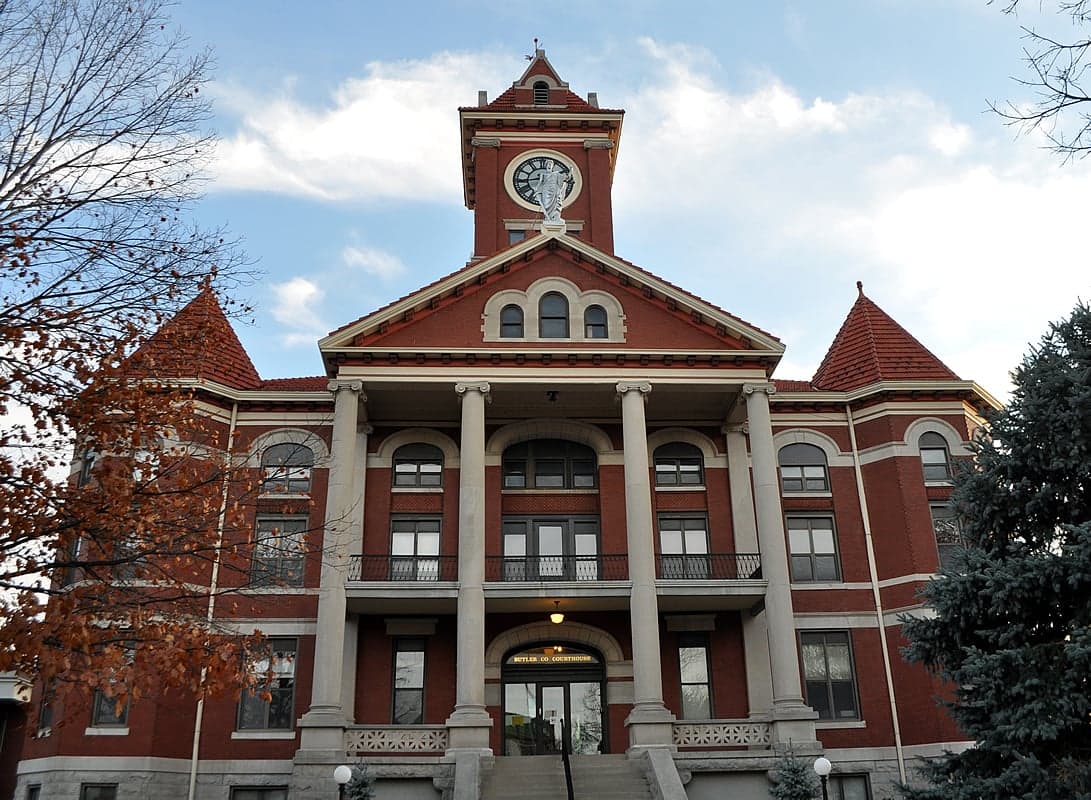
Photo: Wikipedia
Personal Sovereignty in Butler County
Viable for self-reliance. Generally workable, though some barriers may limit total independence.
What does Personal Sovereignty tell us?
Personal Sovereignty measures your capacity for self-reliance and independence with minimal government friction. Higher scores mean fewer barriers between you and the way you want to live... but it assumes you have the space you need and good neighbors.
What does this tell us?
Personal Sovereignty measures your capacity for self-reliance and independence with minimal government friction. Higher scores mean fewer barriers between you and the way you want to live... but it assumes you have the space you need and good neighbors.
State Policy
Energy independence: Self-sufficient (80% of energy produced in-state)
Personal Liberty
Homesteading

Personal Liberty Analysis
Butler County, Kansas, offers a notably high degree of personal sovereignty compared to the tightening regulatory environments found in coastal states and even in neighboring Johnson County. For those prioritizing autonomy—whether from a prepper, survivalist, or constitutional conservative perspective—this region of the Flint Hills presents a practical balance of low regulatory friction, strong gun culture, and genuine homesteading viability. The county seat of El Dorado and the smaller communities like Augusta, Rose Hill, and Douglass each offer distinct flavors of this freedom, but the overarching environment is one where government overreach is met with skepticism and self-reliance is the default expectation.
Tax burden and regulatory posture: How Butler County compares to Kansas and the nation
Butler County’s tax and regulatory climate is a major draw for those seeking to minimize government intrusion. The county’s property tax rate is approximately 1.3% of assessed value, which is moderate for Kansas but significantly lower than the 2%+ rates common in Texas or the Northeast. More importantly, the regulatory posture at the county level is hands-off. There is no county-wide zoning in unincorporated areas, meaning that if you own land outside city limits—say, near Potwin or Whitewater—you can build a workshop, park an RV, or keep livestock without navigating a thicket of permits. The state of Kansas itself is a right-to-work state with no state-level income tax on Social Security benefits and a flat income tax rate of 5.7% (as of 2026). For a single individual or family, this means more of your earnings stay in your pocket, and the local government’s appetite for new regulations is low. The county commission has consistently rejected proposals for stricter building codes or environmental overlay districts, a stance that appeals directly to those wary of creeping federal or state mandates.
Self-defense and gun law specifics: Constitutional carry and local culture
Kansas is a constitutional carry state, and Butler County fully embraces that ethos. No permit is required to carry a concealed firearm for anyone legally allowed to possess one, and the county sheriff’s office in El Dorado is known for issuing concealed carry permits quickly for those who still want reciprocity with other states. The local culture is deeply pro-Second Amendment. You will see open carry in rural gas stations and at the county fair without a second glance. The county has no local ordinances restricting magazine capacity, firearm storage, or where you can carry beyond state preemption laws. For those concerned about self-defense in a deteriorating national scenario, Augusta and Douglass have active shooting ranges and gun clubs where training and community preparedness are normalized. The nearest major city, Wichita, is about 30 minutes from El Dorado, but its more restrictive city ordinances do not apply in Butler County. This creates a buffer zone where gun rights are not just protected but culturally reinforced.
Self-reliance and homesteading viability: Lot sizes, zoning, and off-grid feasibility
For the homesteader or off-grid prepper, Butler County is one of the more accommodating areas in Kansas. In unincorporated areas, there are no minimum lot size requirements for building, though most rural parcels are sold in 5- to 40-acre tracts. The county allows rainwater catchment, composting toilets, and solar panel installation without special permits. Off-grid living is entirely feasible, especially in the northern part of the county near Cassoday—known as the "Cow Chip Capital of Kansas"—where properties are cheap and neighbors are few. The city of El Dorado does have municipal water and sewer hookup requirements within its limits, but outside city boundaries, you can drill a well and install a septic system with a straightforward county health department permit. Zoning is minimal: there are no restrictions on keeping chickens, goats, or even a few head of cattle on rural residential lots. For those looking to build a self-sufficient compound, the area around Potwin offers large, affordable tracts with good groundwater access and minimal regulatory oversight. The county’s agricultural heritage means that feed stores, farm supply co-ops, and equipment dealers are abundant, reducing reliance on big-box retailers.
Personal liberties: Parental rights, medical autonomy, speech, and property
Butler County aligns strongly with the conservative emphasis on parental rights and medical freedom. The local school districts—particularly in Rose Hill and Circle (near Towanda)—have resisted federal overreach on curriculum and health mandates. Parents have significant influence over school boards, and opt-out policies for vaccines or sex education are respected without pushback. Medical autonomy is bolstered by Kansas’s lack of a state vaccine mandate for adults and the presence of several direct-primary-care clinics in El Dorado that operate outside the insurance system. Free speech is robust; local government meetings are open, and citizens regularly voice concerns without fear of retaliation. Property rights are protected by the state’s strong eminent domain laws, which require just compensation and public purpose. There is no county-level rent control, no short-term rental bans in rural areas, and no restrictions on political signage on private property. For the individual who views government overreach as the primary threat to liberty, Butler County offers a legal environment where you can raise your family, practice your faith, and prepare for uncertain times largely on your own terms.
In the broader context of the Great Plains, Butler County stands out as a stronghold of personal sovereignty. Compared to the regulatory density of the Front Range in Colorado or the urban sprawl of Dallas-Fort Worth, this region offers a lower tax burden, fewer restrictions on firearms and property use, and a cultural expectation of self-reliance. For the single individual or parent seeking a base of operations where the government stays out of your way—whether you are prepping for economic collapse, building a homestead, or simply wanting to live free from nuisance ordinances—Butler County delivers a level of autonomy that is increasingly rare in modern America. The trade-off is limited urban amenities and a slower pace of life, but for those who value sovereignty above convenience, that is not a trade-off at all.

* Values derived from national, state, county, city and local statistics and may differ in a specific area. Last updated: 2026-05-16T00:52:33.000Z
Narrative content on this page is AI-generated and may contain mistakes. Verify any details that matter before acting on them.
ReloMaps may earn a commission from affiliate links at no extra cost to you.

