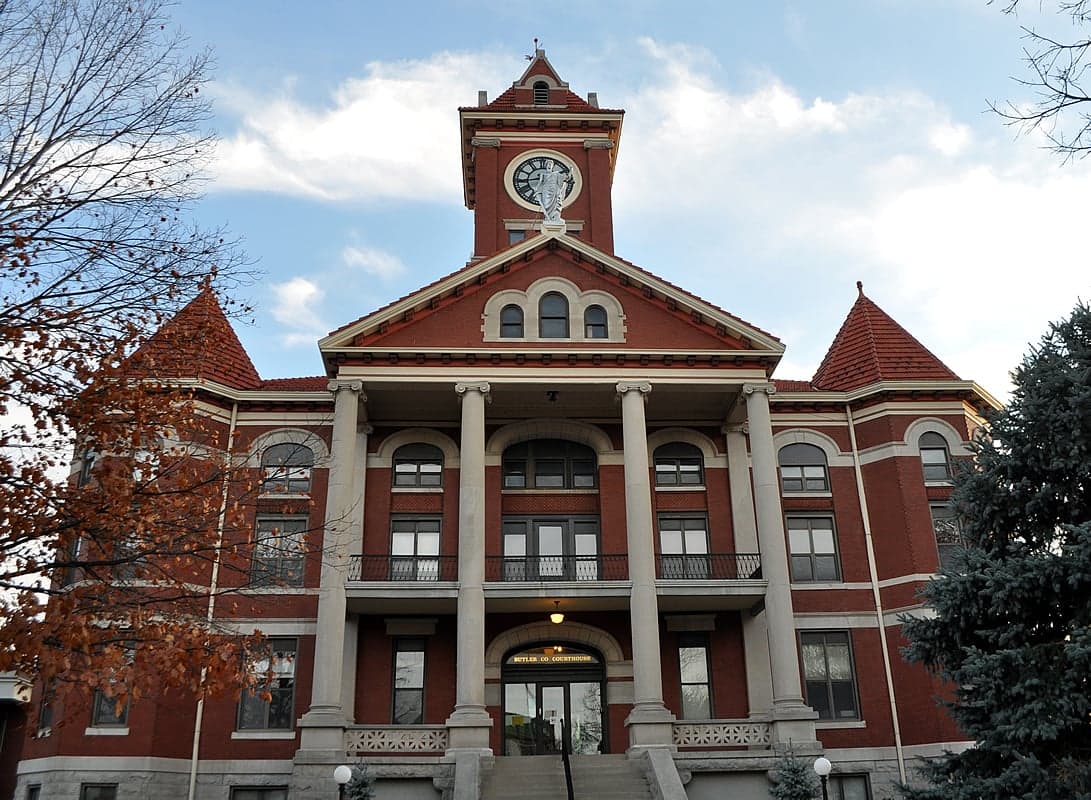
Photo: Wikipedia
Political ClimatePolitical Climate in Butler County
Showing district-level results — no local-only data available.
Local Political AnalysisPolitical Analysis of Butler County
Butler County, Kansas, has long been a solid conservative stronghold, and that hasn't changed much. The Cook PVI here is R+12, which is a good three points redder than the state of Kansas as a whole, which sits at R+9. If you look at the presidential results, it's not even close—Trump carried the county by a comfortable margin in 2020, and that trend has held steady for decades. But if you spend any time here, you'll notice the political vibe isn't a monolith; there are real differences between the towns, and the direction things are heading is worth keeping an eye on.
How it compares
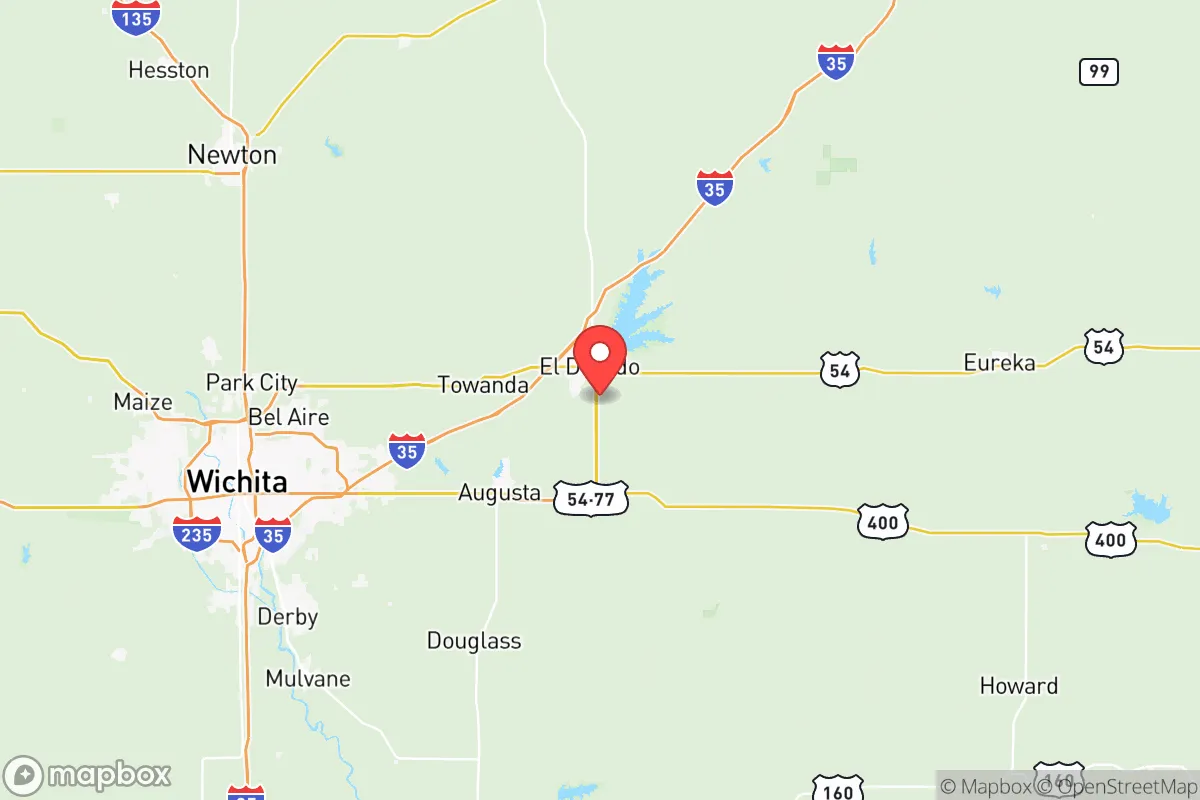
Compared to the rest of Kansas, Butler County is noticeably more conservative, but the gap is narrowing in some spots. The state as a whole has seen a slow drift toward purple in places like Johnson County (suburban Kansas City), but Butler County has largely resisted that shift. Within the county itself, the political map is pretty clear: El Dorado, the county seat, is the most moderate area, with some precincts that can swing or even lean blue, especially around the college (Butler Community College) and the downtown core. Augusta and Andover are reliably red, with Andover being a bit more of a suburban, family-oriented conservative vibe. Rose Hill, Douglass, and Towanda are deep red—these are the farming and oil-field communities where you'll see Trump signs on every other lawn. The swing precincts are mostly in the unincorporated areas near the county's western edge, where new subdivisions are popping up and bringing in folks from Wichita who might not share the same values. That's the real concern: as Wichita's sprawl creeps east, we're seeing a slow bleed of progressive influence into what was once rock-solid territory.
What this means for residents
For those of us who value personal freedoms and limited government, Butler County is still a good place to be—but it's not immune to the trends that are worrying conservatives across the state. The local school boards, for instance, have been battlegrounds over curriculum and parental rights, and some of the more moderate precincts in El Dorado have started to push back on things like mask mandates and vaccine passports. The county commission is still solidly conservative, but you can feel the pressure from the state level, where the governor's office has been leaning left on issues like tax policy and energy regulation. The biggest red flag is the slow erosion of local control—state mandates on everything from land use to public health orders are starting to override what the county wants. If you're moving here for the conservative values, you'll find plenty of like-minded neighbors, but don't expect it to stay this way forever. The newcomers from Wichita and the coast are bringing their politics with them, and it's showing up in the local elections.
Culturally, Butler County still feels like old Kansas—hunting, fishing, church on Sunday, and a general distrust of government overreach. You won't find many pride flags or "defund the police" signs here, and the local gun culture is strong. But the policy distinctions are real: property taxes are lower than in Johnson County, and the county has been aggressive in pushing back against state-level renewable energy mandates that would force wind turbines onto prime farmland. The biggest distinction is the sense of community—people here still know their neighbors, and the local politics reflect that. If you're looking for a place where your voice still matters and the government stays out of your business, Butler County is it. Just keep an eye on those precincts near the county line—that's where the future is being decided.

State Political ClimatePolitical Climate in Kansas
State Political AnalysisPolitical Environment in the State
Kansas is a solidly Republican state with a Cook PVI of R+9, but don’t let that number fool you into thinking it’s a monolith. Over the past 20 years, the state has swung from a moderate, pragmatic conservatism—think Nancy Kassebaum and Bob Dole—into a much sharper, more ideologically driven Republican dominance, punctuated by a brief, jarring experiment with Governor Sam Brownback’s deep tax cuts from 2012-2017. That experiment blew a hole in the state budget, led to school funding crises, and ultimately resulted in a Republican legislature overriding Brownback’s vetoes to raise taxes in 2017. Today, the GOP holds supermajorities in both chambers, but the party is deeply split between a traditional, business-friendly wing and a more populist, liberty-oriented faction. The Democratic presence is largely confined to the urban cores of Kansas City (Wyandotte County) and Lawrence (Douglas County), with a smattering of strength in Topeka and Wichita’s African American and union households. For a conservative-leaning individual or family looking to relocate, Kansas offers a low-tax, culturally traditional environment, but the political drama is real and ongoing.
Urban vs. rural divide
The political map of Kansas is a textbook case of the urban-rural chasm. The state’s two major population centers—the Kansas City metro (Johnson, Wyandotte, and Leavenworth counties) and Wichita (Sedgwick County)—are the only real blue or purple zones. Johnson County, the wealthiest and most educated county in the state, has been trending left for a decade; it voted for Biden in 2020 by a narrow margin and has sent a growing number of Democrats to the legislature. Overland Park and Olathe, its largest cities, are now home to a mix of corporate transplants and younger professionals who lean moderate to liberal on social issues. Wyandotte County (Kansas City, KS) is reliably Democratic, driven by a large minority population and unionized industrial workers. Lawrence, home to the University of Kansas, is the state’s most progressive enclave, a blue island in a sea of red. Meanwhile, the rest of the state—the vast, agricultural expanse from the Flint Hills to the High Plains—votes overwhelmingly Republican. Counties like Wallace, Greeley, and Grant routinely deliver 85-90% of their votes to the GOP. The divide isn’t just about party; it’s about worldview. Rural Kansans see the state government in Topeka as a distant, sometimes meddlesome force, while suburbanites in Johnson County want better-funded schools and more moderate social policies. This tension plays out every legislative session, especially over school funding and tax policy.
Policy environment
Kansas’s policy environment is a mixed bag for a conservative. On the plus side, the state has a flat income tax rate of 5.7% (down from a top rate of 6.45% before the Brownback cuts), no inheritance tax, and a relatively low property tax burden compared to neighboring Missouri. The state is a right-to-work state, meaning you can’t be forced to join a union as a condition of employment. On the regulatory front, Kansas is generally business-friendly, with a streamlined permitting process for new construction and a strong agricultural exemption from many environmental rules. However, the state’s education policy is a perennial battleground. The Kansas Supreme Court has repeatedly ordered the legislature to increase school funding, leading to a series of tax hikes and budget battles that have frustrated fiscal conservatives. Healthcare is another sore spot: Kansas did not expand Medicaid under the Affordable Care Act, leaving a coverage gap for low-income adults, but the state has also avoided the worst of the Obamacare exchange premium spikes. Election laws are solidly conservative: Kansas requires a photo ID to vote, has strict voter registration deadlines, and has purged inactive voters from the rolls. The state also has a constitutional amendment protecting the right to hunt and fish, and a strong castle doctrine law for self-defense.
Trajectory & freedom
On the freedom front, Kansas has been a mixed bag over the past decade. The good news: the state has expanded gun rights significantly. In 2021, Kansas became a permitless carry state, meaning any law-abiding adult can carry a concealed firearm without a license. The state also has strong preemption laws that prevent cities like Lawrence or Kansas City from enacting their own gun control ordinances. On parental rights, Kansas passed a Parents’ Bill of Rights in 2021, requiring schools to notify parents of any changes to a student’s health or well-being, including gender identity issues. The state has also banned transgender athletes from competing in girls’ sports (2023) and prohibited gender-affirming care for minors (2023). On the concerning side, the state has seen a steady creep of government overreach in the name of public health. During COVID, Governor Laura Kelly (a Democrat) imposed a statewide mask mandate and business closures, though the legislature quickly stripped her of emergency powers in 2021. More troubling for liberty-minded folks, the state has a history of aggressive use of eminent domain for economic development projects, most famously in the 1990s when the city of Kansas City, KS, bulldozed a working-class neighborhood to build a NASCAR track. Property rights advocates remain wary. The biggest freedom win in recent years was the 2022 passage of a constitutional amendment declaring that there is no right to abortion in Kansas—but that amendment was rejected by voters in a statewide referendum, a stunning defeat for the pro-life movement that showed the state is not as uniformly conservative as its PVI suggests.
Civil unrest & political movements
Kansas is not a hotbed of civil unrest, but there have been flashpoints. The most visible was the 2022 abortion referendum, which drew massive turnout and saw pro-choice activists outspend and out-organize pro-life groups. Lawrence has seen periodic protests over police brutality and racial justice, but they’ve been small and contained. The state has a small but vocal militia movement, centered in rural areas like the Flint Hills and the Ozark Plateau region near the Missouri border. These groups are generally anti-government and anti-tax, but they’ve been quiet since the 1990s. Immigration politics are less heated than in border states, but there’s a persistent tension over meatpacking plants in towns like Garden City and Dodge City, which have seen large influxes of immigrant labor. The state has no sanctuary city policies, and local law enforcement cooperates with ICE. Election integrity has been a hot topic since 2020, with Republican Secretary of State Scott Schwab implementing strict voter ID laws and pushing for a statewide voter registration database audit. There have been no major election fraud scandals, but the issue remains a rallying cry for the GOP base. The most visible political movement in recent years has been the rise of the “Moms for Liberty” chapter in Johnson County, which has successfully pushed for school board candidates who oppose critical race theory and LGBTQ curriculum.
Projection
Over the next 5-10 years, Kansas is likely to become more politically competitive, but not necessarily more liberal. The key driver is in-migration: Johnson County is growing fast, attracting young professionals and remote workers from the coasts who bring moderate-to-liberal social views. This will continue to push the Kansas City suburbs leftward, potentially flipping a few state legislative seats and making the governor’s race more competitive. However, the rural counties are emptying out, which means their political weight is shrinking. The state’s overall PVI of R+9 is likely to soften to R+6 or R+7 by 2030. The big question is whether the GOP can hold together its coalition of rural conservatives and suburban moderates. If the party veers too far to the populist right on issues like school vouchers or abortion, it could lose the suburbs. Conversely, if Democrats continue to run on a progressive platform, they’ll struggle to win outside of Lawrence and Wyandotte. For a conservative moving in now, expect a state that remains Republican-controlled but with more internal friction. The tax environment will stay favorable, but school funding battles will continue. The biggest wildcard is the state Supreme Court, which has a liberal majority and could strike down conservative laws on education, abortion, or gun rights. A new resident should be prepared for a state that is culturally conservative but politically volatile, with a government that is often at war with itself.
Bottom line for a new resident: Kansas is a good bet if you value low taxes, gun rights, and traditional values, but don’t expect a libertarian paradise. The state government is active and sometimes heavy-handed, especially on education and property rights. If you’re moving to Johnson County, you’ll find a comfortable, well-funded suburban life with a growing progressive presence. If you’re heading to rural Kansas, you’ll find a slower pace, strong community ties, and a deep suspicion of Topeka. Either way, keep an eye on the statehouse—the political winds shift fast on the prairie.
* Values derived from national, state, county, city and local statistics and may differ in a specific area. Last updated: 2026-05-16T00:52:33.000Z
Narrative content on this page is AI-generated and may contain mistakes. Verify any details that matter before acting on them.
ReloMaps may earn a commission from affiliate links at no extra cost to you.

