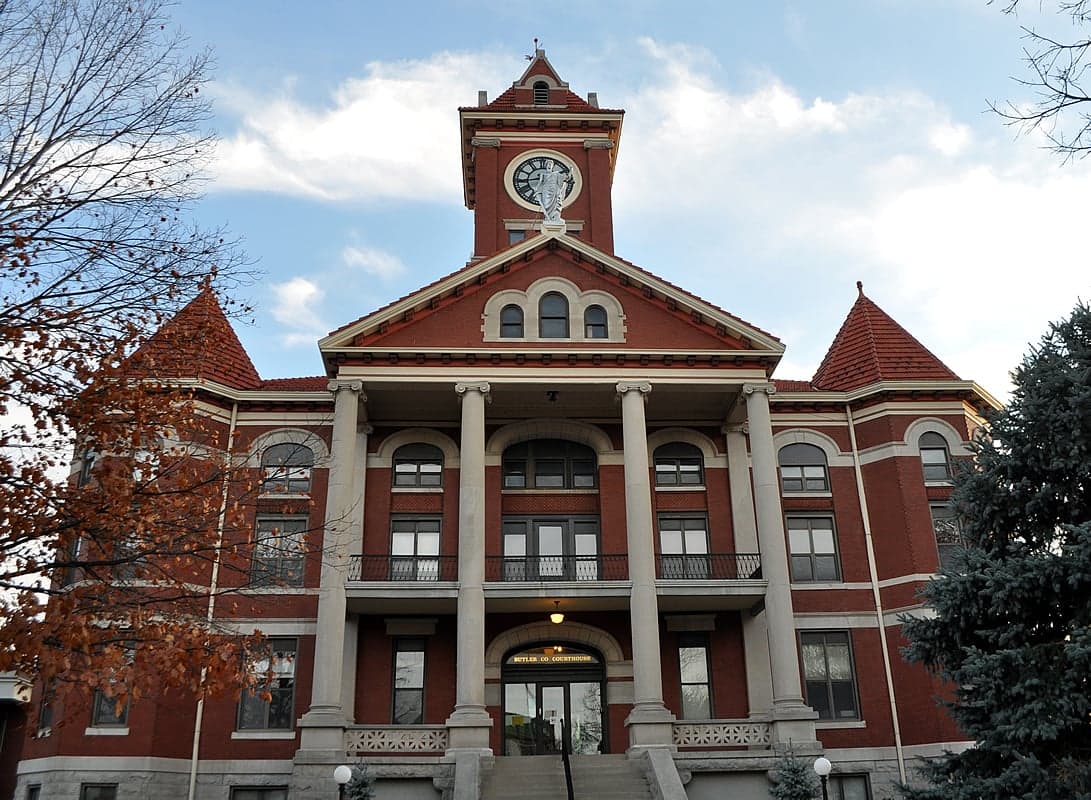
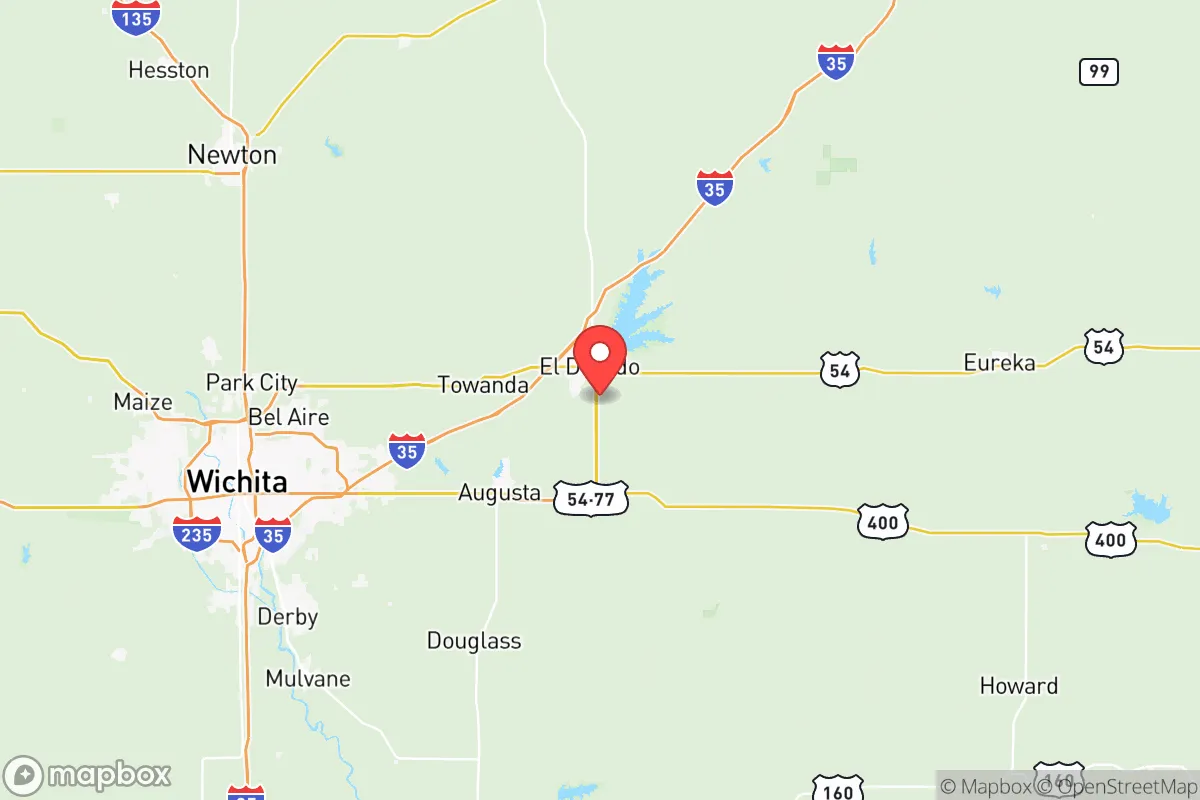
Photo: Wikipedia
Demographics of Butler County
Affluence Level in Butler County
A middle-class area roughly in line with national averages across income, home values, education, and employment.
People of Butler County
Butler County, Kansas, today is a predominantly white, politically conservative community of 67,916 residents, characterized by a strong rural and small-town identity rooted in agriculture and energy. With a foreign-born population of just 2.1%, it remains one of the least ethnically diverse counties in the Wichita metropolitan area, though its Hispanic share (5.6%) has grown modestly in recent decades. The county’s population is spread across a network of small cities and unincorporated communities, with El Dorado serving as the county seat and economic anchor, while Augusta, Andover, Rose Hill, and Douglass each retain distinct identities. Residents often describe the area as a place where family values, self-reliance, and community ties remain central, attracting those seeking a slower pace of life within commuting distance of Wichita.
Settlement & growth (pre-1960)
Before American settlement, the land that is now Butler County was part of the ancestral territory of the Osage Nation, who used the region for hunting bison and other game. The Osage ceded the area to the United States in the 1808 Osage Treaty, and for decades it remained a sparsely populated frontier. The first permanent American settlers arrived in the 1850s, primarily from the Upper South and Midwest—Kentucky, Missouri, Indiana, and Ohio—drawn by the promise of cheap land under the 1854 Kansas-Nebraska Act and later the 1862 Homestead Act. These early settlers were overwhelmingly of English, Scots-Irish, and German ancestry, and they established small farming communities along the Walnut River and its tributaries.
The county was officially organized in 1859, and the town of El Dorado was founded the same year as the county seat, quickly becoming a trading center for area farmers. The arrival of the Atchison, Topeka and Santa Fe Railway in the 1870s spurred the founding of other towns along its route, including Augusta (1871), Douglass (1872), and Whitewater (1884). These rail towns became shipping points for wheat, corn, and livestock, and their populations grew steadily through the late 19th century. A second wave of settlement came in the 1880s and 1890s, when Mennonite immigrants from Russia—of German descent—established communities in the region, bringing with them the Turkey Red wheat variety that would transform Kansas agriculture. While the Mennonite concentration was strongest in neighboring Harvey and Marion counties, their influence extended into northern Butler County, particularly around the town of Potwin.
The discovery of oil in the El Dorado field in 1914 triggered a dramatic population boom, transforming Butler County from a purely agricultural economy into a center of petroleum extraction. The El Dorado oil boom brought thousands of workers from Oklahoma, Texas, and the Midwest, many of them of Scots-Irish and German descent, along with smaller numbers of African American laborers who settled in segregated neighborhoods in El Dorado and Augusta. The county’s population peaked at 43,842 in 1930, then declined during the Great Depression and Dust Bowl years as agricultural mechanization reduced the need for farm labor and oil prices collapsed. The post-World War II period saw modest recovery, with population reaching 38,395 by 1960, as the county’s economy diversified into manufacturing and services tied to the growing Wichita aircraft industry.
Modern era (post-1965)
The 1965 Hart-Cellar Act had a minimal direct impact on Butler County, as the region did not attract significant numbers of post-1965 immigrants. The county’s foreign-born population remains at just 2.1%, far below the national average, and the overwhelming majority of residents are native-born. The most notable demographic shift since 1965 has been the growth of the Hispanic population, which rose from less than 1% in 1970 to 5.6% today. This growth is primarily driven by domestic migration from Texas and the Southwest, as well as some direct immigration from Mexico and Central America, with families settling in El Dorado and Augusta to work in meatpacking, construction, and agriculture. The Hispanic community is largely assimilated into the county’s cultural fabric, with bilingual services available in some schools and churches, but no distinct ethnic enclave has formed.
Domestic migration has been the dominant force shaping modern Butler County. Beginning in the 1970s, the expansion of Wichita’s aircraft manufacturing sector—led by companies like Boeing, Cessna, and Beechcraft—drew workers from across the Midwest and Plains states. Many of these workers chose to live in Butler County’s smaller communities, particularly Andover and Rose Hill, which offered lower taxes, better schools, and larger lots than Wichita’s inner suburbs. Andover has been the fastest-growing city in the county, its population rising from 3,000 in 1980 to over 14,000 today, driven by an influx of middle-class families seeking a suburban lifestyle with a small-town feel. The county’s African American population remains small at 2.0%, concentrated in El Dorado and Augusta, and has declined slightly since 2000 as younger generations have moved to larger cities. East and Southeast Asian residents (0.9%) and Indian subcontinent residents (0.7%) are present in very small numbers, mostly professionals employed in Wichita’s healthcare and engineering sectors who have chosen to live in Andover or El Dorado for their school systems.
The county’s population has grown steadily but slowly, from 38,395 in 1960 to 67,916 today, a rate of about 0.8% per year. This growth is almost entirely due to domestic in-migration, as natural increase (births minus deaths) has been flat or slightly negative since 2010. The population is aging, with a median age of 39.2, slightly above the Kansas average, as younger adults continue to leave for college and urban job markets. The college-educated share of the population stands at 32.6%, reflecting the presence of professional commuters and the county’s investment in public schools, particularly in the Andover and Circle school districts.
The future
Butler County’s demographic trajectory points toward slow, steady growth driven by continued domestic migration from Wichita and other parts of Kansas, rather than by international immigration. The Hispanic share of the population is likely to continue rising gradually, reaching perhaps 8-10% by 2040, as younger Hispanic families move in for affordable housing and construction jobs. However, the county is not expected to become significantly more diverse in the near term, as the white non-Hispanic population remains above 85% and shows no signs of rapid decline. The East/Southeast Asian and Indian subcontinent populations will likely remain small, growing only as Wichita’s professional sectors expand and attract a few more families to Andover’s schools.
The most significant demographic trend is the ongoing suburbanization of the county’s western edge, particularly along the K-254 corridor connecting Wichita to El Dorado. Andover is expected to continue absorbing Wichita’s spillover population, potentially reaching 20,000 residents by 2040, while Rose Hill and Augusta will see more modest growth. The eastern and southern parts of the county, including Douglass, Leon, and Latham, are likely to remain rural and agricultural, with stable or slowly declining populations as farm consolidation continues. The county’s cultural identity—conservative, family-oriented, and rooted in agriculture and energy—shows no signs of being fundamentally altered by in-migration, as new residents tend to be drawn to the area precisely because of those characteristics.
For someone moving to Butler County now, the area offers a stable, predictable demographic environment where community values and institutions change slowly. The population is becoming slightly more diverse and more suburban, but the core identity of the county—as a place of wide-open spaces, strong schools, and conservative politics—remains intact. New residents, particularly those from more urban or diverse areas, should expect to find a community where social networks are built through churches, schools, and local events, and where the pace of life is deliberately slower than in Wichita or the Kansas City suburbs.

* Values derived from national, state, county, city and local statistics and may differ in a specific area. Last updated: 2026-05-16T00:52:33.000Z
Narrative content on this page is AI-generated and may contain mistakes. Verify any details that matter before acting on them.
ReloMaps may earn a commission from affiliate links at no extra cost to you.

