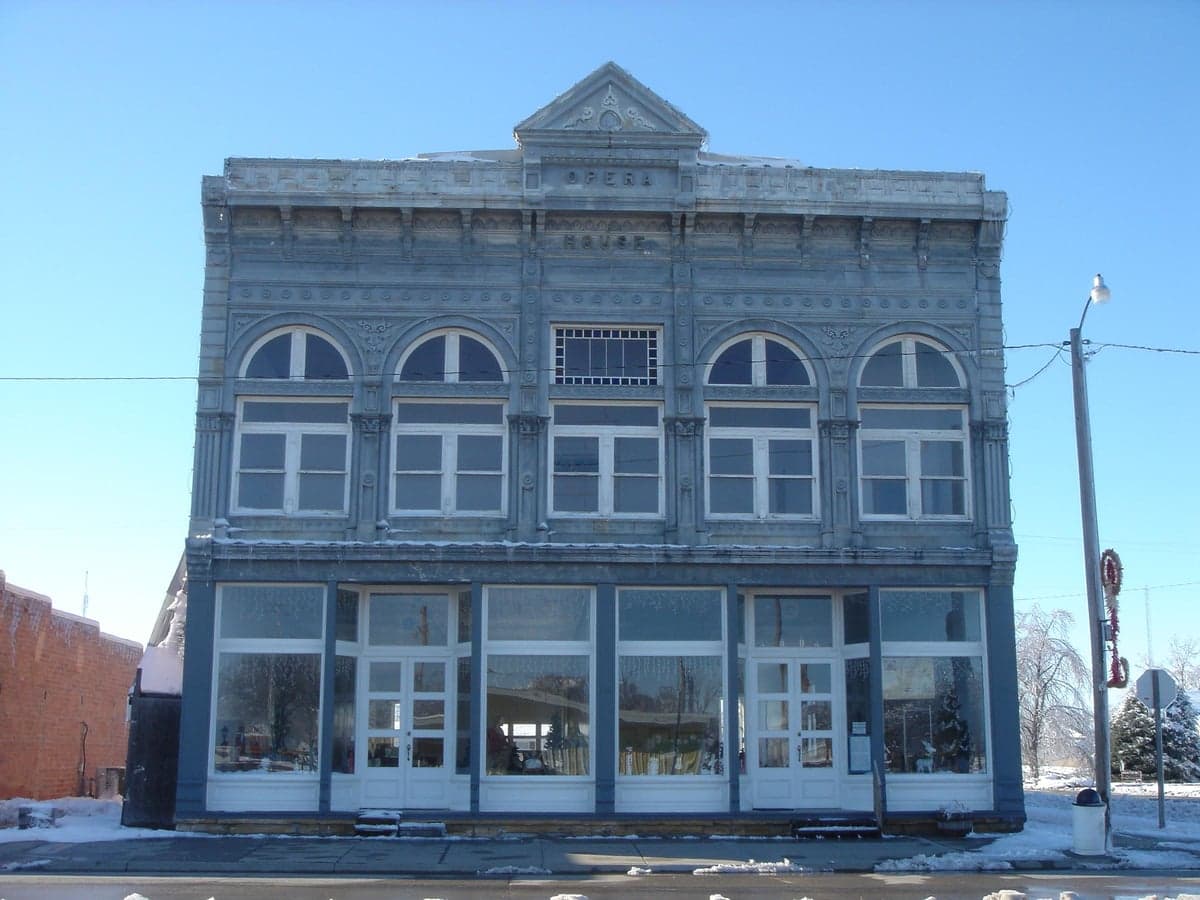
Photo: Wikipedia
Demographics of Gove County
Affluence Level in Gove County
A middle-class area roughly in line with national averages across income, home values, education, and employment.
People of Gove County
Gove County, Kansas, is home to roughly 2,800 people, making it one of the most sparsely populated counties in the state. Its population is overwhelmingly white (95.1%) and native-born, with a foreign-born share of just 0.1%, reflecting a deep-rooted, multi-generational community shaped by homesteading and agriculture. The county’s identity is defined by its small, unincorporated towns and the city of Quinter, where a strong sense of self-reliance and a connection to the land remain central to daily life.
Settlement & growth (pre-1960)
Before American settlement, the area that is now Gove County was part of the vast hunting grounds of the Cheyenne and Arapaho nations. These nomadic tribes followed the bison herds across the High Plains, but their presence was dramatically curtailed by the Indian Removal Act and subsequent military campaigns in the 1860s and 1870s. The land was opened to non-Native settlement under the Homestead Act of 1862, which offered 160 acres to any adult who would improve and live on the claim.
The first major wave of settlers arrived in the late 1870s and 1880s, drawn by the promise of free land. These were primarily Anglo-American homesteaders from the Midwest and the eastern United States, many of whom had already experienced farming in states like Illinois, Indiana, and Ohio. They established the county’s earliest towns, including Gove City (the county seat), Quinter, and Grainfield. The arrival of the Kansas Pacific (later Union Pacific) Railroad in the 1880s was the critical infrastructure event, transforming Quinter and Grainfield into shipping points for wheat and cattle. A smaller but notable wave of German-Russian Mennonite families also arrived in the 1880s, settling near Park and Grinnell. They brought with them the hard winter wheat varieties—Turkey Red—that would become the backbone of the county’s agricultural economy.
By 1900, the population had peaked at over 4,000, as the county filled with family farms. The Dust Bowl of the 1930s hit Gove County hard, causing a significant out-migration of families who could no longer sustain their homesteads. This period marked the beginning of a long, slow population decline, as mechanization reduced the need for farm labor and younger generations moved to cities. The population stabilized around 3,000 by 1960, a figure it has roughly maintained ever since.
Modern era (post-1965)
The 1965 Hart-Cellar Act, which reshaped U.S. immigration, had virtually no impact on Gove County. The foreign-born population remains at 0.1%, and the county has not experienced the waves of new immigrant communities seen in urban Kansas or the Sun Belt. Instead, the modern era has been defined by domestic out-migration and aging in place. Young adults continue to leave for college and job opportunities in larger cities like Hays, Salina, and Denver, while the remaining population grows older.
Hispanic representation, at 1.3%, is minimal compared to other parts of western Kansas, where meatpacking plants have drawn significant Latino populations. Gove County’s economy remains dominated by wheat farming, cattle ranching, and oil and gas extraction, which do not generate the same labor demand. The Black population (0.2%) and East/Southeast Asian population (0.2%) are negligible, reflecting the county’s lack of industrial or service-sector employment that might attract diverse workforces. The Indian subcontinent population (0.1%) is also negligible, with no visible enclave.
Suburbanization has not occurred in Gove County. The towns of Quinter (the largest, with roughly 900 residents), Grainfield, and Gove City have seen their commercial districts shrink, with many services consolidating in Quinter. The county’s population density is about 2.5 people per square mile, one of the lowest in Kansas. The 2020 Census recorded 2,796 residents, a slight decline from 2,808 in 2010, continuing a trend of slow, steady loss.
The future
Gove County’s population is projected to continue its gradual decline over the next 10-20 years. The median age is high, and the birth rate is below replacement level. Without a significant economic shift—such as a major energy boom or a new agricultural industry—the county will likely see further consolidation of its remaining population into Quinter, which offers the best access to schools, healthcare, and retail. The smaller towns like Park, Grinnell, and Gove City may see their populations dwindle to a few dozen families each.
Diversity is unlikely to increase meaningfully. The county’s economy does not attract immigrant labor, and its remote location offers few amenities for new residents. The cultural identity will remain rooted in its agricultural heritage, with a strong emphasis on community events like the Quinter Labor Day Celebration and the Gove County Fair. The county is becoming more of a retirement and second-home destination for former residents who return after careers elsewhere, rather than a magnet for new families.
For someone moving in now, Gove County offers a quiet, low-crime, and deeply connected rural lifestyle, but it requires accepting long distances to services and a population that is shrinking and aging. The kind of person who thrives here is one who values solitude, self-sufficiency, and a community where everyone knows your name—and who is prepared for the reality that the county’s best days of growth are behind it.

* Values derived from national, state, county, city and local statistics and may differ in a specific area. Last updated: 2026-08-26T03:20:10.000Z
Narrative content on this page is AI-generated and may contain mistakes. Verify any details that matter before acting on them.
ReloMaps may earn a commission from affiliate links at no extra cost to you.

