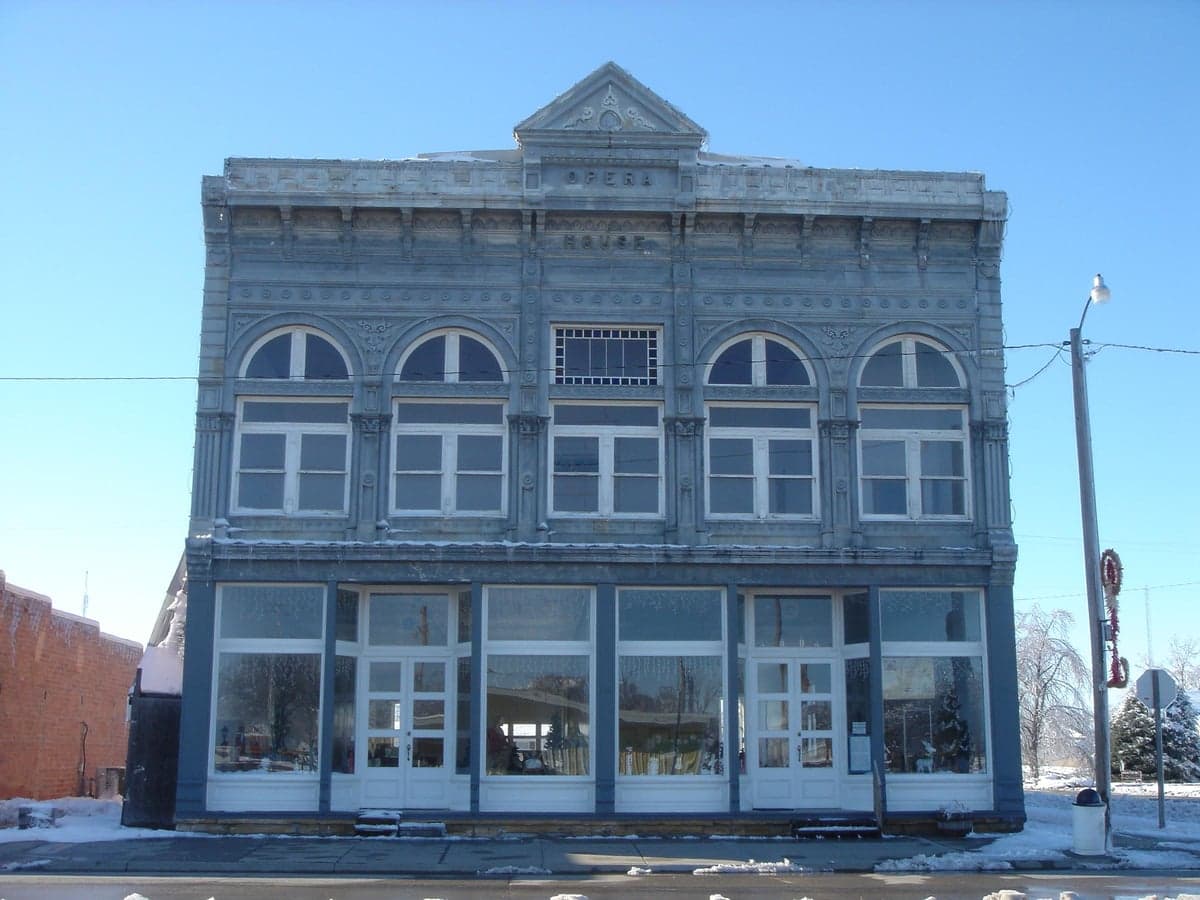
Photo: Wikipedia
Political ClimatePolitical Climate in Gove County
Showing district-level results — no local-only data available.
Local Political AnalysisPolitical Analysis of Gove County
Gove County, Kansas, is one of the most reliably Republican areas in the state, with a Cook Partisan Voting Index (PVI) of R+16—a full seven points more conservative than Kansas as a whole, which sits at R+9. This isn't a recent shift; the county has voted for the GOP presidential candidate by margins of 30 to 40 points in every election since 2000, with no signs of a blue trend. The political reality here is deeply rooted in agricultural values, small-government sentiment, and a population that's overwhelmingly white and older, making it a stronghold for conservative candidates at every level.
How it compares
Compared to the rest of Kansas, Gove County is a political outlier even within a red state. While Kansas overall has seen some suburban shifts toward Democrats in places like Johnson County (Kansas City suburbs), Gove County has remained rock-ribbed Republican. The county's R+16 PVI means a Republican candidate can expect to win by roughly 16 points more than the national average, whereas the state's R+9 reflects a more moderate lean. Within the county itself, there's little variation: the small towns of Gove City (the county seat), Quinter, and Grainfield all vote heavily Republican, with no precincts leaning blue. The only slight deviation is in Park, a tiny unincorporated community where a handful of independent voters sometimes split tickets, but it's still solidly red. The county's trajectory is stable—no major demographic changes are expected, so the political lean is likely to persist for the foreseeable future.
What this means for residents
For conservative residents, Gove County's political climate is a comfortable fit. Local offices—county commission, school board, and sheriff—are almost always held by Republicans, and policy decisions reflect a preference for low taxes, limited regulation, and support for agriculture. The county's GOP lean means that national issues like gun rights, abortion restrictions, and energy development (especially wind and oil) are debated from a conservative standpoint, with little pushback. For liberal residents, the reality is more isolating. There are no organized Democratic groups in the county, and progressive viewpoints are rarely voiced in public forums. A liberal resident might feel out of step at community events or local government meetings, but the small population (around 2,600) means most people know each other personally, so political disagreements are usually handled with civility. The lack of political diversity can be stifling for some, but it also means less partisan rancor than in more competitive areas.
Culturally, Gove County stands apart from urban Kansas in its emphasis on self-reliance and community cooperation. Unlike the state's larger cities, where political polarization is more visible, here the focus is on practical matters like maintaining the local hospital, supporting the school system, and keeping the grain elevator running. The county's strong Republican lean translates into a policy environment where tax increases are rare and government services are lean—for example, the county has no public transportation and limited social services. For residents, this means a high degree of personal responsibility, but also a tight-knit support network where neighbors help each other out. If you're moving here, expect a place where politics is less about national debates and more about how to keep the local hardware store open and the roads paved. It's a quiet, stable political environment that rewards those who fit in and challenges those who don't, but it's never boring in its predictability.

State Political ClimatePolitical Climate in Kansas
State Political AnalysisPolitical Environment in the State
Kansas is a solidly Republican state with a Cook PVI of R+9, but don’t let that single number fool you — the political reality here is more layered than a straight red-state label suggests. Over the past 20 years, the state has shifted rightward in statewide races, driven by rural consolidation and suburban drift, but it’s also seen surprising Democratic wins in governor’s races (Laura Kelly in 2018 and 2022) and a persistent, organized progressive presence in the eastern third of the state. The dominant coalition is a mix of rural conservatives, suburban moderates, and a small but vocal libertarian streak, with the GOP holding supermajorities in the legislature but often fracturing along establishment vs. hardline lines.
Urban vs. rural divide
The political map of Kansas is a tale of three regions. The Kansas City metro area, anchored by Johnson County (Overland Park, Olathe, Lenexa), is the state’s economic and population engine — and its most politically competitive turf. Johnson County voted for Joe Biden in 2020 by about 8 points, a dramatic flip from its 2012 support for Mitt Romney by 12 points. This suburban shift is driven by college-educated professionals, many working in healthcare, tech, and finance, who have moved left on social issues while remaining fiscally moderate. Wyandotte County (Kansas City, KS) and Douglas County (Lawrence) are the Democratic strongholds, with Lawrence’s University of Kansas campus fueling a reliably blue vote. In contrast, western and central Kansas — places like Garden City, Dodge City, and Hays — are deeply Republican, often voting 75-80% for GOP candidates. The rural-urban divide is stark: the 1st Congressional District (western Kansas) is one of the most Republican districts in the nation, while the 3rd District (Johnson County) is a true swing seat. This split means that statewide, Republicans win by running up margins in the west while Democrats try to maximize turnout in the east.
Policy environment
Kansas’s policy environment is a study in contrasts. The state has no income tax on Social Security benefits and a flat state income tax rate of 5.7% (down from a progressive structure before the 2012 Brownback tax cuts). Property taxes are relatively high, especially in Johnson County school districts, but the state offers a homestead exemption for low-income seniors. The regulatory posture is generally business-friendly, with a right-to-work law and limited zoning in rural areas. On education, Kansas has seen a decade-long battle over school funding: the Kansas Supreme Court repeatedly ruled the legislature’s funding formula unconstitutional, leading to a $500 million increase in K-12 spending since 2017. School choice is expanding, with a new tax-credit scholarship program for private school tuition passed in 2023. Healthcare policy is a flashpoint: Kansas is one of only 10 states that has not expanded Medicaid under the Affordable Care Act, leaving roughly 150,000 low-income adults in a coverage gap. Election laws have tightened: the 2021 election integrity law (HB 2332) requires a photo ID for all ballots, limits drop boxes to one per county, and shortens the mail-in ballot return window. Voter turnout in 2022 was 54%, slightly above the national average.
Recent policy direction
The last five years have seen Kansas move in a distinctly conservative direction on several fronts, but with notable exceptions. On gun rights, Kansas is a constitutional carry state (since 2015) and preempts local gun ordinances — you can carry concealed without a permit, and there’s no waiting period or magazine capacity limit. The 2023 Second Amendment Protection Act even attempts to nullify federal gun laws, though it’s been challenged in court. On parental rights and education, the legislature passed a 2023 law requiring schools to notify parents of any “sexuality content” in curricula and banning transgender girls from female sports. A 2022 law prohibits instruction on sexual orientation or gender identity in kindergarten through third grade. On abortion, Kansas is a national outlier: in August 2022, voters overwhelmingly rejected a constitutional amendment that would have allowed the legislature to ban abortion, preserving the state Supreme Court’s 2019 ruling that the state constitution protects abortion rights. This means abortion remains legal up to 22 weeks, with no waiting period or mandatory counseling. On property rights, Kansas has a strong eminent domain law, but the 2023 “Landowner Bill of Rights” strengthened notification requirements for pipeline projects. On privacy and surveillance, the state has no comprehensive data privacy law, but a 2023 bill banning warrantless drone surveillance over private property passed. The overall direction is a patchwork: culturally conservative on education and guns, but with a stubbornly independent streak on abortion and a pragmatic approach to taxes.
Civil unrest & political movements
Kansas has seen its share of political flashpoints, but they tend to be more organized and less chaotic than in some states. The most visible movement in recent years has been the anti-abortion side, which has shifted to a legislative strategy after the 2022 vote — pushing for a 22-week ban and parental notification laws, but failing to pass a total ban. On the left, the Kansas People’s Action and Mainstream Coalition have been active in Johnson County, organizing around Medicaid expansion and school funding. Immigration politics are less heated than in border states, but Garden City and Dodge City have seen tensions over meatpacking plant labor — these towns are now majority-Latino, and local politics have become more competitive, with some city council seats flipping to Democrats. There is no sanctuary city policy anywhere in Kansas; in fact, a 2023 law requires local law enforcement to cooperate with ICE detainers. Election integrity controversies have been muted compared to states like Arizona or Georgia, but the 2020 election did see a brief controversy in Sedgwick County (Wichita) over ballot drop box security, which led to the 2021 law. The most visible protest in recent memory was the 2022 abortion vote, which drew massive turnout and a coordinated door-knocking campaign by both sides. A new resident would notice that political signs and bumper stickers are common, but actual street-level conflict is rare — Kansans tend to be polite even when they disagree.
Projection
Over the next 5-10 years, Kansas is likely to remain a red-leaning state, but the margin will narrow. The key demographic driver is Johnson County, which is growing faster than the rest of the state and becoming more diverse and educated — it’s now home to over 600,000 people, about 20% of the state’s population. If Johnson County continues its leftward drift, it could make statewide races more competitive, especially if Democrats can also turn out voters in Wyandotte and Douglas counties. However, rural Kansas is depopulating — 80 of the state’s 105 counties lost population in the 2020 census — which means the rural vote is shrinking in raw numbers. The wild card is the libertarian vote: Kansas has a strong third-party tradition (the Libertarian Party got 3% in the 2022 governor’s race), and if the GOP continues to fracture between moderates and hardliners, that could open the door for Democratic wins in close races. On policy, expect continued battles over school funding, Medicaid expansion (which has bipartisan support but is blocked by GOP leadership), and abortion — the legislature will keep trying to restrict it, but the state constitution will likely protect it for the near future. A new resident moving in now should expect a state that is culturally conservative in rural areas, but with a growing, politically active suburban corridor that is more moderate and increasingly diverse.
For someone relocating to Kansas, the bottom line is this: you’ll find a state that is reliably Republican in statewide races, but with real pockets of Democratic strength and a policy environment that is conservative on taxes, guns, and education, yet surprisingly protective of abortion rights. If you’re a conservative, you’ll feel at home in most of the state, especially in the west and in suburbs like Olathe or Andover. If you’re a liberal, you’ll want to stick to Lawrence, Kansas City, KS, or the older parts of Overland Park — and you’ll need to accept that your state government will be controlled by the other side. The practical takeaway: Kansas is a place where your vote matters more in primaries than in general elections, where local politics (school boards, city councils) are often more consequential than national ones, and where the political culture is serious but not hostile. It’s a state that rewards engagement, not just affiliation.
* Values derived from national, state, county, city and local statistics and may differ in a specific area. Last updated: 2026-08-26T03:20:10.000Z
Narrative content on this page is AI-generated and may contain mistakes. Verify any details that matter before acting on them.
ReloMaps may earn a commission from affiliate links at no extra cost to you.

