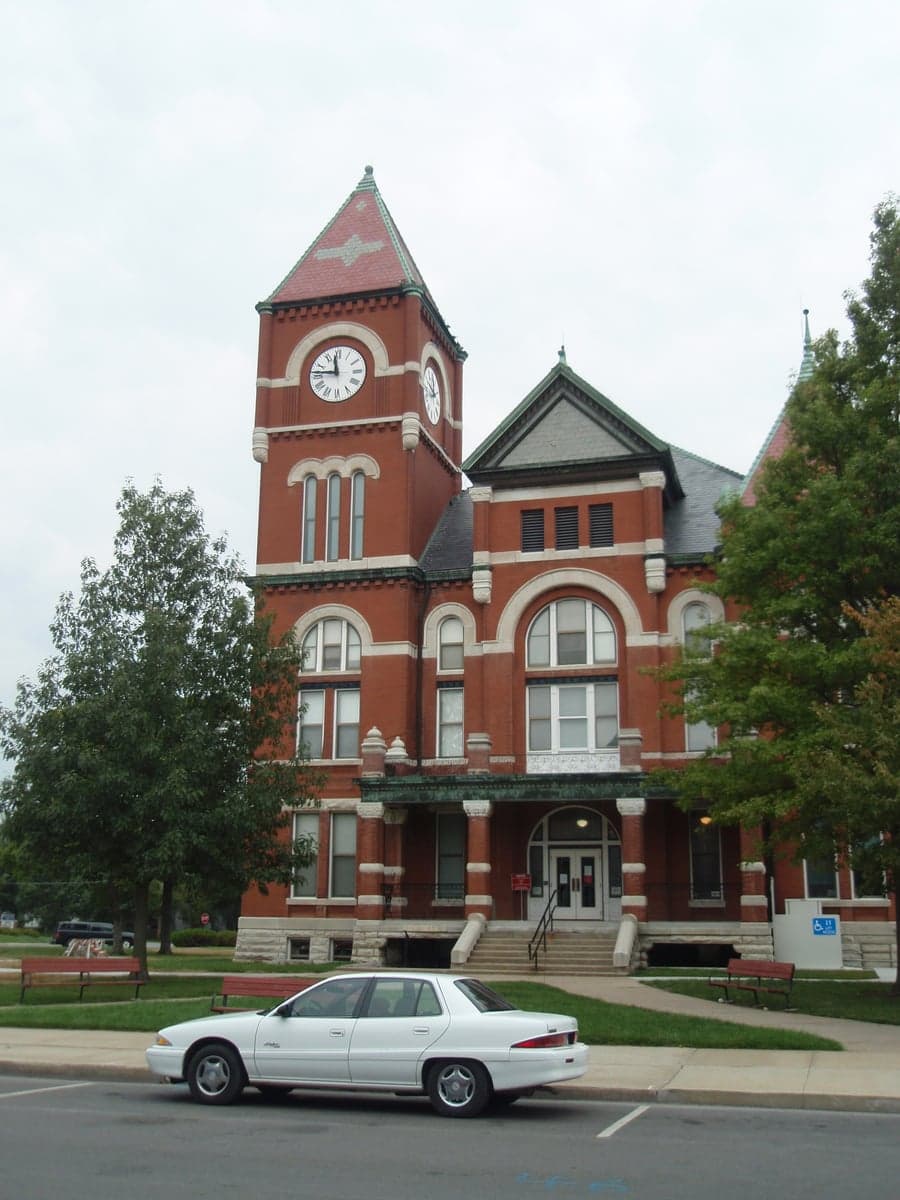
Photo: Wikipedia
Political ClimatePolitical Climate in Miami County
Showing district-level results — no local-only data available.
Local Political AnalysisPolitical Analysis of Miami County
Miami County, Kansas, sits in a curious political spot that surprises a lot of folks. While the county as a whole has a Cook Partisan Voting Index (PVI) of D+2, meaning it leans slightly Democratic compared to the nation, that’s a stark contrast to the state of Kansas itself, which carries a solid R+9 PVI. This isn’t a deep-red rural county; it’s a genuine battleground where the old-line Democratic roots of eastern Kansas still hold some sway, even as the state shifts rightward. The trajectory here is a slow drift toward the GOP, but it’s happening at a much slower pace than in the rest of Kansas, thanks to a mix of suburban growth from the Kansas City metro and a stubborn streak of local independence.
How it compares
The difference between Miami County and the rest of Kansas is night and day. The state’s R+9 PVI reflects a dominance of conservative, rural, and exurban voters who reliably back Republicans in statewide races. In Miami County, though, the D+2 PVI tells a story of a place that’s still purple, with real pockets of blue. Louisburg and Paola are the traditional Democratic strongholds, where union ties from the old railroad and manufacturing days keep the vote competitive. Osawatomie leans more conservative, but even there, the margin is often single digits. The real swing precincts are in the unincorporated areas around Hillsdale Lake and the newer subdivisions near Spring Hill—these are the places where a moderate Republican or a conservative Democrat can still win a county commission seat. In contrast, a county like Johnson County to the north is R+10, and Franklin County to the west is R+15. Miami County is the last bastion of competitive two-party politics in this corner of the state.
What this means for residents
For a conservative resident, living in a D+2 county means you’re not in a deep-red echo chamber. You’ll see Democratic signs in yards, and the local paper might run op-eds from both sides. But you’re also close enough to the state’s conservative majority that your values are reflected in Topeka—abortion restrictions, gun rights, and school choice are all state-level realities. For a liberal resident, the local politics can feel like a refuge. Paola’s city council has a history of progressive votes on housing and infrastructure, and the county’s Democratic Party is active, not just a paper organization. The downside is that statewide elections can feel like a lost cause, with your vote for governor or senator often being a protest against a GOP landslide. The practical effect is that local issues—zoning, school funding, road maintenance—are where the real political fights happen, and they’re genuinely contested.
Culturally, Miami County has a distinct identity that sets it apart from the rest of Kansas. The Miami County Fair in Paola is a big deal, but it’s not the hyper-patriotic, gun-show vibe you’d get in western Kansas. There’s a strong sense of local history tied to the Miami Tribe and the John Brown Museum in Osawatomie, which gives the area a more nuanced, less monolithic view of the past. Policy-wise, the county has been slower to adopt the kind of tax-cutting, anti-regulation fervor you see in places like Sedgwick County. The local school boards, especially in Louisburg and Osawatomie, have been more willing to fund bond issues for new buildings, even if it means a slight tax hike. It’s a place where the old Kansas—the one that sent moderate Republicans like Nancy Kassebaum to the Senate—still has a pulse, even as the state around it has changed. If you’re moving here, expect a political climate that’s more about compromise than confrontation, at least at the local level.

State Political ClimatePolitical Climate in Kansas
State Political AnalysisPolitical Environment in the State
Kansas is a solidly Republican state with a Cook PVI of R+9, meaning it typically votes about nine points more conservative than the national average. Over the past 20 years, the state has shifted rightward in statewide races, but not without internal turbulence — the 2018 governor’s race saw Democrat Laura Kelly win, and the 2022 race was a nail-biter, reflecting a state that is reliably red but not uniformly so. The dominant coalition is a mix of rural conservatives, suburban moderates, and a growing libertarian-leaning wing, while the Democratic base is concentrated in a few urban centers and college towns.
Urban vs. rural divide
The political map of Kansas is a textbook study in urban-rural polarization. The Kansas City metro area, anchored by Johnson County (Overland Park, Olathe, Lenexa), is the state’s most populous and politically competitive region. Johnson County has been trending blue in presidential years — it voted for Biden in 2020 by about 8 points — but still elects moderate Republicans to local and state offices. Wyandotte County (Kansas City, KS) is the state’s most reliably Democratic stronghold, delivering 70%+ margins for Democrats. Shawnee County (Topeka) is a swing county, often tipping the balance in statewide races. Douglas County (Lawrence, home to the University of Kansas) is a deep blue island, voting Democratic by 30+ points. In contrast, the vast rural expanse — from the Flint Hills to the High Plains — votes heavily Republican. Counties like Sherman (Goodland) and Grant (Ulysses) routinely give Republicans 80-85% of the vote. The Wichita metro (Sedgwick County) is a bellwether: it leans Republican but has a sizable moderate bloc, and its suburbs like Derby and Andover are reliably red, while the city itself is more purple.
Policy environment
Kansas’s policy environment is defined by a low-tax, limited-government ethos, but with notable exceptions. The state has a flat income tax rate of 5.7% (as of 2025), down from a progressive structure a decade ago, and no tax on Social Security benefits. Sales tax is high — the state rate is 6.5%, and local add-ons can push it over 10% in some cities. Property taxes are moderate but vary widely by county. The state is a right-to-work state and has a Republican supermajority in the legislature, which has passed laws restricting abortion (a near-total ban after 22 weeks, with a 2024 amendment enshrining no state constitutional right to abortion), expanding school choice (the 2024 Kansas School Choice Act created education savings accounts for low-income students), and preempting local gun ordinances. Election laws include voter ID requirements and a ban on ballot harvesting, but the state also offers advance voting and no-excuse mail-in ballots — a relatively moderate approach compared to some neighboring states.
Recent policy direction
Over the past five years, Kansas has moved decisively in a conservative direction on several fronts. Gun and self-defense law: In 2021, the legislature passed a constitutional carry law (permitless carry for adults 21 and older), overriding Governor Kelly’s veto. Parental and education rights: The 2023 Parents’ Bill of Rights requires schools to notify parents about curriculum changes and allows them to opt their children out of certain materials. Speech and privacy: The state has not passed a broad social media censorship law, but a 2024 law restricts public schools from requiring students to use pronouns that don’t match their biological sex. Medical and bodily autonomy: Abortion remains legal up to 22 weeks, but a 2024 law requires a 24-hour waiting period and mandatory counseling. A 2023 law bans gender-affirming care for minors. Property rights: Kansas is a strong eminent domain state, but a 2022 law tightened requirements for pipeline projects. Taxation: The 2024 Tax Cuts for Kansas Families Act accelerated the flat tax phase-in and increased the standard deduction. Voting and ballot access: A 2023 law tightened signature verification for mail ballots but kept advance voting. The overall direction is toward more individual liberty on guns and taxes, but more government regulation on social and medical issues.
Civil unrest & political movements
Kansas has seen its share of political flashpoints, but they tend to be more legal and legislative than street-level. The most visible recent movement was the 2022 abortion rights protests after the Dobbs decision, which drew thousands to the Statehouse in Topeka and helped defeat a proposed constitutional amendment that would have allowed a near-total ban. On the right, the Kansas Republican Assembly and Kansas Conservative Action have been active in primary challenges against moderate Republicans. Immigration politics are relatively quiet — Kansas is not a border state, and there are no sanctuary cities. However, a 2024 law requires local law enforcement to cooperate with ICE detainers. Election integrity controversies flared in 2020 and 2022, with Republican legislators holding hearings on voting machine security, but no major fraud was found. The Kansas Freedom Coalition (libertarian-leaning) and Kansas Values (social conservative) are the two main activist poles. A new resident would notice occasional protests on the KU campus in Lawrence, but most political activity is inside the Statehouse or at county commission meetings.
Projection
Over the next 5-10 years, Kansas is likely to remain solidly Republican but with a growing libertarian streak. The key demographic shift is the continued growth of Johnson County, which is becoming more diverse and more moderate — it may eventually become a swing county, pulling the state slightly toward the center. Meanwhile, rural counties are depopulating, which will reduce their electoral weight. In-migration is modest, but the Wichita and Kansas City metros are attracting younger families from higher-cost states, and these newcomers tend to be more moderate on social issues. The Republican Party’s internal divide — between the business-friendly, moderate wing and the populist, social conservative wing — will likely intensify. Expect continued battles over school funding, tax cuts, and abortion access. A Democratic governor is possible again if the GOP nominates a far-right candidate, but the legislature will remain Republican. For a new resident, the state will feel politically stable but not static — the culture wars will be fought in school boards and primaries, not on the streets.
For a new resident, the bottom line is that Kansas offers a low-tax, gun-friendly environment with a strong sense of local control, but you’ll need to be comfortable with a state that is actively debating social issues like abortion and transgender rights. If you’re conservative, you’ll find a welcoming policy environment and a like-minded community in most of the state. If you’re liberal, you’ll find your political home in Lawrence, Kansas City, or parts of Johnson County, but you’ll be in the minority in statewide elections. The practical takeaway: Kansas is a place where your vote matters more in local races than in presidential ones, and where the political conversation is shaped more by the Statehouse than by national trends. It’s a state that rewards engagement — if you show up to school board meetings and county commission hearings, you can have a real impact on the direction of your community.
* Values derived from national, state, county, city and local statistics and may differ in a specific area. Last updated: 2026-10-12T21:54:16.000Z
Narrative content on this page is AI-generated and may contain mistakes. Verify any details that matter before acting on them.
ReloMaps may earn a commission from affiliate links at no extra cost to you.

