
Photo: Wikipedia
Personal Sovereignty in Shawnee County
Viable for self-reliance. Generally workable, though some barriers may limit total independence.
What does Personal Sovereignty tell us?
Personal Sovereignty measures your capacity for self-reliance and independence with minimal government friction. Higher scores mean fewer barriers between you and the way you want to live... but it assumes you have the space you need and good neighbors.
What does this tell us?
Personal Sovereignty measures your capacity for self-reliance and independence with minimal government friction. Higher scores mean fewer barriers between you and the way you want to live... but it assumes you have the space you need and good neighbors.
State Policy
Energy independence: Self-sufficient (80% of energy produced in-state)
Personal Liberty
Homesteading

Personal Liberty Analysis
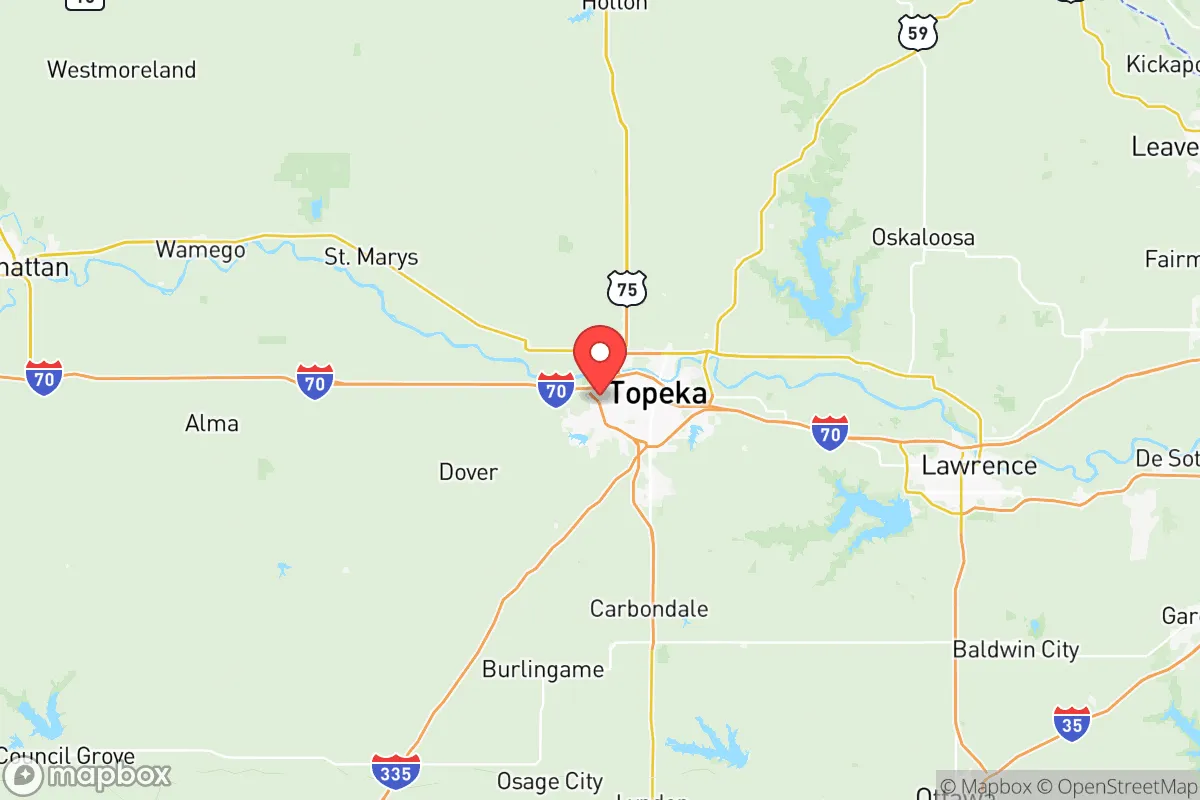
Shawnee County, anchored by Topeka but stretching into rural towns like Silver Lake, Rossville, and Tecumseh, offers a surprisingly resilient environment for personal sovereignty when you know where to look. This is not a coastal enclave of overreach; it is a Kansas county where state-level protections for gun rights, property use, and parental authority generally outweigh local restrictions, though the urban core of Topeka itself brings more regulatory noise. For the strategic relocator—especially one with a prepper sensibility who values self-reliance over permission slips—Shawnee County delivers a baseline of freedom that is increasingly rare, with meaningful variation between the city limits and the surrounding farmsteads.
Tax burden and regulatory posture: what Shawnee County costs vs. surrounding areas
Kansas maintains a flat personal income tax rate of roughly 5.7% and a state-level property tax cap that keeps the overall burden competitive, but Shawnee County's local mill levy is worth a hard look before you commit. The county levy, combined with city and school district taxes, pushes effective property tax rates to about 1.4% of assessed value in Topeka proper—higher than the state average of 1.1% and notably steeper than what you will find in neighboring Osage or Wabaunsee counties. If you locate in unincorporated areas near Dover or Willard, you trade the city's levies for lower base rates, though you lose some services you may not want anyway. Regulatory posture here is moderate: the county does not impose a general business license, and building codes are largely limited to the metro area. In Silver Lake or Rossville, you can put up a pole barn or add a workshop without the kind of permit theater you would face in Johnson County or anywhere near the Missouri line. For a survivalist perspective, the tax burden here is tolerable—far less than in the coastal states—but you are better off on the rural fringe where the county's regulatory tentacles thin out.
Self-defense and gun law specifics: where Shawnee County stands on the right to keep and bear arms
Kansas is a constitutional carry state: no permit is required to carry a concealed firearm for anyone 21 or older who can legally possess one, and Shawnee County has no local ordinances that materially restrict that right. You can carry in most areas of Topeka, Silver Lake, and Rossville without fear of stepping on a hidden local ban, though the City of Topeka does restrict open carry on city-owned property like the landfill and certain parks—a modest but real encroachment. The county does not have its own registry or magazine restrictions, and the state preempts any city or county from creating their own gun control laws. That preemption is solid, but it was tested in 2020 when Topeka attempted to pass a local "red flag" ordinance; it was defeated after heavy pushback. Practically speaking, if you live in rural Tecumseh or south of the Kansas River near Pauline, you can store, carry, and transport firearms with minimal government interference. The gun culture here is self-reliant and community-driven, with multiple private ranges and gun clubs that operate with little regulatory hassle. For the prepper mindset, the biggest risk is not state law but proximity to Topeka's higher crime neighborhoods—you will need a capable defensive setup if you choose the urban core.
Self-reliance and homesteading viability: lot sizes, zoning, and off-grid feasibility
This is where Shawnee County truly rewards the strategic relocator who wants productive land without suburban handcuffs. In unincorporated areas outside Topeka—places like Rossville, Silver Lake, and the area around Lake Shawnee—minimum lot sizes are typically 3 to 10 acres for new splits, though existing older parcels can be smaller. The county's zoning in areas classified as "Agricultural" allows for livestock, poultry, and gardens without special use permits, as long as you meet basic setback requirements. Off-grid feasibility is genuine: there is no county-mandated connection to municipal water or sewer in rural zones, so a drilled well and a septic system are perfectly legal. Solar panels, wind turbines, and backup generators face no net metering strangulation because Kansas law allows net metering up to 25 kW, and the county does not add its own restrictions. You can compost, raise meat rabbits, and keep a wood-burning stove in rural Shawnee County without needing to ask permission—something you absolutely cannot do in most of Johnson County or anywhere near the metro. If you want to store fuel, build a root cellar, or set up a rainwater catchment system, the county's regulatory posture is passive rather than invasive. The catch is that if you buy inside the Topeka city limits, you inherit the city's zoning which restricts livestock and requires permits for accessory structures. The smart play is Rossville or the rural fringes of Tecumseh, where the neighbors are likelier to share your worldview.
Personal liberties: parental rights, medical autonomy, and freedom of speech in Shawnee County
Parental rights in Shawnee County are shaped by Kansas law and local school board politics, which vary sharply between Topeka USD 501 and the smaller rural districts like Silver Lake USD 301 or Rossville USD 321. The state has a Parental Bill of Rights that theoretically prevents schools from withholding information about a child's health or well-being, and the rural districts in this county tend to respect that more consistently than the urban Topeka schools, where administrators have been known to push "social-emotional" frameworks that bypass parents. Medical autonomy has been a contentious topic, but Kansas is not a mandate-heavy state for adults: no broad vaccine mandates for employment, no forced medications, and no "vaccine passport" requirement. The county health department in Topeka does push public health messaging aggressively, but compliance is not enforced outside of school attendance requirements for certain childhood vaccines—and those have religious and medical exemptions that are relatively straightforward to claim. Property rights here are solidly protected by state law against regulatory takings; the county cannot easily downzone your land without compensation. Free speech and assembly are not significantly restricted beyond normal time-place-manner rules for public gatherings in Topeka, but rural residents report minimal interference with political signs or even regular gatherings on private property. One caveat: the county has a nuisance ordinance that can be weaponized against "unsightly" properties, so you'll want to keep your prepping storage discreet or out of plain view if you are near a main road.
Overall, Shawnee County ranks as one of the more sovereignty-friendly counties within the Topeka metro orbit, especially when compared to the regulatory weight of Johnson or Wyandotte counties. The rural towns—Silver Lake, Rossville, Dover, and the Tecumseh area—offer a degree of personal freedom that aligns well with a self-reliant, conservatively grounded lifestyle, while the Topeka urban core requires more vigilance against local ordinances and tax creep. For a strategic relocator considering the Midwest as a bulwark against federal overreach, Shawnee County is a solid but not perfect choice: the state-level protections are strong, but you must select your specific municipality carefully to avoid inheriting someone else's idea of control. The land is affordable, the gun laws are defensive, and the off-grid potential is real. If you value personal sovereignty more than municipal convenience, you will find a home here.

* Values derived from national, state, county, city and local statistics and may differ in a specific area. Last updated: 2026-06-01T12:00:29.000Z
Narrative content on this page is AI-generated and may contain mistakes. Verify any details that matter before acting on them.
ReloMaps may earn a commission from affiliate links at no extra cost to you.

