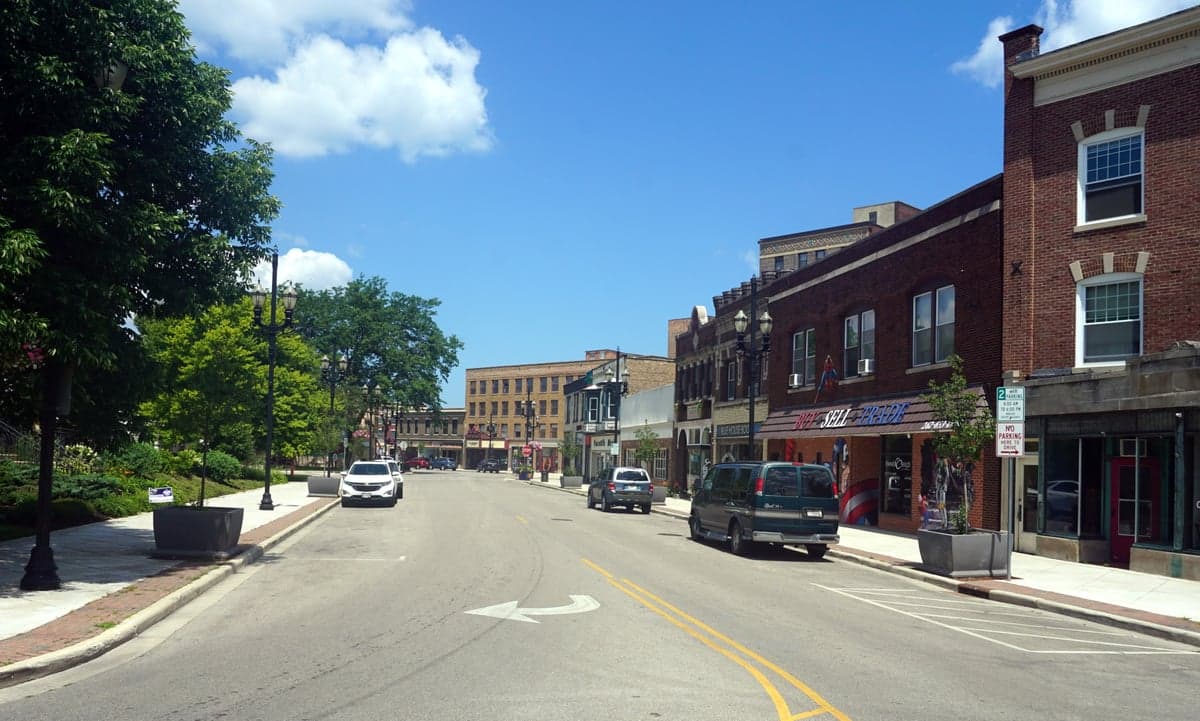
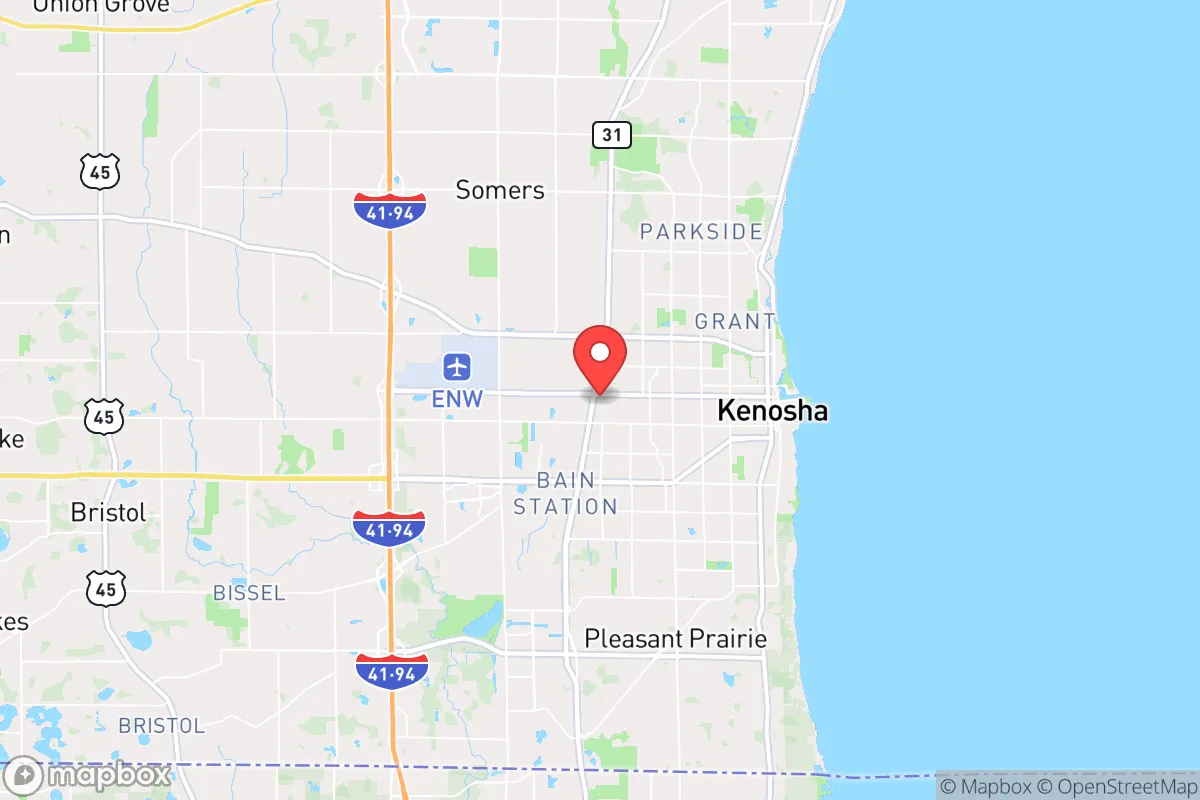
Photo: Wikipedia
Demographics of Kenosha, WI
Affluence Level in Kenosha, WI
A middle-class area roughly in line with national averages across income, home values, education, and employment.
People of Kenosha, WI
The people of Kenosha, Wisconsin, today number 99,147, forming a dense, working-class city with a distinctly blue-collar character rooted in its industrial past. The population is notably diverse for the region, with a White majority of 63.2%, a substantial Hispanic community at 19.5%, a Black population of 9.5%, and smaller East/Southeast Asian (1.6%) and Indian subcontinent (0.4%) groups. Only 5.1% of residents are foreign-born, and 28.9% hold a college degree, reflecting a community that remains more industrial and trade-oriented than its suburban neighbors to the north.
How the city was settled and grew
Kenosha’s population history begins with the Potawatomi people, who ceded the land in the 1833 Treaty of Chicago. American settlement followed quickly, with the first permanent white settlers arriving in 1835. The city’s early growth was driven by its natural harbor on Lake Michigan and the arrival of the railroad in the 1850s, which transformed it into a manufacturing hub. The first major immigrant wave was German and Irish, who built the working-class neighborhoods of Lincoln Park and Uptown in the mid-1800s, working in the new wagon factories and tanneries. By the late 19th and early 20th centuries, Italian and Polish immigrants arrived in large numbers, settling in the Southport and Bratton neighborhoods near the lakefront factories. The city’s industrial boom peaked with the rise of the American Motors Corporation (AMC) plant, which by the 1950s employed over 10,000 workers and drew a steady stream of Appalachian migrants and later, African American workers from the South during the Great Migration. These Black families primarily settled in the Uptown and Columbus Park areas, establishing a distinct community that remains today.
Modern era (post-1965)
The post-1965 era reshaped Kenosha’s population dramatically. The 1965 Hart-Cellar Act opened immigration from Latin America and Asia, but Kenosha’s foreign-born share (5.1%) remains modest compared to larger cities. The most significant demographic shift came from domestic migration. The closure of the AMC plant in 1987 (later briefly revived as a Chrysler plant) triggered a population decline and economic restructuring. In the 1990s and 2000s, Kenosha became a bedroom community for Chicago and Milwaukee, attracting White and Hispanic families seeking cheaper housing. The Hispanic population surged from roughly 3% in 1990 to 19.5% today, with most settling in the Uptown and Wilson Heights neighborhoods, where they have established a growing commercial corridor along 22nd Avenue. The Black population, at 9.5%, remains concentrated in Uptown and the Columbus Park area, though some have moved to newer subdivisions in the western part of the city. The East/Southeast Asian community (1.6%) is small and dispersed, with no single ethnic enclave, while the Indian subcontinent population (0.4%) is even smaller, often tied to professional roles at the local hospital or the University of Wisconsin-Parkside. The White population, while still the majority, has declined from over 90% in 1980 to 63.2% today, as many older White families have moved to exurban towns like Bristol or Salem.
The future
The population of Kenosha is heading toward greater diversity, but it is not homogenizing. The Hispanic community is the fastest-growing group, projected to reach 25-30% of the city’s population by 2040, driven by both domestic migration from Chicago and higher birth rates. This growth is concentrated in Uptown and Wilson Heights, creating a distinct Latino cultural and commercial district that is increasingly visible. The Black population is stable but not growing rapidly, as many younger Black residents move to Milwaukee or Racine for better job opportunities. The White population is aging and declining, with many younger White families choosing the outer suburbs or the more rural parts of Kenosha County. The East/Southeast Asian and Indian communities are expected to remain small, as Kenosha lacks the high-tech job base that attracts these groups to other Midwestern cities. The city is becoming more tribalized into distinct ethnic neighborhoods rather than blending into a single melting pot, a pattern common in older industrial cities.
For someone moving in now, Kenosha is becoming a more diverse, younger, and more Hispanic city, while retaining its blue-collar identity. The city offers affordable housing and a strong sense of community, but the economic base remains fragile, with many residents commuting to jobs in Racine, Milwaukee, or northern Illinois. The next decade will likely see continued Hispanic growth, a stable Black population, and a declining White share, making Kenosha a more multicultural but also more economically stratified place than it was a generation ago.

* Values derived from national, state, county, city and local statistics and may differ in a specific area. Last updated: 2026-04-21T10:14:14.000Z
Narrative content on this page is AI-generated and may contain mistakes. Verify any details that matter before acting on them.
ReloMaps may earn a commission from affiliate links at no extra cost to you.

