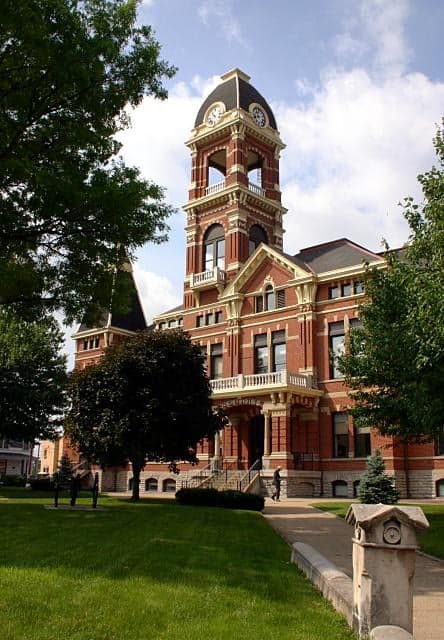
Photo: Wikipedia
Personal Sovereignty in Campbell County
Viable for self-reliance. Generally workable, though some barriers may limit total independence.
What does Personal Sovereignty tell us?
Personal Sovereignty measures your capacity for self-reliance and independence with minimal government friction. Higher scores mean fewer barriers between you and the way you want to live... but it assumes you have the space you need and good neighbors.
What does this tell us?
Personal Sovereignty measures your capacity for self-reliance and independence with minimal government friction. Higher scores mean fewer barriers between you and the way you want to live... but it assumes you have the space you need and good neighbors.
State Policy
Energy independence: Importer (60% of energy produced in-state)
Personal Liberty
Homesteading

Personal Liberty Analysis
Campbell County, Kentucky, offers a notably strong environment for personal sovereignty compared to many suburban and urban areas in the Ohio River Valley, though it is not a libertarian free-for-all. The county’s mix of rural towns like Alexandria, unincorporated areas near California, and the more developed city of Newport creates a patchwork of autonomy where state-level protections often outweigh local restrictions. For those prioritizing self-reliance and minimal government interference, the key is understanding which parts of the county align with a survivalist or prepper mindset—and which pockets still carry the regulatory weight of Northern Kentucky’s suburban sprawl.
Tax burden and regulatory posture in Campbell County
Kentucky’s state-level tax structure is relatively favorable for those seeking to keep more of their earnings and reduce government footprint. The state imposes a flat individual income tax rate of 4.5% as of 2026, with a scheduled reduction to 4.0% by 2027, and no state-level tax on Social Security benefits. Property taxes in Campbell County are moderate, with the county’s real estate tax rate hovering around $0.85 per $100 of assessed value, which is lower than neighboring Hamilton County, Ohio (Cincinnati area) and comparable to Boone County. However, the regulatory posture varies sharply by jurisdiction. The city of Newport, with its historic district and urban zoning, imposes stricter building codes and business licensing requirements than unincorporated areas near Ryland Heights or Silver Grove. For a prepper or homesteader, the unincorporated zones offer far more breathing room—no city-level business taxes, fewer permit hurdles for outbuildings, and less oversight on land use. The county’s overall regulatory climate leans conservative, but local city councils in places like Fort Thomas and Dayton have shown more willingness to adopt state-mandated growth plans, which can feel like creeping overreach to those wary of government expansion.
Self-defense and gun law specifics in Campbell County
Kentucky is a constitutional carry state, meaning no permit is required to carry a concealed firearm for anyone legally allowed to possess one. This is a bedrock of personal sovereignty for the survivalist-minded. Campbell County’s sheriff’s office, led by a Republican sheriff as of 2026, is known for a pro-Second Amendment stance, with no local ordinances that restrict magazine capacity or firearm types—unlike the patchwork of bans seen in nearby Ohio cities. The county’s gun culture is strongest in the rural northern and eastern parts, particularly around California, Kentucky and Alexandria, where shooting ranges and private land use for target practice are common. In contrast, Newport and Bellevue have more dense populations and occasional noise complaints that can lead to law enforcement calls for backyard shooting, though no formal bans exist. Stand-your-ground laws apply statewide, and there is no duty to retreat in any place where a person has a legal right to be. For those concerned about government overreach in times of crisis, Campbell County’s lack of red-flag laws (as of 2026) and its sheriffs’ stated refusal to enforce any future federal firearm bans provide a strong layer of protection. The county’s proximity to Ohio and Indiana, both with varying gun laws, means that a prepper living near Cold Spring can easily access different legal landscapes within a 30-minute drive.
Self-reliance and homesteading viability in Campbell County
Homesteading and off-grid living are viable in Campbell County, but only in specific zones. The county’s agricultural and rural-residential zoning in areas like California and Ryland Heights allows for larger lot sizes—typically 1 to 5 acres minimum—without the restrictive covenants found in suburban subdivisions. In these areas, raising chickens, goats, or even a few head of cattle is straightforward, and building a detached workshop or root cellar rarely requires more than a basic permit. Off-grid feasibility is moderate: Kentucky has no state-level ban on rainwater collection, and solar panel installation is unregulated in unincorporated areas. However, the county does enforce building codes for habitable structures, meaning a tiny house on wheels or a converted shipping container may face scrutiny if used as a primary residence. The city of Silver Grove, with its small-town character, is more permissive than Fort Thomas, which has strict historic preservation rules that can block solar arrays or non-standard roofing. For the prepper seeking true self-reliance, the northern half of the county—away from the Ohio River corridor—offers the best balance of land availability, low density, and minimal zoning interference. Water access is generally good via wells, and the county’s soil in the Licking River valley supports gardening, though heavy clay in some areas requires raised beds.
Personal liberties: parental rights, medical autonomy, speech, and property
Kentucky has strong legal protections for parental rights, including a 2024 law that requires schools to obtain parental consent before administering any health survey or mental health screening. This aligns with a conservative view of family sovereignty, and Campbell County’s school districts—particularly Campbell County Schools (covering Alexandria and rural areas) and Dayton Independent Schools—have generally complied without local pushback. Medical autonomy is more nuanced: Kentucky has no state-level vaccine mandate for adults, and the county’s health department does not enforce mask mandates or business closures beyond state orders. However, the state’s strict abortion laws (near-total ban with limited exceptions) reflect a pro-life stance that many in the audience may view as a positive assertion of sovereignty over bodily autonomy for the unborn. Speech protections are robust, with no local hate speech ordinances or permit requirements for public gatherings in unincorporated areas—though Newport and Bellevue have noise ordinances that can be used to limit amplified speech at protests. Property rights are well-defended: Campbell County does not have rent control, and eminent domain actions are rare and subject to state-level compensation requirements. For the prepper concerned about government seizure of supplies during emergencies, Kentucky’s lack of a state-level emergency powers law that allows warrantless property confiscation is a significant plus. The county’s overall legal climate respects the individual’s right to make decisions about their family, health, and land without excessive bureaucratic interference.
In the broader context of the Ohio River Valley, Campbell County stands out as a stronghold for personal sovereignty, especially when compared to the more restrictive environments of Cincinnati (just across the river) or Louisville. The county’s combination of constitutional carry, low property taxes, permissive rural zoning, and parental rights protections creates a viable base for those seeking to minimize government overreach. However, the autonomy is not uniform—living in Newport or Fort Thomas means accepting more municipal oversight, while California or Ryland Heights offer the closest approximation to a prepper’s ideal of self-rule. For single individuals and families who prioritize freedom over convenience, Campbell County’s unincorporated and rural areas provide a strategic location with access to urban resources but a legal framework that respects individual sovereignty. The key is choosing the right zip code—and avoiding the city limits of the more regulated river towns.

* Values derived from national, state, county, city and local statistics and may differ in a specific area. Last updated: 2026-05-13T08:42:12.000Z
Narrative content on this page is AI-generated and may contain mistakes. Verify any details that matter before acting on them.
ReloMaps may earn a commission from affiliate links at no extra cost to you.

