
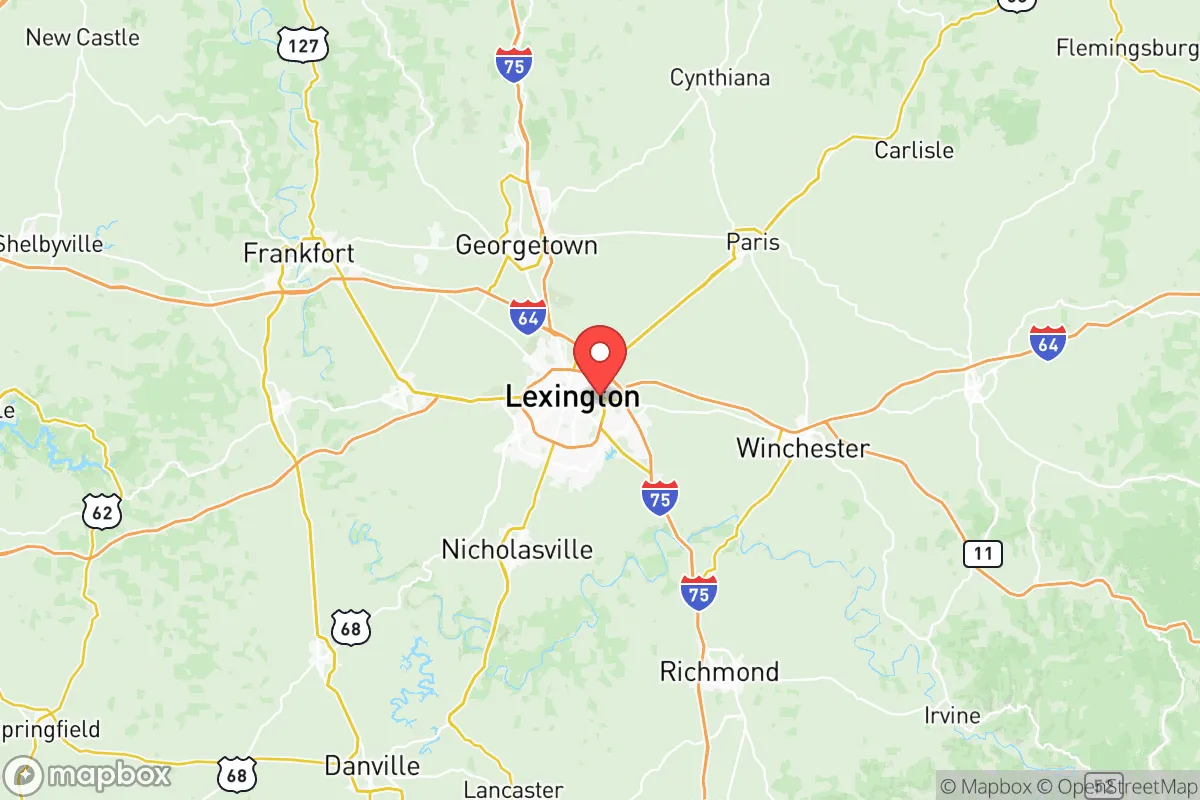
Photo: Wikipedia
Personal Sovereignty in Fayette County
Viable for self-reliance. Generally workable, though some barriers may limit total independence.
What does Personal Sovereignty tell us?
Personal Sovereignty measures your capacity for self-reliance and independence with minimal government friction. Higher scores mean fewer barriers between you and the way you want to live... but it assumes you have the space you need and good neighbors.
What does this tell us?
Personal Sovereignty measures your capacity for self-reliance and independence with minimal government friction. Higher scores mean fewer barriers between you and the way you want to live... but it assumes you have the space you need and good neighbors.
State Policy
Energy independence: Importer (60% of energy produced in-state)
Personal Liberty
Homesteading

Personal Liberty Analysis
Fayette County, Kentucky, anchored by Lexington, presents a nuanced landscape for personal sovereignty that demands careful scrutiny from those prioritizing autonomy. While Kentucky’s state-level posture on gun rights and limited government is among the strongest in the nation, the local dynamics within Fayette County—particularly inside the Lexington urban growth boundary—introduce layers of regulation that can feel at odds with a survivalist or prepper mindset. For single individuals and parents seeking to maximize self-reliance, the key is understanding where within the county the balance tilts toward freedom versus oversight, and how specific areas like Versailles Road, the rural pockets near Athens-Boonesboro, and the unincorporated stretches around Tates Creek offer distinctly different environments than the denser core of downtown Lexington.
Tax burden and regulatory posture in Fayette County
Kentucky’s flat state income tax of 4.5% (as of 2026, with a path to 4% by 2027) is moderate, but Fayette County adds a local occupational tax of 2.25% on wages and net profits—a levy that directly reduces disposable income for those building independent livelihoods. Property taxes are relatively low, with the county rate hovering around $1.20 per $100 of assessed value, but the Urban County Government’s zoning code is where the regulatory bite lives. The county enforces a strict urban service boundary that concentrates development and limits rural sprawl, meaning that if you want to buy a few acres for a homestead, you’ll need to look outside the boundary—specifically into areas like the southeastern quadrant near Keene or the southwestern fringe around the Jessamine County line. Inside the boundary, building permits, stormwater management requirements, and noise ordinances are enforced with a consistency that can frustrate those accustomed to rural Kentucky’s laissez-faire ethos. For a prepper, the regulatory posture is tolerable but not ideal; the county’s planning department has a reputation for slow approvals on alternative energy systems like solar arrays or rainwater catchment, though state law does preempt some local restrictions on solar access.
Self-defense and gun law specifics in Fayette County
Kentucky is a constitutional carry state, meaning no permit is required to carry a concealed firearm for anyone 21 or older who can legally possess a gun. This is a bedrock advantage for personal sovereignty. Fayette County does not impose its own additional restrictions beyond state law, so the same carry rights apply in Lexington as in rural parts of the county. However, the practical environment differs. In downtown Lexington and near the University of Kentucky campus, private businesses and public buildings (courthouses, schools, government offices) post “no firearms” signs with greater frequency than in the outlying areas. The Lexington Police Department is generally professional and not known for aggressive enforcement of gun laws, but the cultural vibe in the city core is less openly armed than in places like the Hamburg Pavilion area or the rural crossroads of Ford, where open carry is more common and socially accepted. For parents, the state’s “stand your ground” law and castle doctrine provide strong legal protection, but the county’s prosecutor has a mixed record on self-defense cases—some defense attorneys note a slight bias toward charging in incidents involving firearms near schools or public events. Overall, Fayette County is a solid B+ for gun rights, but it lacks the unapologetic gun culture of deeper rural Kentucky counties like Rockcastle or Pulaski.
Self-reliance and homesteading viability across Fayette County
Homesteading in Fayette County is a tale of two zones. Inside the urban service boundary, lot sizes are typically 0.25 to 0.5 acres, and raising livestock is heavily restricted—chickens are allowed with a permit, but goats, pigs, or cattle are effectively banned. The area around the Lexington Cemetery and the Ashland Park neighborhood is beautiful but utterly impractical for self-reliance. Outside the boundary, in unincorporated areas like the Athens-Boonesboro corridor along the Kentucky River, you can find 5- to 20-acre parcels where zoning allows for small-scale farming, beekeeping, and even a few head of cattle. Off-grid feasibility is mixed: Kentucky’s net metering policy is decent, allowing solar owners to sell excess power back to the grid, but Fayette County’s building code requires grid connection for new construction in most zones, making true off-grid living a legal gray area. Rainwater collection is legal without a permit for non-potable uses, but the county health department requires a permit for any system that supplies drinking water. For a prepper, the best bet is to target the rural tracts near the Clark County line or the area around the Jessamine County border, where enforcement is lax and neighbors are more likely to be like-minded. The soil in Fayette County is some of the richest in the state—the famous Bluegrass Region—so gardening and food production are highly viable if you can secure the land.
Personal liberties: parental rights, medical autonomy, speech, and property
Kentucky has strong parental rights protections under state law, including a Parents’ Bill of Rights that affirms the right to direct a child’s education, healthcare, and religious upbringing. Fayette County Public Schools, the district serving most of the county, has a reputation for progressive policies on curriculum and gender identity that have sparked friction with conservative parents. Homeschooling is straightforward—Kentucky requires only a notice of intent and an annual assessment, with no curriculum approval or home visits—and the county has a robust homeschool community, particularly in the southern part of the county near the Madison County line. Medical autonomy is a mixed bag: Kentucky has some of the strictest abortion laws in the nation (near-total ban), which aligns with a conservative worldview, but the state also has a vaccine mandate for schoolchildren that is enforced in Fayette County with few exceptions. Property rights are generally strong, but the county’s historic preservation overlay in areas like the Gratz Park and South Hill neighborhoods can restrict what you can do with your own home—painting colors, window replacements, and even landscaping may require approval from a review board. Free speech is protected, but Lexington’s city council has passed ordinances limiting protest activity near public events, which some see as a chill on assembly rights. For a survivalist, the property rights issue is the most concerning: the county’s zoning and preservation powers can feel like an overreach into what you can build, grow, or modify on your own land.
Compared to other areas in the region, Fayette County offers a moderate-to-strong sovereignty environment that is better than urban counties like Jefferson (Louisville) but weaker than truly rural counties like Bourbon or Woodford. The trade-off is access to resources—medical facilities, supply chains, and community networks—that are valuable in a crisis. For a single individual or parent who values autonomy above all, the smart move is to live just outside the urban service boundary, in a place like the unincorporated area near the intersection of US-27 and I-75, where you can enjoy the county’s strong gun laws and low property taxes while avoiding the densest regulations. Fayette County is not a libertarian paradise, but with careful location choice, it can be a solid base for a self-reliant life.

* Values derived from national, state, county, city and local statistics and may differ in a specific area. Last updated: 2026-05-21T13:12:52.000Z
Narrative content on this page is AI-generated and may contain mistakes. Verify any details that matter before acting on them.
ReloMaps may earn a commission from affiliate links at no extra cost to you.

