
Photo: Wikipedia
Political ClimatePolitical Climate in Fayette County
Showing district-level results — no local-only data available.
Local Political AnalysisPolitical Analysis of Fayette County
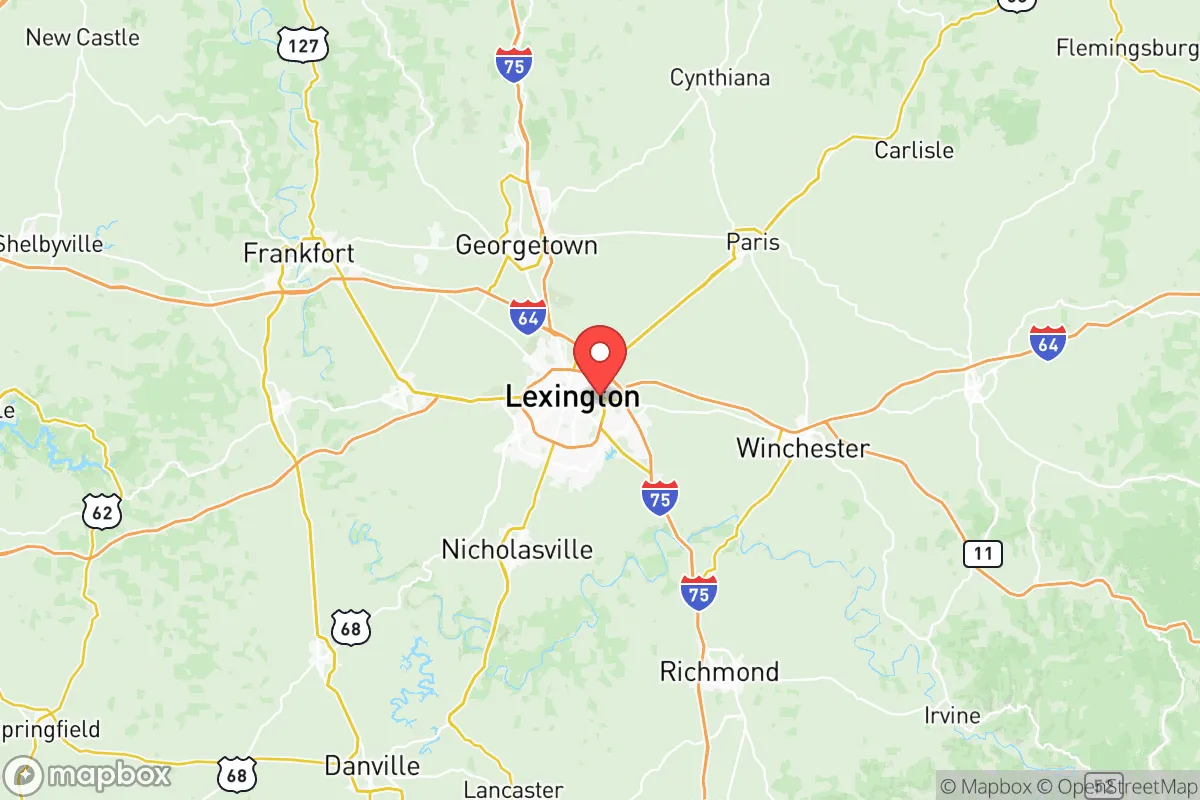
Fayette County, anchored by Lexington, has long been a blue dot in a red state, but the political winds here are shifting in ways that should give anyone who values personal freedom and limited government pause. The county’s Cook Partisan Voting Index (PVI) sits at R+7, meaning it leans Republican overall, but that’s a far cry from the rest of Kentucky, which clocks in at R+15. What that tells you is that while the state as a whole has moved decisively conservative, Fayette County has been stubbornly resistant—and in some ways, it’s drifting further left, especially in the urban core. If you’re looking for a place where government stays out of your business, you need to know where the lines are drawn.
How it compares
Drive just 10 miles outside Lexington’s city limits, and you’re in a different world. Towns like Versailles (Woodford County) and Nicholasville (Jessamine County) vote reliably red, often by margins of 20 points or more. Inside Fayette County itself, the rural precincts—think areas around Athens and Briar Hill—lean conservative, with many voters backing candidates who talk about cutting taxes and protecting Second Amendment rights. But the city of Lexington is where the trouble starts. The urban precincts around the University of Kentucky and downtown consistently vote Democratic by wide margins, and that’s where you see the push for higher taxes, stricter zoning, and progressive social policies. The swing precincts are in the suburbs—places like Beaumont and Hamburg—where voters are split, but even there, the trend is worrying. In 2020, Fayette County went for Biden by about 8 points, while the rest of the state went for Trump by 26. That gap is growing, not shrinking.
What this means for residents
For folks who value personal freedoms, the practical effect is a constant tug-of-war. Lexington’s city council has been pushing measures that feel like government overreach—think mask mandates that lasted longer than the state’s, strict noise ordinances that target rural traditions like shooting on private land, and a housing code that makes it harder to build or renovate without endless permits. The county’s tax burden is higher than surrounding areas, and property taxes have crept up as the city expands its services. Meanwhile, the state legislature in Frankfort keeps passing laws to preempt local control—like the 2024 bill that limited cities’ ability to regulate firearms—which creates a weird dynamic where your rights depend on which side of the county line you live on. If you’re in the city, you’re more likely to deal with red tape; if you’re in the county, you get more breathing room, but you’re still paying for the city’s spending.
The cultural divide is real, too. Lexington’s progressive tilt means you’ll see more pride flags and “In This House We Believe” signs in the urban core, while the rural parts of the county still fly Trump flags and host church potlucks. The University of Kentucky drives a lot of the leftward shift—its faculty and students are a reliable voting bloc for Democrats, and its influence on local media and policy is outsized. If you’re a conservative, you’ll find your people in the county’s outer edges, but you’ll also feel like you’re constantly fighting a rear-guard action against a city government that doesn’t share your values. The long-term trajectory? Unless the state legislature steps in to rein in local overreach, Fayette County will likely keep sliding left, making it a tougher place for anyone who just wants to be left alone.

State Political ClimatePolitical Climate in Kentucky
State Political AnalysisPolitical Environment in the State
Kentucky is a deeply red state with a Cook PVI of R+15, meaning it votes about 15 points more Republican than the national average in presidential elections. Over the past 10-20 years, the state has shifted from a reliably Democratic-leaning commonwealth at the state level to a solidly Republican stronghold, driven largely by the realignment of rural and working-class voters who once identified with the Democratic Party but now overwhelmingly support the GOP. The dominant coalition is a mix of evangelical conservatives, rural populists, and a growing number of suburban families fleeing the chaos of blue states, all united by a shared skepticism of federal overreach and a desire for local control.
Urban vs. rural divide
The political map of Kentucky is a textbook case of the urban-rural split. The two major metros—Louisville (Jefferson County) and Lexington (Fayette County)—are the only reliably blue areas, with Louisville voting about 20 points more Democratic than the state average and Lexington following closely. These cities are home to the University of Louisville, the University of Kentucky, and a growing professional class that leans progressive on social issues. But drive 20 minutes outside either city, and you’re in deep red territory. The rest of the state—places like Bowling Green, Owensboro, Paducah, and the Appalachian counties in the east—votes Republican by massive margins. The real story is the suburbs: areas like Oldham County (northeast of Louisville) and Boone County (part of the Cincinnati metro) have flipped hard red over the last decade, with Oldham County now voting about 40 points more Republican than the state average. These are the places where families are moving specifically for lower taxes, better schools, and a sense of safety that they feel is eroding in urban centers.
Policy environment
Kentucky’s policy environment is aggressively pro-business and pro-freedom, at least compared to its neighbors. The state has a flat income tax that is currently being phased down from 5% to 4% by 2026, with a long-term goal of elimination entirely. There is no state-level property tax on real estate, though local governments levy their own. The regulatory posture is light: Kentucky is a right-to-work state, meaning you cannot be forced to join a union as a condition of employment, and it has some of the loosest occupational licensing requirements in the region. On education, the state passed a universal school choice bill in 2022 that allows families to use state funds for private or homeschool expenses, a major win for parents who want control over their kids’ education. Healthcare is a mixed bag: Kentucky expanded Medicaid under Obamacare, but the state legislature has pushed back against federal mandates, including a 2023 law that prohibits the state from enforcing any federal vaccine mandates. Election laws are solid: Kentucky requires voter ID, has no-excuse absentee voting, and purges inactive voters regularly. It’s not a perfect system, but it’s far cleaner than what you’ll find in states like Illinois or Michigan.
Trajectory & freedom
Kentucky is becoming more free, especially on the cultural and economic fronts. The state passed a constitutional carry law in 2019, meaning you can carry a concealed firearm without a permit—a major expansion of Second Amendment rights. In 2023, the legislature passed the “Parents’ Bill of Rights,” which requires schools to get parental consent before teaching about sexuality or gender identity, and it bans transgender athletes from competing in girls’ sports. On medical freedom, Kentucky passed a law in 2022 that prohibits the state from enforcing any federal public health emergency orders that restrict individual liberties, including mask mandates or lockdowns. Property rights are strong: Kentucky is a “Dillon’s Rule” state, meaning local governments only have powers explicitly granted by the state, which limits the ability of cities like Louisville to impose rent control or zoning restrictions that infringe on property owners. The only real concern is the state’s reliance on federal funding—about 40% of the state budget comes from Washington—which creates a vulnerability if the federal government ever tries to attach strings to that money.
Civil unrest & political movements
Kentucky has seen its share of political flashpoints, but they’ve been relatively contained compared to states like Oregon or Washington. The most notable was the Breonna Taylor protests in Louisville in 2020, which turned violent and led to the National Guard being deployed. That event galvanized a strong backlash: in the 2022 midterms, Jefferson County saw a 10-point swing toward Republicans in the state legislature, and the city’s Democratic mayor was nearly recalled. On the right, there is a growing “constitutional sheriff” movement in rural counties like Pulaski and Whitley, where sheriffs have publicly stated they will not enforce any federal gun control or vaccine mandates. Immigration politics are relatively quiet—Kentucky is not a border state, and the immigrant population is small—but there is a strong undercurrent of opposition to sanctuary cities, with the state legislature passing a law in 2023 that bans any local government from adopting sanctuary policies. Election integrity is a hot topic: the 2020 election saw widespread allegations of irregularities in Jefferson County, leading to a 2021 law that tightened absentee ballot procedures and banned private funding of election administration. You won’t see daily protests in most of the state, but the cultural tension between the blue cities and the red countryside is palpable.
Projection
Over the next 5-10 years, Kentucky is likely to become even more conservative, driven by two trends: in-migration from blue states and the continued realignment of rural voters. People are moving to Kentucky from California, Illinois, and New York specifically for the lower cost of living, lower taxes, and cultural alignment—places like Bowling Green, Richmond, and the suburbs of Louisville are seeing significant growth. These new arrivals tend to be conservative-leaning, often fleeing the policies of their home states. At the same time, the urban cores of Louisville and Lexington are becoming more progressive, but they are losing population relative to the rest of the state. The state legislature is likely to continue cutting taxes, expanding school choice, and passing laws that protect individual liberties from federal overreach. The wild card is the state’s aging population and the opioid crisis in eastern Kentucky, which could strain the budget and create pressure for more federal intervention. But for now, the trajectory is clear: Kentucky is a state that is actively pushing back against the progressive agenda, and it’s only going to get redder.
For a new resident, the bottom line is this: Kentucky offers a high degree of personal freedom, low taxes, and a culture that values self-reliance and local control. You’ll find a welcoming community in most places outside of Louisville and Lexington, and the state government is actively working to protect your rights—whether it’s the right to carry a gun, the right to choose your child’s education, or the right to refuse a vaccine. The trade-off is that you’ll have fewer big-city amenities and a slower pace of life, but if you’re looking for a place where the government stays out of your business, Kentucky is hard to beat. Just be aware that the urban-rural divide is real, and if you move to a blue pocket, you’ll be swimming against the current. Pick a red suburb or a small town, and you’ll feel right at home.
* Values derived from national, state, county, city and local statistics and may differ in a specific area. Last updated: 2026-05-21T13:12:52.000Z
Narrative content on this page is AI-generated and may contain mistakes. Verify any details that matter before acting on them.
ReloMaps may earn a commission from affiliate links at no extra cost to you.

