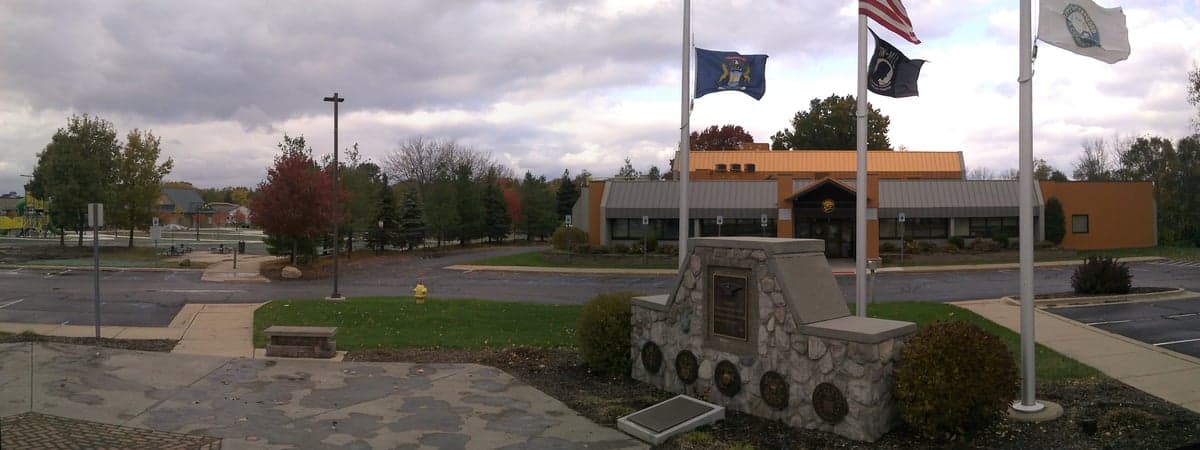
Photo: Wikipedia
Personal Sovereignty in Kentwood, MI
Strong independent fundamentals that actively favor personal liberty and low regulation.
What does Personal Sovereignty tell us?
Personal Sovereignty measures your capacity for self-reliance and independence with minimal government friction. Higher scores mean fewer barriers between you and the way you want to live... but it assumes you have the space you need and good neighbors.
What does this tell us?
Personal Sovereignty measures your capacity for self-reliance and independence with minimal government friction. Higher scores mean fewer barriers between you and the way you want to live... but it assumes you have the space you need and good neighbors.
State Policy
Energy independence: Importer (20% of energy produced in-state)
Personal Liberty
Homesteading

Personal Liberty Analysis
For the individual or family prioritizing personal sovereignty, Kentwood, Michigan offers a mixed but workable environment within a state that has seen increasing tension between local autonomy and state-level mandates. While Michigan’s overall regulatory climate has tightened in recent years—particularly around emergency powers and environmental rules—Kentwood itself sits in a region where practical self-reliance is still the norm, and the day-to-day intrusions of government are less pronounced than in the state’s urban cores. The key for a survivalist or prepper is understanding where the state’s reach ends and where local culture and geography still allow for a high degree of personal control over your life, property, and security.
Tax burden and regulatory posture: what you keep and what you fight
Michigan’s state-level tax burden is moderate compared to high-tax states like New York or California, but it is not a low-tax haven. The state income tax is a flat 4.25%, and sales tax is 6% on most goods. Property taxes in Kentwood are levied at the local level, with the average effective rate around 1.5% of assessed value—higher than some rural Michigan counties but lower than many suburban Detroit communities. The real advantage for a sovereignty-minded resident is the Headlee Amendment, which caps annual property tax increases on existing homes to the rate of inflation or 5%, whichever is less, unless voters approve a new millage. This provides predictability and prevents runaway assessments from pricing you out of your own property. On the regulatory side, Kentwood operates under Michigan’s Right to Farm Act, which offers significant protection for agricultural activities even within city limits—a critical detail for anyone wanting to keep livestock or grow substantial food. However, the city does enforce standard zoning and building codes, so any off-grid modifications (like composting toilets or alternative energy systems) will require permits and inspections. The state’s Michigan Occupational Safety and Health Administration (MIOSHA) also has a reach into small businesses and home-based enterprises, so if you plan to run a side hustle or trade goods, expect some paperwork. Overall, the tax burden is manageable, but the regulatory posture is one of “compliance required, but not oppressive”—you can build your life here without constant government interference, but you cannot ignore the rules entirely.
Self-defense and gun law specifics: what you can carry and where
Michigan is a shall-issue state for concealed pistol licenses (CPL), meaning if you meet the basic requirements—age 21, no disqualifying criminal record, completion of a state-approved safety course—the county sheriff must issue your permit. Kentwood is in Kent County, where the sheriff’s office processes CPL applications efficiently, typically within the statutory 45-day window. Open carry is legal without a permit for anyone 18 or older who can legally possess a firearm, though private businesses and some public buildings (schools, hospitals, sports arenas) can restrict it. The state does not have a “duty to inform” law for police during traffic stops, but it is wise to do so anyway. Magazine capacity is unrestricted, and there is no state-level assault weapons ban, so you can own standard AR-15s, high-capacity magazines, and suppressors (with a federal tax stamp). Stand Your Ground laws are in effect—Michigan does not impose a duty to retreat before using deadly force if you are in a place you have a legal right to be. Castle Doctrine also applies to your home and vehicle. The one significant restriction is that Michigan requires a purchase license for handguns (issued by local police or sheriff after a background check), and private sales of handguns must go through a licensed dealer for a background check. Long gun purchases from dealers require a NICS check but no additional state permit. For the prepper, the bottom line is that Kentwood allows you to arm yourself fully, carry concealed with a CPL, and defend your home and person without legal second-guessing—provided you follow the licensing steps.
Self-reliance and homesteading viability: lot sizes, zoning, and off-grid feasibility
Kentwood is a suburban city, not a rural township, so homesteading potential depends heavily on which specific neighborhood you choose. The city’s zoning code allows for single-family residential lots as small as 7,200 square feet in standard subdivisions, but there are also areas with one-acre minimum lot sizes in the more rural southern and eastern edges of the city. If you want to keep chickens, goats, or bees, you are in luck: Kentwood’s animal ordinance permits up to six hens (no roosters) on any residential lot, and up to two dwarf goats with a permit. Larger livestock like cows or horses require at least two acres. Gardening is unrestricted, and you can grow a substantial portion of your own food on a quarter-acre lot. Off-grid feasibility is limited by city code: you must be connected to municipal water and sewer if available, but if you are on a well and septic (common on larger lots), you have more independence. Solar panels are allowed with a building permit, and battery storage is not prohibited, but net metering with the local utility (Consumers Energy) is capped at 150% of your annual usage. Rainwater collection is legal for non-potable uses, but you cannot disconnect from the grid entirely without a variance. The biggest hurdle for a serious prepper is that burn bans and outdoor fire restrictions are enforced during dry periods, limiting your ability to cook or heat without utility power. Overall, Kentwood is viable for a moderate level of self-reliance—you can raise some food, generate some power, and store supplies—but it is not a remote homestead. If you want total off-grid independence, you will need to look further into rural Kent County or neighboring Barry County.
Personal liberties: parental rights, medical autonomy, speech, and property
Michigan has become a battleground for personal liberties in recent years, and Kentwood residents are not immune to state-level shifts. Parental rights are generally strong: Michigan law gives parents the final say over their children’s education, medical decisions, and religious upbringing. The state does not have a universal vaccine mandate for schoolchildren, though individual school districts can require certain immunizations (with medical and religious exemptions available). Homeschooling is legal with minimal regulation—you do not need to register with the state, but you must teach the required subjects (reading, math, science, social studies, etc.) for an equivalent number of days as public schools. Medical autonomy is more contested: Michigan has a broad informed consent law for medical procedures, but the state also expanded emergency powers during the pandemic, leading to mask and vaccine mandates that many viewed as overreach. As of 2026, those mandates are lifted, but the legal framework for future emergencies remains a concern. Free speech is protected under both the U.S. and Michigan constitutions, and Kentwood has no local ordinances restricting political expression, signage, or assembly. Property rights are solid: Michigan is a “notice and cure” state for foreclosures, meaning you get a chance to catch up on missed payments before losing your home. Eminent domain is rarely used for private development, and the city’s zoning board is generally responsive to variance requests if you have a legitimate need. The biggest liberty concern for a conservative-leaning resident is the potential for state-level preemption of local decisions—for example, if the state legislature were to pass a red flag law or further restrict firearm ownership, Kentwood’s local government would have to comply. For now, the city itself is a relatively free environment where you can raise your family, speak your mind, and control your property without excessive government intrusion.
Compared to other areas in the Midwest, Kentwood offers a solid middle ground for personal sovereignty. It is not as free as a rural county in the Upper Peninsula or northern Indiana, but it is far more accommodating than the regulatory-heavy environments of Ann Arbor, Grand Rapids proper, or any city in Illinois or Minnesota. The tax burden is reasonable, gun laws are permissive, homesteading is possible on the right lot, and personal liberties are largely intact—provided you stay engaged with local politics to defend them. For a survivalist or prepper who wants suburban convenience without sacrificing autonomy, Kentwood is a viable base of operations, but you must be willing to navigate state-level risks and invest in a property that gives you room to breathe.

* Values derived from national, state, county, city and local statistics and may differ in a specific area. Last updated: 2026-04-29T20:39:15.000Z
Narrative content on this page is AI-generated and may contain mistakes. Verify any details that matter before acting on them.
ReloMaps may earn a commission from affiliate links at no extra cost to you.

