Photo: Wikipedia
Political ClimatePolitical Climate in Ketchikan, AK
District shown is the primary district for this city’s centroid. Cities may span multiple districts.
Inherited from parent state — no local data available.
Local Political AnalysisPolitical Analysis of Ketchikan, AK
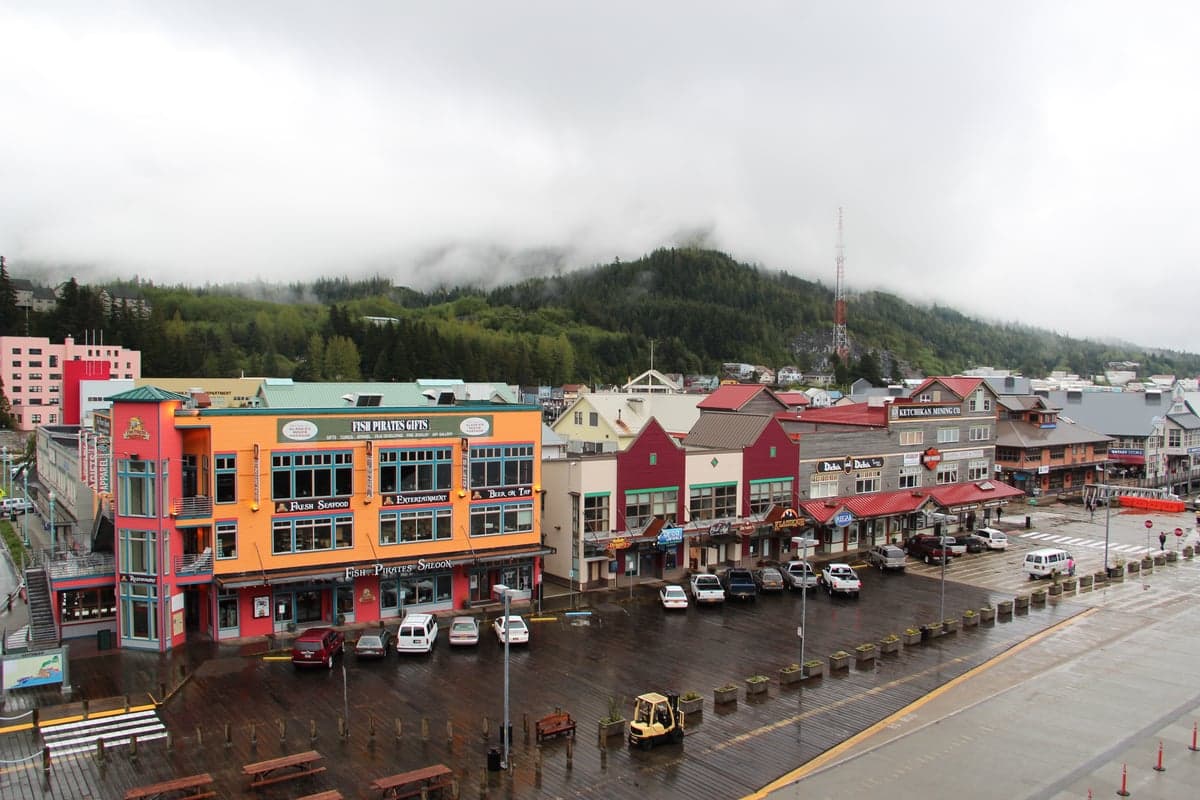
Ketchikan leans reliably conservative, with a Cook PVI of R+6 that puts it to the right of the national average, but it’s not the deep-red stronghold some folks assume. The town has long been a mix of fishing families, loggers, and tourism workers—people who value hard work and don’t take kindly to being told how to live. That said, you’ll notice a slow drift toward progressive ideas creeping in, especially among younger transplants drawn by the scenery and remote lifestyle. It’s still a place where most folks vote Republican, but the margins have tightened a bit over the last decade, and that shift is worth keeping an eye on.
How it compares
Compared to other Southeast Alaska towns, Ketchikan is more conservative than Juneau, which leans left with a D+9 PVI and a state government that often pushes regulations on fishing and land use. Sitka is similar to Juneau—progressive, with a strong environmentalist streak. Head north to Anchorage, and you’ll find a purple mix, but Ketchikan’s R+6 rating puts it closer to the Mat-Su Valley’s conservative vibe, though without the same evangelical influence. The real contrast is with smaller, more isolated villages like Craig or Klawock, where local politics are less about party lines and more about subsistence rights and tribal governance. For a longtime resident, the worry is that Ketchikan’s conservative roots are being eroded by outside money and ideology, especially as tourism brings in seasonal workers who don’t always share local values.
What this means for residents
For someone living here, the political climate directly affects daily life in ways that matter. Property rights are a big deal—there’s constant tension over federal land use, with the Tongass National Forest covering most of the region. Recent pushes to restrict logging and mining feel like government overreach to many locals, especially when they threaten jobs that have sustained families for generations. The same goes for fishing regulations; state and federal limits on salmon and halibut catches are often seen as bureaucratic meddling that ignores the realities of a small-town economy. On the social side, Ketchikan is still a place where you can own a firearm without hassle and where school boards haven’t gone full progressive on curriculum—yet. But there’s a creeping concern that as more people move in from places like Seattle or Portland, they’ll bring policies that don’t fit a community that values self-reliance over government handouts.
Culturally, Ketchikan holds onto a few distinctions that set it apart from the rest of Alaska. The local Tlingit and Haida heritage is strong, and most residents respect that without turning it into a political football. The big policy fights tend to center on the cruise ship industry—it’s the economic lifeblood, but it also brings crowds and pressure to adopt more “green” regulations that can feel like a burden on small businesses. Looking ahead, the long-term trend is uncertain. If the progressive wave continues, Ketchikan could lose its character as a place where personal freedom comes first. For now, it’s still a solid conservative town, but the warning signs are there, and anyone paying attention knows that the next few election cycles will decide whether it stays that way.

State Political ClimatePolitical Climate in Alaska
State Political AnalysisPolitical Environment in the State
Alaska has long been a unique political outlier — a state where libertarian-leaning independence, resource extraction, and a fierce frontier spirit create a conservative bent that’s distinct from the Lower 48. The state leans Republican at the presidential level, voting for Trump by 10 points in 2024, but its politics are far from monolithic. Over the past 20 years, the GOP has solidified its grip on state government, but a strong independent streak and a growing urban progressive movement in Anchorage have created a dynamic, often unpredictable, political landscape. For a conservative considering relocation, Alaska offers a mix of low taxes, abundant personal freedom, and a government that, while generally friendly to business and gun rights, is increasingly wrestling with the same cultural battles playing out nationally.
Urban vs. rural divide
The political map of Alaska is a stark study in contrasts. The Anchorage bowl, home to nearly 40% of the state’s population, is the epicenter of Democratic and progressive power. In 2024, Anchorage’s House districts leaned blue, with strong support for Biden in 2020 and Harris in 2024, driven by a coalition of government workers, university faculty, and a growing minority population. The city’s suburbs, like Eagle River and Chugiak, are reliably red, but the urban core of Anchorage, particularly around Spenard and downtown, is where the state’s left-leaning activism is concentrated. Outside of Anchorage, the story flips dramatically. The Mat-Su Valley, anchored by Wasilla and Palmer, is a conservative stronghold — think Sarah Palin country — where Trump won by 30 points in 2024. The Kenai Peninsula, with towns like Soldotna and Homer, is more mixed: Soldotna is deeply red, while Homer has a quirky, artsy, libertarian-left vibe. The interior, dominated by Fairbanks, is a swing area — the city itself leans slightly left, but the surrounding boroughs are deeply conservative. The rural bush, from Nome to Barrow (Utqiaġvik), is a wild card: heavily Native, often voting Democratic for federal benefits, but culturally conservative on issues like subsistence hunting and family structure. The bottom line: if you’re looking for a red enclave, the Valley, Kenai, and Fairbanks’ outskirts are your best bets. Anchorage is where the fight is.
Policy environment
Alaska’s policy environment is a mixed bag for conservatives, but the good news is that the state’s DNA is fundamentally freedom-oriented. There is no state income tax and no state sales tax — a huge draw for anyone tired of being nickel-and-dimed by government. Property taxes are low, though they vary by borough. The state’s Permanent Fund Dividend (PFD) — an annual check to every resident from oil revenues — is a sacred cow, and any politician who threatens it gets voted out fast. On education, Alaska has a robust school choice environment: there are no charter school caps, and homeschooling is popular, especially in rural areas. However, the state’s education funding formula is a perennial battleground, with Anchorage progressives pushing for more money while rural conservatives demand local control. Healthcare is a mixed bag: Alaska has a high uninsured rate, but the state expanded Medicaid under the ACA in 2015, a move that still rankles many conservatives. Election laws are relatively clean — Alaska uses a top-four primary system and ranked-choice voting for general elections, a reform passed by ballot initiative in 2020 that has been a flashpoint. Conservatives hate ranked-choice voting, seeing it as a way to dilute the GOP vote, and there’s a strong movement to repeal it. On the regulatory front, Alaska is generally business-friendly, especially for resource extraction — oil, gas, mining, and fishing — but environmental groups have successfully slowed new projects in recent years.
Trajectory & freedom
Alaska is currently in a tug-of-war between expanding and contracting personal freedom. On the plus side, the state is a constitutional carry state — no permit needed to carry a concealed firearm — and has strong preemption laws that prevent local governments from enacting their own gun restrictions. In 2023, the legislature passed a law protecting parents’ rights in education, requiring schools to notify parents of any curriculum involving sexuality or gender identity. That’s a win for parental rights. On the downside, the state’s ranked-choice voting system, passed by ballot initiative in 2020, has been a disaster for conservatives, leading to the election of a Democrat (Mary Peltola) to Congress in a heavily Republican district. There’s a strong repeal effort underway, but the system remains in place for now. Medical freedom is a bright spot: Alaska has no vaccine mandates for state employees, and the legislature has resisted federal overreach on public health orders. However, the state’s Medicaid expansion and a growing push for government-funded universal healthcare in Anchorage are concerning trends. On property rights, Alaska is generally strong — there’s no statewide zoning, and you can build on your land with minimal interference — but environmental regulations on wetlands and coastal development are tightening. The trajectory is mixed: the state is still freer than most, but the progressive foothold in Anchorage and the ranked-choice voting system are eroding that freedom.
Civil unrest & political movements
Alaska has seen its share of political flashpoints, but they’re generally less violent than in the Lower 48. The most visible movement is the Alaska Independence Party, which advocates for secession from the United States and has a small but vocal following, especially in the Mat-Su Valley. In 2020, there were protests in Anchorage over police brutality, but they were small compared to Portland or Seattle. The bigger story is the fight over ranked-choice voting: the repeal effort, led by conservative groups, has been a major organizing force, with rallies and door-knocking campaigns across the state. Immigration politics are less of a factor here — Alaska has a small foreign-born population — but there’s a strong undercurrent of resentment toward federal land management, with the “Bundy-style” rhetoric of local control over federal lands being a common theme. Election integrity is a hot topic: the 2020 and 2022 elections saw allegations of irregularities in rural precincts, though no major fraud was proven. The most visible flashpoint for a new resident would be the culture war in Anchorage, where the school board has been a battleground over critical race theory and transgender policies. If you’re moving to the Valley or Kenai, you’ll find a more settled, conservative environment. In Anchorage, you’ll see the same fights you’d see in any blue city.
Projection
Over the next 5-10 years, Alaska is likely to become more politically divided, but the overall trend is toward a slight conservative consolidation — if the ranked-choice voting system is repealed. Demographic shifts are working in conservatives’ favor: the state is seeing an influx of remote workers and retirees from red states like Texas and Florida, who are drawn to the low taxes and outdoor lifestyle. The urban core of Anchorage is aging and losing population, while the Mat-Su Valley and Kenai are growing. This will shift the balance of power in the state legislature toward the GOP. However, the progressive foothold in Anchorage is unlikely to disappear, and the fight over ranked-choice voting will determine whether conservatives can fully capitalize on these trends. If the repeal succeeds, expect a decade of solid Republican control. If it fails, expect more moderate-to-liberal outcomes in statewide races. The wild card is the oil industry: if the state’s resource economy booms, it will fund conservative priorities. If it declines, the state will face budget crises that could force tax increases — a red line for most Alaskans. For someone moving in now, expect to find a state that is still freer than most, but where the battle for that freedom is intensifying.
Bottom line for a new resident: Alaska is a great choice if you value low taxes, gun rights, and personal autonomy. But don’t expect a conservative utopia — Anchorage is a progressive city, and the ranked-choice voting system means you can’t take Republican victories for granted. If you’re willing to live in the Valley, Kenai, or Fairbanks’ outskirts, you’ll find a community that shares your values. If you’re moving to Anchorage, be prepared for the same cultural battles you’d find in any blue city. The state’s trajectory is positive for conservatives, but only if we stay engaged and fight for the freedom that makes Alaska special.
* Values derived from national, state, county, city and local statistics and may differ in a specific area. Last updated: 2026-04-19T19:27:12.000Z
Narrative content on this page is AI-generated and may contain mistakes. Verify any details that matter before acting on them.
ReloMaps may earn a commission from affiliate links at no extra cost to you.

