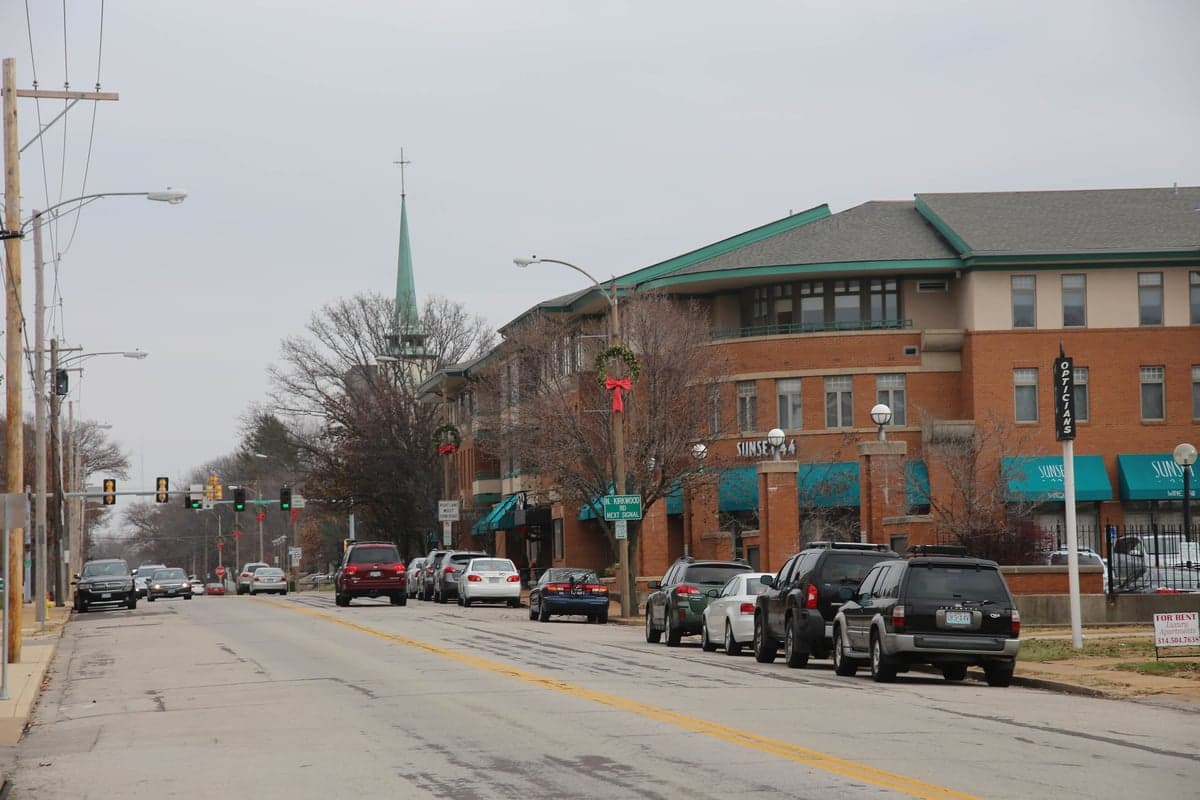
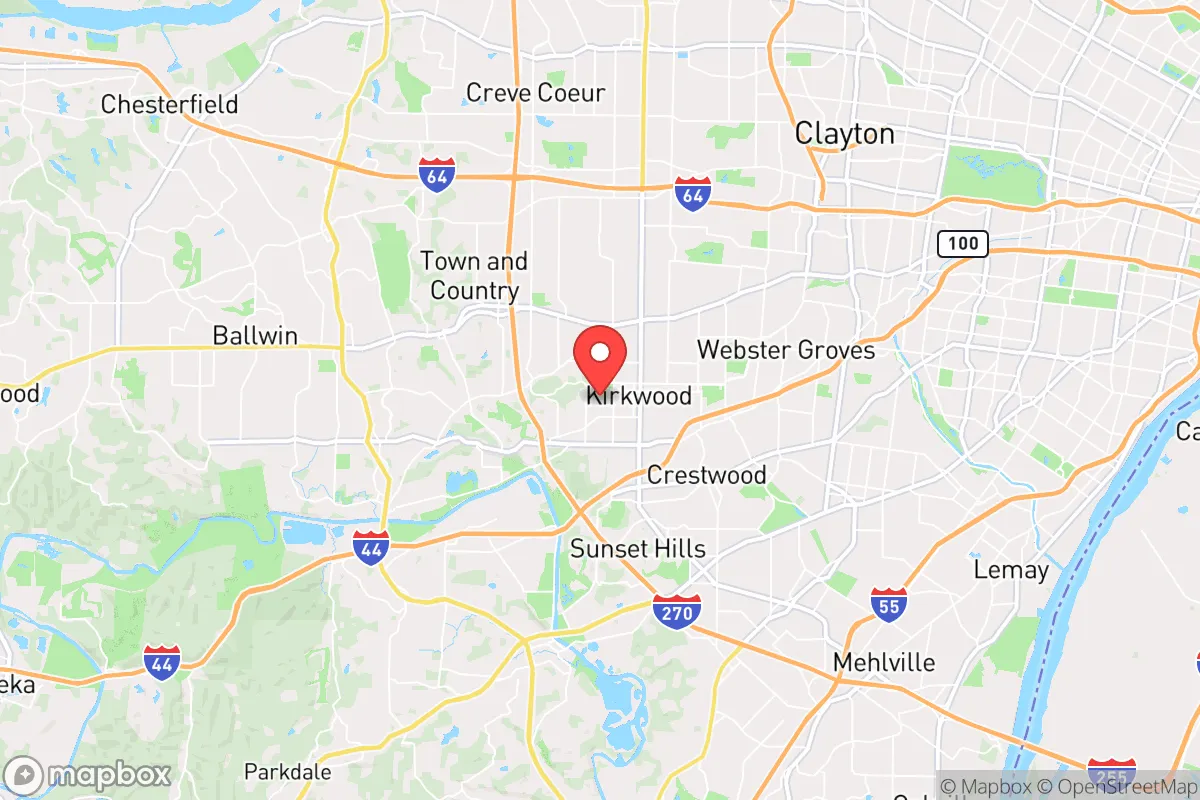
Photo: Wikipedia
Political ClimatePolitical Climate in Kirkwood, MO
District shown is the primary district for this city’s centroid. Cities may span multiple districts.
Local Political AnalysisPolitical Analysis of Kirkwood, MO
Kirkwood, Missouri, has long been a solidly conservative community, but like many inner-ring suburbs, it’s starting to feel the pressure of shifting political winds. The area carries a Cook PVI of R+4, meaning it leans Republican by a modest margin, but that number doesn’t tell the whole story of what’s happening on the ground. If you’ve lived here for a while, you’ve seen the slow creep of progressive policies—especially in local school board decisions and city council zoning debates—that feel out of step with the traditional values most folks around here still hold. The trajectory is concerning: while Kirkwood itself remains a Republican stronghold on paper, the surrounding St. Louis County has been trending blue for years, and that influence is seeping into local governance.
How it compares
Drive ten minutes east into downtown St. Louis, and you’re in a deep-blue city where progressive policies on policing, taxes, and land use are the norm. Head west to Wildwood or Eureka, and you’ll find communities that are even more reliably conservative than Kirkwood, with fewer fights over school curriculum or housing density. The contrast is sharpest with nearby Clayton, the county seat, which has embraced a far-left agenda on everything from environmental mandates to “equity” initiatives in public schools. Kirkwood sits in the middle—still red enough to feel familiar, but with a growing faction pushing for the same kind of government overreach you see in Clayton. That R+4 rating masks the fact that local elections are often decided by a few hundred votes, and the progressive side is getting more organized every cycle.
What this means for residents
For anyone who values personal freedom and limited government, the warning signs are real. The biggest flashpoint right now is the school board, where activists are pushing for critical race theory-adjacent curriculum and “restorative justice” discipline policies that undermine parental authority. There’s also a push to rezone single-family neighborhoods for higher-density housing, which would strip property owners of the right to decide what happens on their own street. On the plus side, Kirkwood’s city council has so far resisted the worst of it—they’ve kept property taxes relatively low and haven’t imposed the kind of mask or vaccine mandates you see in St. Louis City. But the long-term trend is worrying: as younger, more progressive families move in from the city, the political balance is shifting. If you’re thinking of relocating here, know that your vote and your voice matter more than ever, because the fight to keep Kirkwood from turning into another Clayton is very much alive.
Culturally, Kirkwood still feels like a place where neighbors look out for each other and the Fourth of July parade is a bigger deal than any political rally. But the policy distinctions are becoming sharper: the city has resisted adopting St. Louis County’s more aggressive affordable housing mandates, and the police department remains well-funded and community-oriented, unlike the defund-the-police experiments happening elsewhere. The biggest red flag for conservatives is the slow erosion of local control—state-level preemption laws have helped block some of the worst county overreach, but the fight over school curriculum and zoning is a constant reminder that government intrusion doesn’t always come from Washington. For now, Kirkwood is still a good place to raise a family if you value traditional values and personal responsibility, but you’ll need to stay engaged to keep it that way.

State Political ClimatePolitical Climate in Missouri
State Political AnalysisPolitical Environment in the State
Missouri has long been a bellwether state, but over the past 20 years it has shifted from a classic purple swing state to a solidly red one, with Republicans now holding supermajorities in both legislative chambers and every statewide office except the governorship (which flipped back to red in 2024). The state voted for Donald Trump by roughly 18 points in 2024, a dramatic shift from 2008 when it was decided by just 3,900 votes for John McCain. This rightward march is driven by a combination of rural exodus from Democratic roots, suburban realignment, and a steady stream of conservative-leaning transplants from the coasts, though St. Louis and Kansas City remain stubborn blue islands.
Urban vs. rural divide
The political map of Missouri is a textbook study in the urban-rural chasm. The two major metros—St. Louis and Kansas City—are deep blue, with St. Louis City and County delivering margins of 80%+ for Democrats in recent cycles. Kansas City’s Jackson County is similarly lopsided. But drive 20 minutes outside either city and you hit a wall of red. The rural Ozarks, including Springfield, Branson, and the Lake of the Ozarks region, are among the most conservative areas in the country, routinely voting 75-80% Republican. The real story, though, is the suburbs. Places like St. Charles County (west of St. Louis) and Clay County (north of Kansas City) were once competitive but have moved decisively right since 2016. St. Charles County gave Trump 62% in 2024, up from 55% in 2012. Meanwhile, Boone County (home to Columbia and the University of Missouri) is a rare blue dot in the middle of the state, voting Democratic by about 10 points, driven by the university population. The only other notable blue outlier is St. Louis County’s inner-ring suburbs, which have become increasingly diverse and progressive.
Policy environment
Missouri’s policy environment is aggressively conservative, and it’s been getting more so. The state has a flat income tax rate of 4.8% (down from 6% in 2019), with a trigger law that will phase it down to 4.5% if revenue targets are met. There is no state property tax on vehicles, and property taxes on real estate are among the lowest in the nation, averaging about 0.9% of home value. The state is a right-to-work state (though the law was repealed by ballot initiative in 2018, the legislature has since passed a new version that survived court challenge). Education policy is a major battleground: Missouri has a robust charter school system in St. Louis and Kansas City, and in 2024 the legislature passed a universal school choice bill allowing education savings accounts for any family, regardless of income. Healthcare is a mixed bag—Missouri expanded Medicaid via ballot initiative in 2020, but the legislature has refused to fund it adequately, leading to provider shortages. Election laws have tightened: voter ID is required, and in 2022 the legislature passed a law banning private funding of elections and limiting absentee ballot drop boxes. The state also passed a 2024 law requiring citizenship verification for voter registration, which critics say could suppress legal immigrant voting but supporters argue is necessary for election integrity.
Trajectory & freedom
On the freedom front, Missouri has been moving decisively in the direction of expanded personal liberty, particularly on gun rights, parental rights, and medical autonomy. In 2021, the state passed a Second Amendment Preservation Act (SAPA) that purports to nullify federal gun laws, though it has been partially blocked by federal courts. In 2023, the legislature passed a law banning gender-affirming care for minors, overriding a gubernatorial veto. Parental rights in education were strengthened in 2022 with a law requiring schools to notify parents of any curriculum involving sexual orientation or gender identity. On the medical front, Missouri is one of the few states that has not legalized recreational marijuana (though medical marijuana is legal and widely available), and the legislature has repeatedly blocked efforts to put legalization on the ballot. Property rights are strong—the state has a robust Castle Doctrine and Stand Your Ground law, and in 2024, the legislature passed a law limiting homeowners’ association authority to restrict solar panels and clotheslines. However, there are concerning signs: the state’s Kansas City police department is under state control (a unique arrangement), and the legislature has threatened to take over the St. Louis Metropolitan Police Department as well, citing rising crime. This tension between local control and state preemption is a recurring theme.
Civil unrest & political movements
Missouri has been a flashpoint for political movements on both sides. The 2014 Ferguson protests (in a suburb of St. Louis) were a national catalyst for the Black Lives Matter movement, and the city has seen periodic unrest since, including protests over the 2020 death of George Floyd that turned violent in downtown St. Louis. On the right, the state has a strong Second Amendment sanctuary movement, with over 100 counties passing resolutions declaring themselves “sanctuary counties” for gun rights. Immigration politics are relatively quiet compared to border states, but in 2023, the legislature passed a law banning “sanctuary city” policies and requiring local law enforcement to cooperate with ICE. There have been no major secession or nullification movements, though the SAPA law is essentially a nullification attempt. Election integrity remains a hot-button issue: in 2020, St. Louis saw a high-profile incident where Republican poll watchers were allegedly blocked from observing ballot counting, leading to a 2021 law that explicitly guarantees poll watcher access. The state’s attorney general, Andrew Bailey, has been aggressive in suing the Biden administration over federal overreach, including on student loan forgiveness and environmental regulations.
Projection
Looking ahead 5-10 years, Missouri is likely to become even more conservative, but with some caveats. The rural population is aging and shrinking, while the suburbs of St. Charles, Wentzville, and Lee’s Summit are growing rapidly with families fleeing higher-cost states. These newcomers tend to be conservative but may be less culturally hardline than the rural base. The St. Louis and Kansas City metros will continue to be blue, but their influence is diluted by the state’s legislative map, which heavily favors rural districts. The biggest wildcard is in-migration: Missouri is seeing a steady stream of transplants from Illinois, California, and New York, drawn by low taxes and housing costs. If these newcomers are predominantly conservative (as early data suggests), the state’s rightward tilt will accelerate. However, if the suburbs start to moderate—as they have in some other states—Missouri could see a slight purple shift in the 2030s. For now, the trajectory is clear: more school choice, lower taxes, stronger gun rights, and continued tension between state and local control.
Bottom line for a new resident: If you’re moving to Missouri for freedom from government overreach, you’re coming to the right place—but pick your county carefully. The rural areas and outer suburbs offer the most aligned policy environment, while St. Louis City and Kansas City will feel like a different state entirely. Expect low taxes, strong gun rights, and a legislature that is actively pushing back against federal overreach. Just be prepared for the culture war to be a constant background noise, especially in the statehouse. If that sounds like home, you’ll fit right in.
* Values derived from national, state, county, city and local statistics and may differ in a specific area. Last updated: 2026-04-30T13:24:11.000Z
Narrative content on this page is AI-generated and may contain mistakes. Verify any details that matter before acting on them.
ReloMaps may earn a commission from affiliate links at no extra cost to you.

