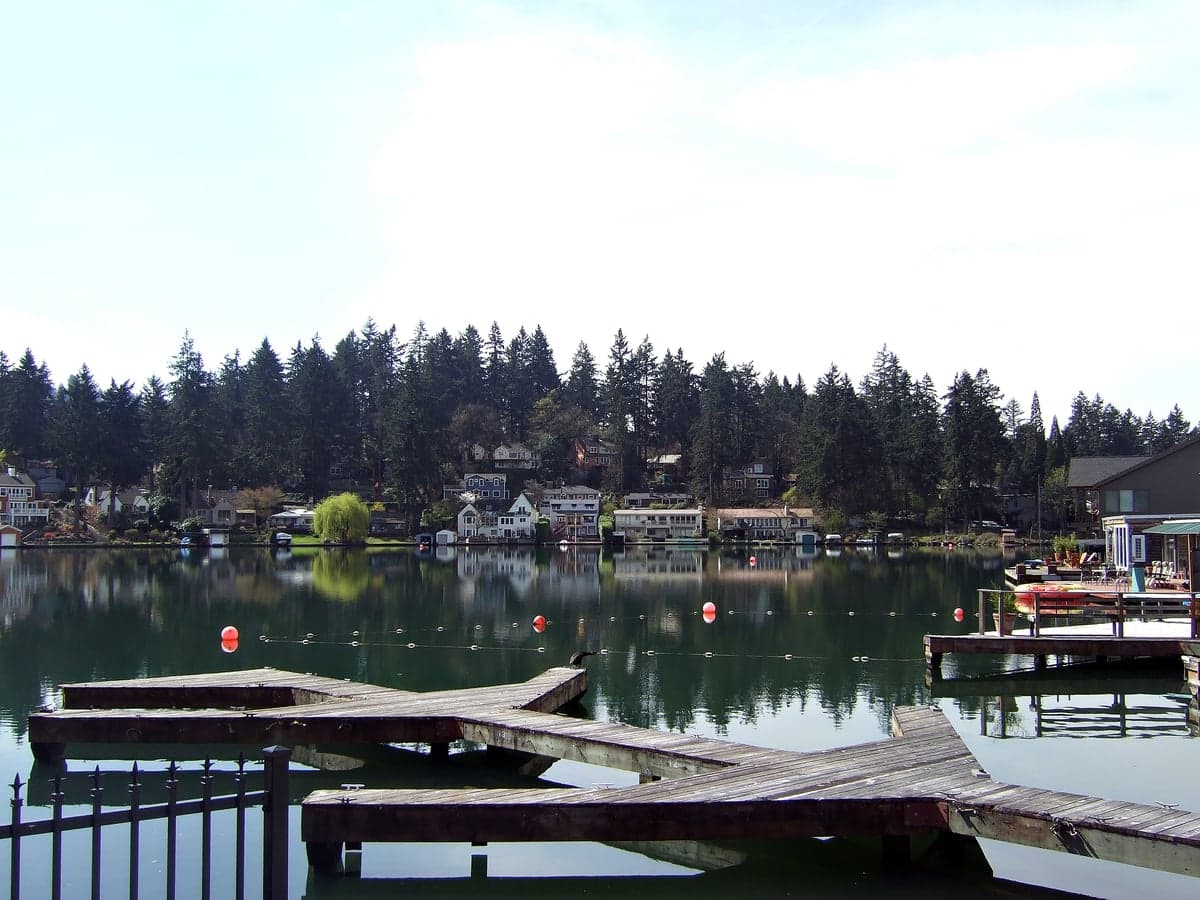
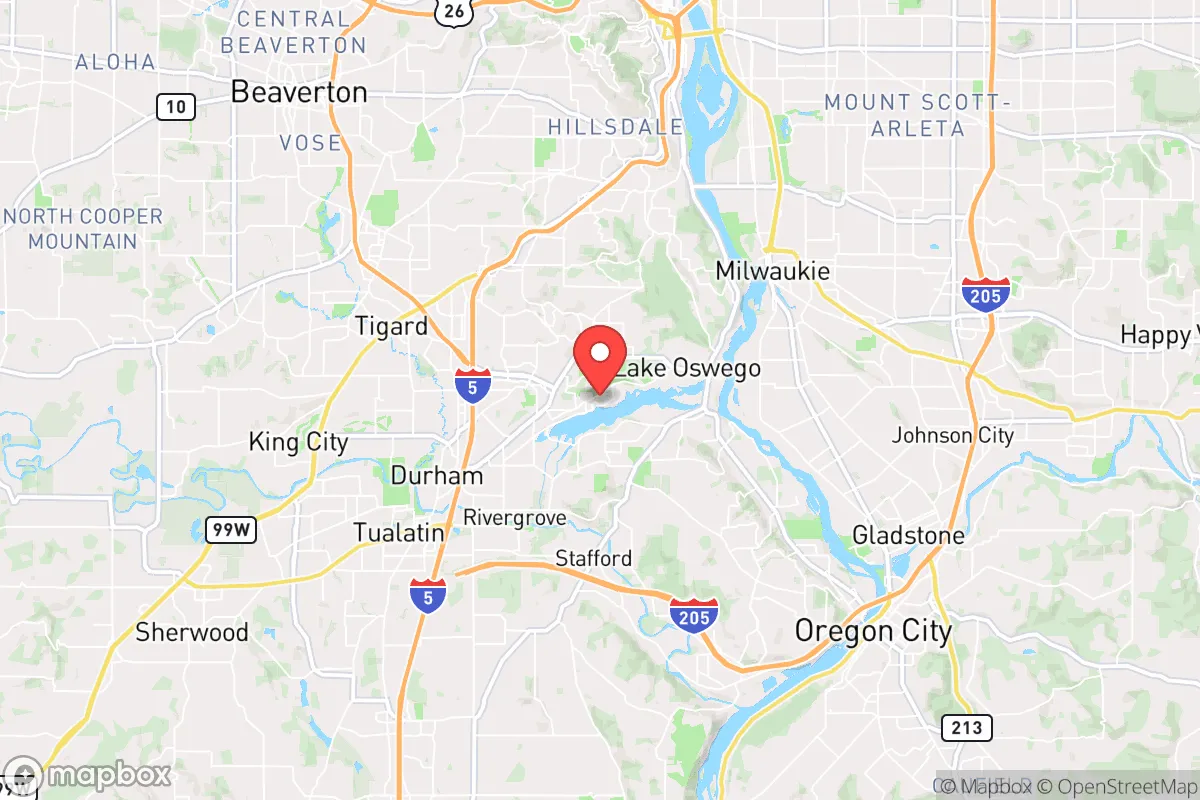
Photo: Wikipedia
Demographics of Lake Oswego, OR
Affluence Level in Lake Oswego, OR
A wealthy area with high-earning, well-educated households. Incomes, home values, and educational attainment meaningfully outpace national averages.
People of Lake Oswego, OR
Today, Lake Oswego is a city of 40,367 residents defined by high educational attainment and relative affluence, with 75.1% of adults holding a college degree. The population is predominantly White (77.9%), with the largest minority groups being East and Southeast Asian communities (6.7%) and Hispanic residents (4.9%). The city’s character is shaped by its history as a planned suburban retreat for Portland’s elite, a legacy that continues to influence its demographics and neighborhood composition.
How the city was settled and grew
Lake Oswego’s human history begins not with colonial settlement but with the Oswego Iron Company in the 1860s, which drew a workforce of European immigrants—primarily Irish, Welsh, and German laborers—to work the iron smelters. These workers settled in the Old Town district, near the lake and the original furnace site, building modest homes that contrast with the city’s later affluence. The iron industry collapsed by the 1880s, and the area languished until the early 20th century, when Portland’s wealthy began building summer cottages along the newly created Oswego Lake. The Lake Grove neighborhood, on the lake’s west side, became a haven for these seasonal residents, many of whom were business leaders and professionals from Portland. By the 1920s, the city was formally incorporated as a planned residential community, with restrictive covenants that explicitly excluded non-White residents—a policy that shaped the city’s demographics for decades. The post-World War II boom brought a wave of middle-class families, many of them returning veterans and their families, who settled in the First Addition and Forest Hills neighborhoods, drawn by good schools and the lake’s recreational appeal. These areas remain predominantly White and upper-middle-class today.
Modern era (post-1965)
The 1965 Hart-Cellar Act and subsequent fair housing laws gradually opened Lake Oswego to non-White residents, though change came slowly. The most significant demographic shift has been the growth of East and Southeast Asian communities, who now make up 6.7% of the population—the largest non-White group. These families have concentrated in the Westlake and Lake Forest neighborhoods, drawn by the city’s top-ranked school system and proximity to high-tech employment in the Silicon Forest corridor. Indian-subcontinent residents, at 1.5%, are a smaller but growing presence, often settling in newer developments near Kruse Way, a commercial and office corridor that hosts many tech and professional services firms. Hispanic residents (4.9%) and Black residents (1.1%) remain small shares, with no single neighborhood emerging as a distinct ethnic enclave; instead, these groups are dispersed across the city, often in older housing stock in Old Town and along the Boones Ferry Road corridor. The foreign-born population is just 4.1%, well below the national average, reflecting the city’s limited role as an immigrant destination. Domestic in-migration—particularly from California and other parts of the Pacific Northwest—has been the primary driver of population change since the 1990s, reinforcing the city’s professional-class character.
The future
Lake Oswego’s population is likely to continue its gradual diversification, but at a slower pace than the Portland metro area as a whole. The East and Southeast Asian share is projected to grow modestly, driven by second-generation families and new arrivals in tech and medical fields, while the Indian-subcontinent population may double from its current 1.5% as the Kruse Way employment hub expands. The Hispanic and Black shares are expected to remain low, as high housing costs—median home prices exceed $900,000—limit in-migration from lower-income groups. The city is not tribalizing into distinct ethnic enclaves; instead, it is homogenizing around a professional-class identity, with income and education level becoming stronger predictors of neighborhood than race. The Lake Grove and First Addition areas will likely remain overwhelmingly White and wealthy, while Westlake and Kruse Way may see increasing Asian and Indian presence. For a conservative-leaning mover, this means Lake Oswego is becoming more diverse in background but not in worldview—political and cultural values remain broadly aligned with its affluent, college-educated character.
For someone moving in now, Lake Oswego is a city that has largely achieved its planned identity: a well-educated, prosperous suburb where demographic change is real but gradual, and where neighborhood character is defined more by housing stock and school attendance zones than by ethnic clustering. The city’s future is one of slow diversification within a stable, high-amenity framework—a place where newcomers will find a community that values order, education, and property values above all else.

* Values derived from national, state, county, city and local statistics and may differ in a specific area. Last updated: 2026-05-01T13:34:10.000Z
Narrative content on this page is AI-generated and may contain mistakes. Verify any details that matter before acting on them.
ReloMaps may earn a commission from affiliate links at no extra cost to you.

