Photo: Wikipedia
Political ClimatePolitical Climate in Larimore, ND
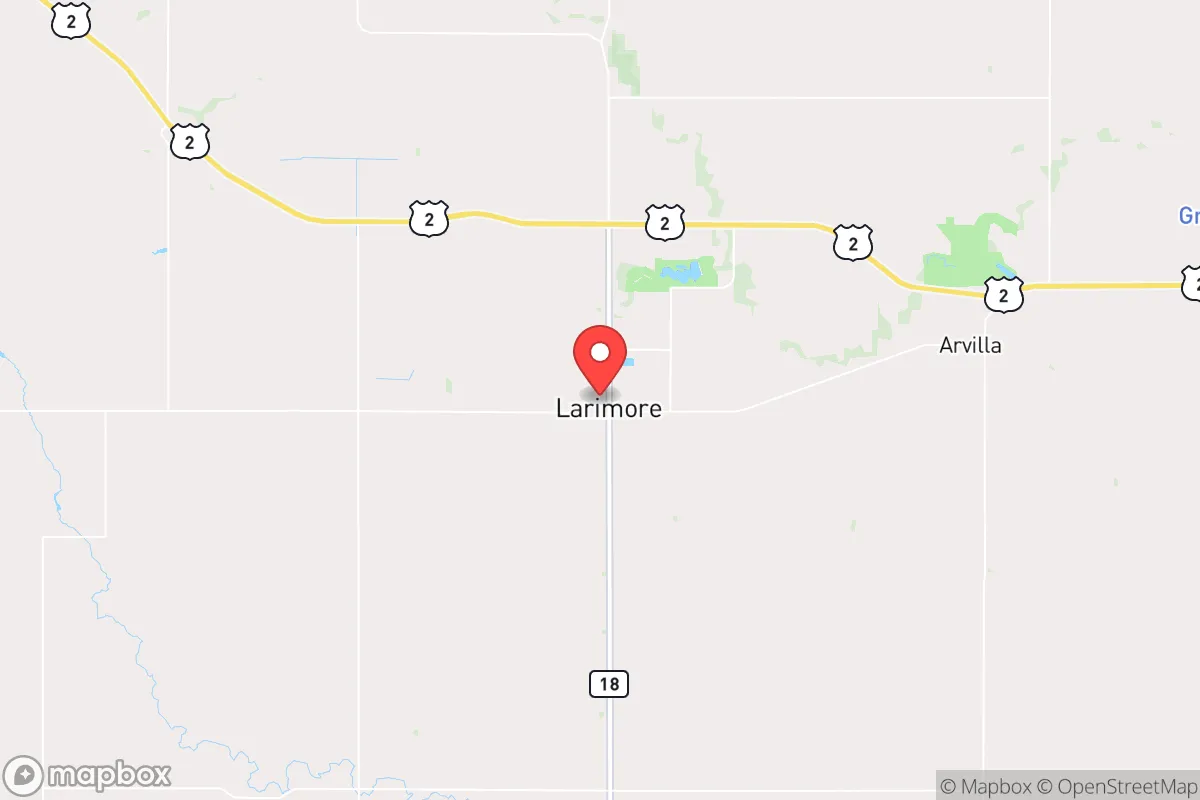
District shown is the primary district for this city’s centroid. Cities may span multiple districts.
Inherited from parent state — no local data available.
Local Political AnalysisPolitical Analysis of Larimore, ND
Larimore, North Dakota, is about as reliably conservative as small-town America gets, with a Cook PVI of R+18 that puts it deep in solid-red territory. That number isn't just a statistic—it reflects a community where traditional values, personal responsibility, and a healthy skepticism of government overreach have been the norm for generations. The political trajectory here has been remarkably stable; while some nearby cities like Grand Forks (about 20 miles east) have seen a slow drift toward more progressive policies, especially among younger voters and university-affiliated residents, Larimore has held its ground. If anything, the local sentiment has hardened in recent years as folks watch state-level and national debates over mandates, property rights, and school curriculum play out. The feeling on the ground is that the less government interference in daily life, the better.
How it compares
Compared to Grand Forks, which leans more moderate-to-liberal thanks to the University of North Dakota and a larger service-sector workforce, Larimore feels like a different world politically. Grand Forks County as a whole is still red-leaning, but the city itself has elected Democrats to local office and passed measures like a nondiscrimination ordinance that wouldn't fly in Larimore. To the west, cities like Devils Lake and Rugby are similarly conservative, but Larimore stands out for its consistency—there's no real progressive faction to speak of. The surrounding Grand Forks County rural precincts vote even more heavily Republican than the city of Larimore itself, but the town's R+18 rating puts it squarely in the same camp as places like Mayville or Hillsboro. The contrast is sharpest when you look at state legislative races: Larimore's district has sent staunchly conservative representatives to Bismarck for decades, while Grand Forks districts often feature competitive primaries between moderate and more libertarian-leaning Republicans.
What this means for residents
For someone living here, the political climate means you can generally trust that local government will stay out of your way. Zoning is minimal, property taxes are low compared to national averages, and there's little appetite for new regulations on businesses or homeowners. The school board has resisted progressive curriculum trends, and the city council rarely entertains proposals that would expand government services or spending. That said, the downside of such a uniform political environment is that it can feel insular—newcomers who bring big-city ideas about "equity" or "sustainability" mandates often find themselves frustrated. The long-term concern among locals is that as North Dakota's energy economy shifts and younger people move away, outside pressure from federal funding strings or state-level progressive initiatives could start to chip away at local autonomy. For now, though, Larimore remains a place where the Second Amendment is respected, taxes are kept in check, and the prevailing attitude is "live and let live—as long as you're not asking me to pay for it."
Culturally, Larimore stands out for its strong sense of neighborly self-reliance. There's no public transportation system, no city-wide recycling program, and no noise ordinances past 10 p.m.—and residents prefer it that way. The annual Potato Days festival is a celebration of local agriculture, not a platform for political activism. One policy distinction worth noting: Larimore has consistently voted against any form of local sales tax increase for infrastructure, preferring to fund roads and water systems through user fees rather than broad-based taxes. That's a direct reflection of the community's belief that government should ask permission before taking your money. If you're looking for a place where the political culture matches the "don't tread on me" ethos, Larimore delivers—but don't expect it to change anytime soon, and don't bring proposals that would.

State Political ClimatePolitical Climate in North Dakota
State Political AnalysisPolitical Environment in the State
North Dakota has long been one of the most reliably Republican states in the nation, but don’t let the red-on-red map fool you—there’s a real political fault line running through the state that’s been widening for the past two decades. The state leans roughly +20 to +25 points Republican in presidential elections, with Donald Trump carrying it by 20 points in 2020 and 27 points in 2016, but the coalition is fracturing along urban-rural lines and generational attitudes. Over the last 10-20 years, the old “prairie populist” Republicanism that once dominated has been slowly giving way to a more nationalized, culturally conservative brand, while the state’s few growing cities have started to drift leftward. If you’re looking for a place where conservative values still hold the levers of power, North Dakota is a strong bet—but the cracks are visible if you know where to look.
Urban vs. rural divide
The political map of North Dakota is a study in contrasts. The eastern half, anchored by the Fargo metro area (Cass County), is the state’s population center and its most politically competitive region. Fargo itself has trended blue in recent cycles—Hillary Clinton won Cass County by 2 points in 2016, and Joe Biden improved on that, though Trump still carried the county in 2020 by a slim margin. The city’s growth has been driven by younger professionals, university students at North Dakota State University, and a growing immigrant community, all of which push the political needle left. Just 70 miles west, Grand Forks (Grand Forks County) is a similar story but less pronounced: the University of North Dakota campus creates a small blue island in an otherwise deep-red county. Meanwhile, the western half of the state—places like Williston, Dickinson, and Watford City—is where the oil boom of the 2010s supercharged a libertarian-leaning, pro-energy conservative culture. These counties routinely vote 80-90% Republican. The rural counties in between, like Towner, Cavalier, and Ramsey, are reliably red but with a more populist, anti-establishment streak that sometimes clashes with the free-market oil patch conservatives. The divide isn’t just about geography—it’s about economic base: agriculture vs. energy vs. services, and each has its own political flavor.
Policy environment
North Dakota’s policy environment is a conservative’s dream on paper, but the devil is in the details. The state has no personal income tax (a major draw for relocators), a flat corporate income tax rate of 4.31%, and a sales tax that averages around 6-7% depending on local add-ons. Property taxes are relatively high compared to other low-tax states—about 1.2% of assessed value—but there’s a homestead credit for homeowners over 65. The regulatory posture is generally light-touch, especially for energy and agriculture, but the state government has a habit of picking winners and losers through subsidies (think: the $1.2 billion in incentives for the failed Dakota Access Pipeline-related projects). On education, North Dakota has a robust school choice landscape: charter schools are legal, though few exist, and homeschooling is lightly regulated with no notification requirement. The state’s higher education system, however, is a point of tension—the University of North Dakota and NDSU have faced pressure from conservative lawmakers over DEI programs and critical race theory, leading to a 2023 law banning mandatory diversity training in public universities. Healthcare policy is mixed: the state expanded Medicaid under the Affordable Care Act in 2013, a move that still rankles many conservatives, but it also has some of the strongest pro-life laws in the nation, including a near-total abortion ban passed in 2023 (triggered by Dobbs) with exceptions only for rape, incest, and life of the mother. Election laws are solid: voter ID is required, no-excuse absentee voting is allowed, and the state has a robust system of paper ballots. No widespread fraud issues have been documented, but the 2020 election saw some local GOP officials question the security of mail-in ballots, leading to a 2021 law that tightened absentee ballot return procedures.
Trajectory & freedom
On the freedom front, North Dakota has been a mixed bag over the last five years, trending in both directions depending on the issue. The good news for conservatives: the state passed a constitutional carry law in 2017, allowing permitless concealed carry, and in 2023 it expanded that to allow firearms in most public buildings (including schools with some restrictions). Parental rights got a boost with a 2021 law requiring schools to notify parents of any “sexually explicit” instructional materials, and a 2023 law banned transgender girls from participating in K-12 girls’ sports. On medical freedom, the state passed a 2021 law prohibiting COVID-19 vaccine mandates by private employers (though it was later struck down in court), and a 2023 law banned mask mandates in schools. But there are concerning trends: the state’s property tax burden has been creeping up, with local levies rising faster than inflation, and the 2023 legislative session saw a failed attempt to pass a property tax elimination bill. The state also has a history of using eminent domain aggressively for pipeline projects, which has alienated some rural landowners. On the plus side, the state’s “right to farm” constitutional amendment (passed in 2012) protects agricultural operations from nuisance lawsuits, and a 2023 law expanded telehealth access for rural residents. The biggest red flag for liberty-minded folks: the state’s occupational licensing requirements are among the most burdensome in the nation, with over 200 licensed professions—a 2023 reform bill made modest cuts but didn’t go far enough. Overall, North Dakota is still moving in a conservative direction, but the pace is slower than many would like, and the state’s reliance on oil and gas revenue creates a boom-bust cycle that can lead to government overreach during downturns.
Civil unrest & political movements
North Dakota is not a hotbed of civil unrest, but it has had its flashpoints. The most famous is the Standing Rock protests (2016-2017), where thousands of activists—including many from out of state—clashed with law enforcement over the Dakota Access Pipeline. The protests turned violent at times, with water cannons used in subfreezing temperatures, and the event left a lasting scar on the state’s political culture. The oil patch counties (Williams, McKenzie, Dunn) saw a surge in libertarian and anti-government sentiment as a result, with some locals feeling the federal government and outside activists were trampling on property rights. On the left, there’s a small but vocal activist scene in Fargo and Grand Forks focused on racial justice and LGBTQ rights, but it hasn’t translated into electoral wins. The state’s immigration politics are relatively quiet—North Dakota has a very small foreign-born population (about 4%), and there’s no sanctuary city movement. The most visible political movement in recent years has been the “North Dakota Freedom Caucus,” a group of hardline conservative state legislators who have pushed for property tax elimination, school choice expansion, and stricter abortion laws. They’ve had mixed success but have shifted the Overton window rightward. Election integrity controversies have been minimal, though a 2022 audit of the 2020 election in Burleigh County (Bismarck) found no significant issues. The state’s small population means political movements tend to be personal and low-key—you’re more likely to see a heated city council meeting in Minot than a protest march.
Projection
Looking ahead 5-10 years, North Dakota’s political trajectory is likely to be one of slow, steady conservative consolidation with some notable exceptions. The demographic trends are working in favor of the GOP: the state’s population is aging (median age 35.7, but rising), and the young people who leave for college often don’t return, meaning the electorate is getting older and more conservative. The oil patch counties will continue to be deep red, and the rural agricultural counties are unlikely to flip. The wild card is Fargo: if the city continues to grow at its current pace (about 1.5% annually), it could become a blue-leaning metro that occasionally flips the state’s at-large congressional seat (currently held by Republican Kelly Armstrong). But even then, the state’s legislative districts are heavily gerrymandered to favor rural areas, so the GOP will likely maintain supermajorities in both chambers. The biggest policy fights will be over property taxes (a growing grassroots movement to eliminate them), school choice (expect a push for education savings accounts), and energy policy (the state will continue to fight federal regulations on oil and gas). The wild card is the state’s budget: if oil prices crash again, the state will face a fiscal crisis that could force tax increases or spending cuts, which could trigger a populist backlash. For someone moving in now, expect a state that remains deeply conservative on social issues, moderately conservative on economic issues, and increasingly skeptical of federal overreach—but with a growing urban-rural divide that will make local politics more interesting than the statewide numbers suggest.
Bottom line for a new resident: North Dakota is a safe bet if you want a state where conservative values still dominate policy, but don’t expect a libertarian paradise. The state government is active in ways that can frustrate freedom-minded folks—high property taxes, occupational licensing, and a tendency to use eminent domain for energy projects are real concerns. The political culture is polite and personal, not confrontational, and you’ll find that most disagreements happen over coffee, not on the streets. If you’re moving from a blue state, you’ll find the policy environment refreshingly aligned with your values, but you’ll also find that the state’s small population means your vote actually matters—for better or worse. Just keep an eye on Fargo; that’s where the future of North Dakota politics will be decided.
* Values derived from national, state, county, city and local statistics and may differ in a specific area. Last updated: 2026-04-19T07:19:21.000Z
Narrative content on this page is AI-generated and may contain mistakes. Verify any details that matter before acting on them.
ReloMaps may earn a commission from affiliate links at no extra cost to you.

