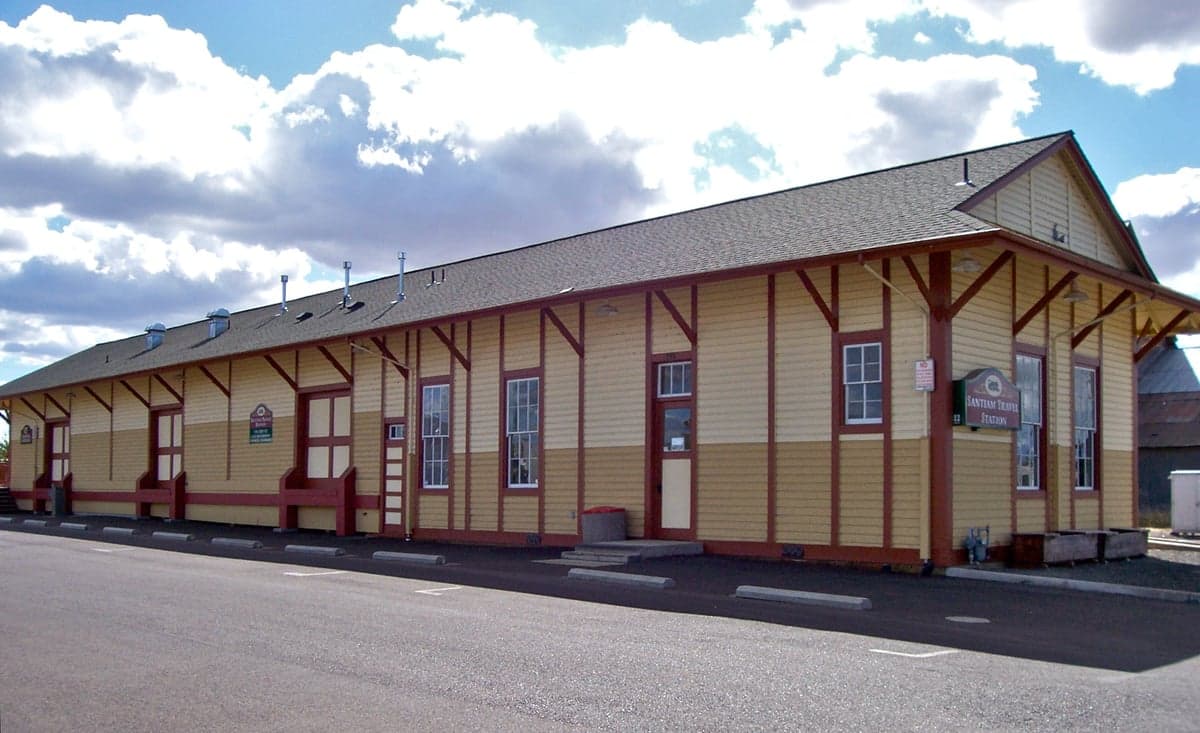
Photo: Wikipedia
Personal Sovereignty in Lebanon, OR
Viable for self-reliance. Generally workable, though some barriers may limit total independence.
What does Personal Sovereignty tell us?
Personal Sovereignty measures your capacity for self-reliance and independence with minimal government friction. Higher scores mean fewer barriers between you and the way you want to live... but it assumes you have the space you need and good neighbors.
What does this tell us?
Personal Sovereignty measures your capacity for self-reliance and independence with minimal government friction. Higher scores mean fewer barriers between you and the way you want to live... but it assumes you have the space you need and good neighbors.
State Policy
Energy independence: Importer (35% of energy produced in-state)
Personal Liberty
Homesteading

Personal Liberty Analysis
Lebanon, Oregon, offers a notably high degree of personal sovereignty compared to the Portland metro area or the Willamette Valley’s more regulated cities, making it a strategic consideration for those prioritizing autonomy. The city’s smaller population, rural-adjacent setting, and Linn County’s more conservative governance create an environment where government overreach into daily life is less pronounced. For a prepper or survivalist mindset, Lebanon represents a middle ground—close enough to urban resources for supply runs, but far enough to avoid the heavy-handed regulatory and cultural pressures that erode self-reliance.
Tax burden and regulatory posture: How Lebanon compares to the rest of Oregon
Oregon’s lack of a sales tax is a double-edged sword for personal sovereignty. While it keeps the cost of acquiring gear, tools, and supplies lower, the state makes up for it with a progressive income tax that can hit 9.9% on higher earners and some of the highest property taxes in the nation—typically around 1.0% to 1.2% of assessed value annually. In Lebanon, property taxes are slightly below the state average due to lower home valuations, but the tax burden remains a real consideration for anyone trying to maximize retained earnings for self-sufficiency projects. The regulatory posture in Lebanon is far more relaxed than in Portland or Eugene. Zoning codes in the city limits are standard for a town of its size, but Linn County’s rural zoning allows for more flexibility with outbuildings, workshops, and even small-scale agricultural structures without the permitting headaches common in urban areas. Business licensing is straightforward, and the city council has historically resisted adopting Portland-style land-use restrictions or tenant protection ordinances that infringe on property rights. For a prepper, this means fewer bureaucratic barriers to setting up a home-based business, storing supplies, or modifying your property for resilience.
Self-defense and gun law specifics: What Lebanon offers for the armed citizen
Oregon’s gun laws have shifted leftward in recent years, but Lebanon sits in a county where the sheriff’s office has publicly stated it will not enforce certain state-level restrictions deemed unconstitutional. Measure 114, which would require a permit to purchase and ban magazines over 10 rounds, remains tied up in court as of 2026, and Linn County has been a focal point of Second Sanctuary resolutions. In practical terms, this means Lebanon residents can still purchase standard-capacity magazines and exercise their right to keep and bear arms with fewer local impediments. The city has no standalone gun control ordinances, and concealed carry permits are issued by the sheriff’s office with a relatively straightforward process—though Oregon is a “shall issue” state, background checks are mandatory for all firearm transfers, including private sales. For the survivalist, the key advantage is cultural: gun ownership is normalized in Lebanon, and you won’t face the social stigma or legal harassment common in Portland. Ranges and training facilities are accessible within a 20-minute drive, and the rural surroundings offer ample opportunity for private practice on your own land if you have the acreage. Stand-your-ground laws apply statewide, but the local legal climate is far more favorable to self-defense claims than in liberal jurisdictions.
Self-reliance and homesteading viability: Lot sizes, zoning, and off-grid feasibility
Lebanon’s zoning is a mixed bag depending on whether you’re inside city limits or in the surrounding county. Inside town, standard residential lots range from 6,000 to 10,000 square feet, which is enough for a substantial garden, a chicken coop, and a small workshop, but not for livestock or serious off-grid infrastructure. The city code does allow rainwater catchment for non-potable uses, and solar panels are permitted without excessive red tape. However, going fully off-grid—septic, well, solar, and no utility hookups—is effectively impossible within city limits due to building codes that require connection to municipal water and sewer. The real opportunity lies in Linn County’s rural zoning, where you can find parcels of 1 to 20 acres within a 10-minute drive of Lebanon’s grocery stores and hardware shops. On those properties, you can drill a well, install a septic system, and set up solar panels with minimal county interference. The county does require building permits for structures over 200 square feet, but enforcement is lax compared to the Willamette Valley’s more populated areas. For a prepper, the sweet spot is a 5-acre parcel just outside the urban growth boundary—close enough for supply runs, far enough to live by your own rules. The local soil is fertile, the growing season is long, and water rights are generally available for domestic use without the bureaucratic battles seen in drier states.
Personal liberties: Parental rights, medical autonomy, speech, and property
Lebanon’s cultural and political climate strongly supports parental rights in education and healthcare. The local school board has resisted adopting controversial curriculum mandates from the state, and parents have a real voice in school policies through active PTA groups and board meetings. Medical autonomy is a more complex picture. Oregon has some of the most permissive vaccine mandates and public health orders in the country, but Lebanon’s rural hospital and local clinics have been less aggressive in enforcing state-level directives than their Portland counterparts. Exemptions for religious or philosophical reasons are still available for school vaccine requirements, though the paperwork is more burdensome than in states like Idaho or Montana. Free speech is robust in Lebanon—public meetings are open, and the city has not attempted to create “free speech zones” or restrict political expression on public property. Property rights are the strongest pillar of sovereignty here. Oregon’s land-use laws are notoriously restrictive statewide, but Linn County has historically fought against downzoning and overreach. You can build a fence, store equipment, and use your land for personal projects without the constant threat of code enforcement that plagues more regulated areas. The city does have nuisance ordinances, but they are enforced with common sense—your neighbor’s junk car won’t get you a citation unless it’s an actual hazard.
Overall, Lebanon, Oregon offers a level of personal sovereignty that is increasingly rare in the Pacific Northwest. It is not a libertarian paradise—Oregon’s state-level taxes, gun restrictions, and public health mandates still apply—but the local culture and enforcement patterns create a buffer zone where self-reliant individuals can operate with far less friction than in Portland, Salem, or Eugene. For the prepper or survivalist looking to balance access to urban infrastructure with the freedom to live on your own terms, Lebanon is a strong contender. The key is to buy land in the county, not the city, and to stay informed on state-level legislation that could erode the autonomy you’ve carved out. Compared to rural Idaho or Montana, you’ll pay more in taxes and deal with more state-level overreach, but you’ll also have better access to medical care, supply chains, and a community that still values the Second Amendment and parental rights. It’s a trade-off worth analyzing carefully, but for many, Lebanon’s balance of freedom and practicality is the right call.

* Values derived from national, state, county, city and local statistics and may differ in a specific area. Last updated: 2026-05-05T08:08:35.000Z
Narrative content on this page is AI-generated and may contain mistakes. Verify any details that matter before acting on them.
ReloMaps may earn a commission from affiliate links at no extra cost to you.

