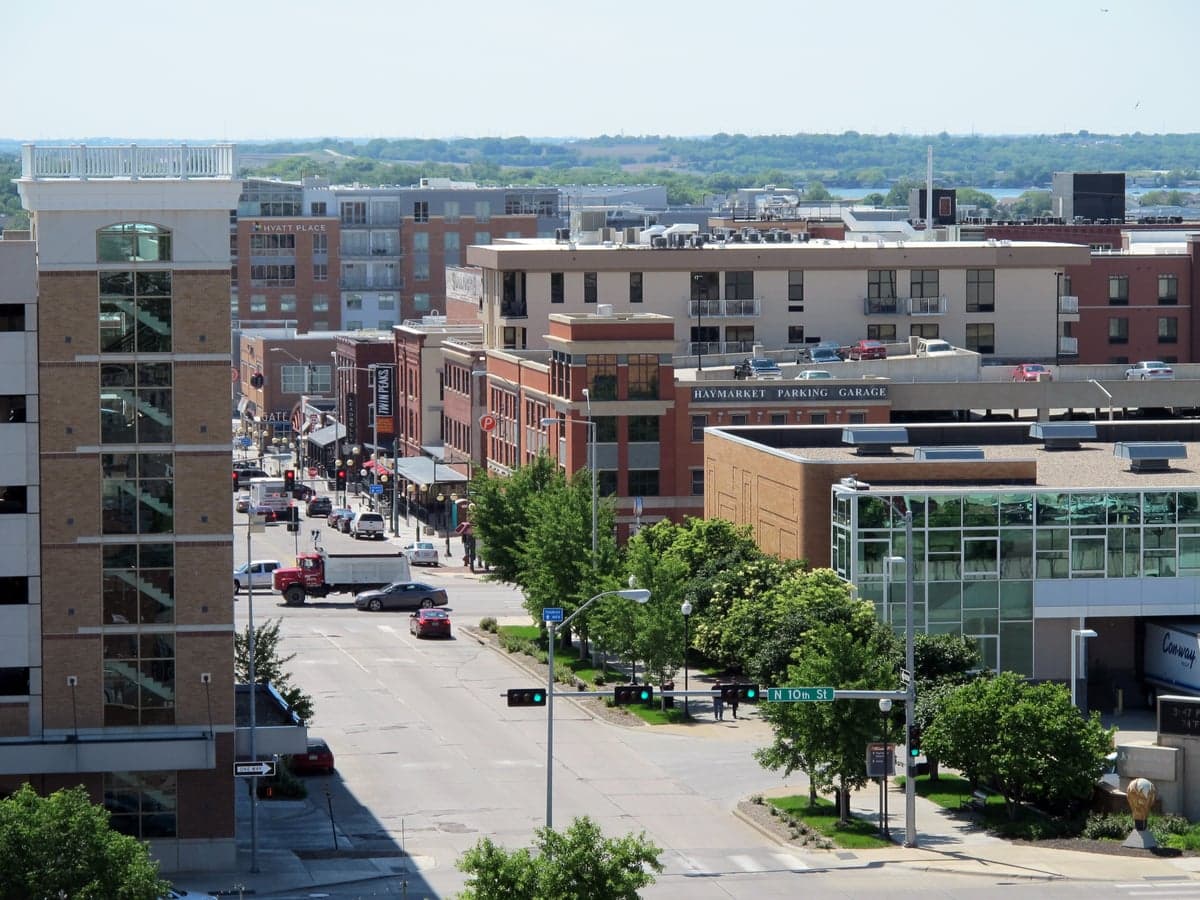
Photo: Wikipedia
Personal Sovereignty in Lincoln, NE
Viable for self-reliance. Generally workable, though some barriers may limit total independence.
What does Personal Sovereignty tell us?
Personal Sovereignty measures your capacity for self-reliance and independence with minimal government friction. Higher scores mean fewer barriers between you and the way you want to live... but it assumes you have the space you need and good neighbors.
What does this tell us?
Personal Sovereignty measures your capacity for self-reliance and independence with minimal government friction. Higher scores mean fewer barriers between you and the way you want to live... but it assumes you have the space you need and good neighbors.
State Policy
Energy independence: Importer (35% of energy produced in-state)
Personal Liberty
Homesteading

Personal Liberty Analysis
For the individual or family who prioritizes personal sovereignty—the ability to live, defend, and provide for oneself without excessive government interference—Lincoln, Nebraska presents a mixed but ultimately promising picture. While it is a state capital with the inevitable bureaucratic footprint that entails, Nebraska’s constitutional and statutory framework generally leans toward protecting individual rights, particularly when compared to coastal states. The key for a liberty-minded resident is understanding where the city’s local ordinances diverge from the state’s more permissive posture, and how to navigate the trade-offs of living in a growing, politically moderate city within a reliably conservative state.
Tax burden and regulatory posture: How Lincoln compares to surrounding states
Nebraska’s tax burden is a significant factor in any sovereignty calculation. The state imposes a progressive income tax with a top marginal rate of 6.84%, which is moderate by national standards but higher than neighboring South Dakota (which has no income tax) and Wyoming. Property taxes in Lancaster County are notably high, with effective rates often exceeding 1.8% of assessed home value, placing a real burden on landowners. However, the state has no inheritance tax and no estate tax, which is a meaningful advantage for those looking to pass property to the next generation. On the regulatory front, Nebraska is a right-to-work state, meaning no one can be forced to join a union as a condition of employment. Occupational licensing is less onerous than in many states, but Lincoln’s city government does impose its own set of business and rental licensing requirements that can feel like red tape to a small operator. The overall regulatory posture is best described as “pragmatic conservative”—the state government generally stays out of your way, but the city will want its permits and fees.
Self-defense and gun law specifics: What Lincoln residents need to know
Nebraska is a strong Second Amendment state, and Lincoln residents benefit from that foundation. The state adopted constitutional carry in 2023, meaning law-abiding adults 21 and older can carry a concealed handgun without a permit. This is a major win for personal sovereignty, removing a bureaucratic barrier to self-defense. However, Lincoln itself has a history of local gun ordinances that have occasionally conflicted with state law. For example, the city has attempted to regulate the discharge of firearms within city limits more strictly than state law, and there have been past disputes over the carrying of firearms in city parks. The good news is that Nebraska preemption law is relatively strong, and recent state-level legislation has further limited the ability of cities like Lincoln to enact their own gun control measures. For the prepper, this means you can legally own and carry standard firearms, including AR-15s and other modern sporting rifles, without the magazine capacity bans or “assault weapon” registrations seen in states like Colorado or Illinois. Stand-your-ground laws are in effect, and there is no duty to retreat in any place you are lawfully present. The legal climate for defensive gun use is favorable, though a responsible gun owner should still be aware of the specific nuances of Nebraska’s use-of-force statutes.
Self-reliance and homesteading viability: Lot sizes, zoning, and off-grid feasibility
For the homesteader or survivalist, Lincoln’s urban core is not the ideal environment, but the surrounding Lancaster County and adjacent areas offer real opportunities. Within the city limits, standard residential lots are typically one-quarter acre or smaller, and zoning codes are fairly conventional—meaning backyard chickens are allowed in many areas, but larger livestock, beekeeping, or extensive gardening may be restricted by homeowners’ associations or city ordinances. The real potential lies in the unincorporated areas of the county or in nearby towns like Hickman, Firth, or even farther out toward Seward. There, you can find parcels of 1 to 10 acres at prices far below the national average, often with no HOA and minimal county oversight. Off-grid living is legally feasible in Nebraska, but you must navigate well water rights and septic system regulations. Nebraska water law is based on prior appropriation, meaning you need a permit to drill a well, and domestic use is generally allowed but subject to state oversight. Solar panels are unregulated at the state level, and there are no laws preventing you from disconnecting from the grid, though local utility companies may have interconnection policies. For the serious prepper, the land around Lincoln offers a viable path to self-sufficiency, but you must be willing to live outside the city’s zoning jurisdiction to fully escape the regulatory leash.
Personal liberties: Parental rights, medical autonomy, speech, and property
On the spectrum of personal liberties, Nebraska scores well in several areas critical to a conservative worldview. Parental rights are explicitly protected in state law, and Nebraska was one of the first states to pass a Parents’ Bill of Rights, giving parents the legal standing to review educational materials and opt their children out of objectionable instruction. Medical autonomy is a mixed bag: Nebraska has not expanded Medicaid under the Affordable Care Act, which limits government healthcare dependency, but it also has a relatively strict medical establishment that has not embraced the kind of medical freedom legislation seen in states like Idaho or Montana. Vaccine mandates are not enforced at the state level for adults, and there is a religious exemption for schoolchildren. Free speech is robustly protected under the Nebraska Constitution, and there are no state-level “hate speech” laws that criminalize protected expression. Property rights are strong, with Nebraska having a relatively straightforward eminent domain process that requires just compensation, and no statewide rent control laws. The city of Lincoln does have a rental inspection program that some landlords view as an overreach, but for a property owner, the state’s legal framework is generally respectful of your right to use your land as you see fit, within reasonable zoning limits.
In the broader landscape of American personal sovereignty, Lincoln, Nebraska offers a solid, if not exceptional, environment for the liberty-minded individual. It lacks the extreme regulatory freedom of a place like rural Idaho or the tax advantages of a no-income-tax state like Texas, but it also avoids the authoritarian overreach of states like California or New York. The city’s moderate political climate means you will encounter some bureaucratic friction, particularly around property taxes and local permitting, but the state’s constitutional protections for gun rights, parental rights, and property rights provide a sturdy floor beneath your feet. For the prepper or survivalist who values community and infrastructure but refuses to surrender their autonomy, Lincoln represents a viable compromise—a place where you can build a life of self-reliance without having to live completely off the grid or constantly fight the government for the right to live your own way.

* Values derived from national, state, county, city and local statistics and may differ in a specific area. Last updated: 2026-04-15T23:39:09.000Z
Narrative content on this page is AI-generated and may contain mistakes. Verify any details that matter before acting on them.
ReloMaps may earn a commission from affiliate links at no extra cost to you.

